
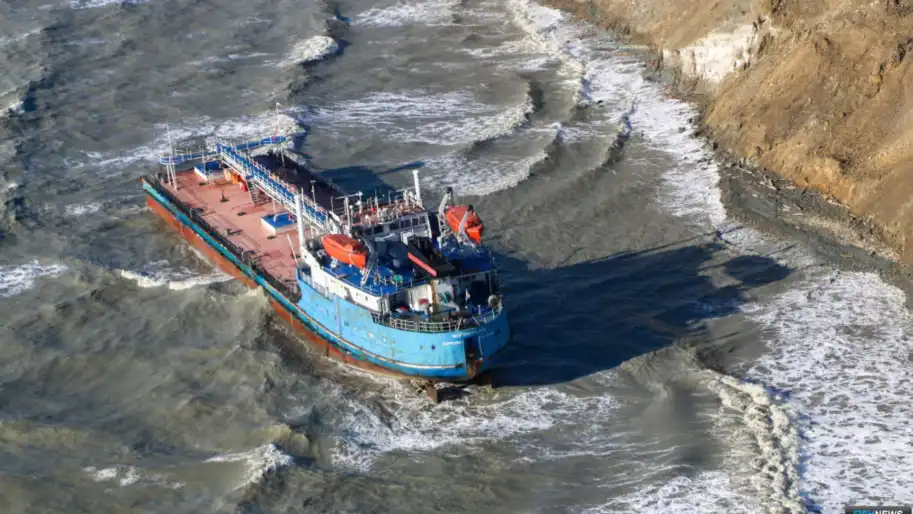

New fuel oil stains were seen in the Kerch Strait: petroleum products continue to leak from russian tankers that sank in December 2024.
This was reported in Telegram by the Center for Countering Disinformation under the National Security and Defense Council of Ukraine, with a reference to satellite images.
"Environmentalists are sounding the alarm, but russian officials are in no hurry to react," the message says.
When the tanker broke up, part of the fuel oil settled to the bottom due to low temperatures, and part was thrown ashore by waves. With the onset of heat, the fuel oil that settled to the bottom began to surface. Experts predict new fuel oil spills on the coast of the temporarily occupied Crimea and the Krasnodar Krai of the russian federation in April.
According to preliminary estimates, the consequences of the fuel oil spill will have to be eliminated for at least three years. It may take five to ten years to fully restore the Black Sea coast.
At the same time, the russians have not managed to remove the tankers from the seabed. This work is scheduled for next year.
To create the illusion of control, officials plan to send thousands of children to the ecological disaster zone for "rehabilitation."
As Ukrainian News Agency earlier reported, on December 15, it became known that two russian tankers had suffered a disaster due to a storm in the Kerch Strait.
According to Greenpeace Ukraine, the incident resulted in at least 4,300 tons of fuel oil spilling into the waters of the Black and Azov Seas. Gradually, this fuel oil began to wash up on the shores of occupied Crimea and the russian Krasnodar Krai.
Near the western part of the Dzhantsheysky and Sasyk estuaries, near the Danube Biosphere Reserve, significant areas of spillage were discovered, on which fuel oil spilled from russian tankers was found.
On the beach of the Tuzlivski Lymany National Park, up to 4 kg of fuel oil was collected, dumped after the accident of russian tankers in the Kerch Strait, millions of small fractions are still drifting in the Black Sea.
Who we are: About us, Contacts. How we write news and our principles: Editorial code. We did our best. If you found this valuable – please support us.
To request a correction, please send an email.