
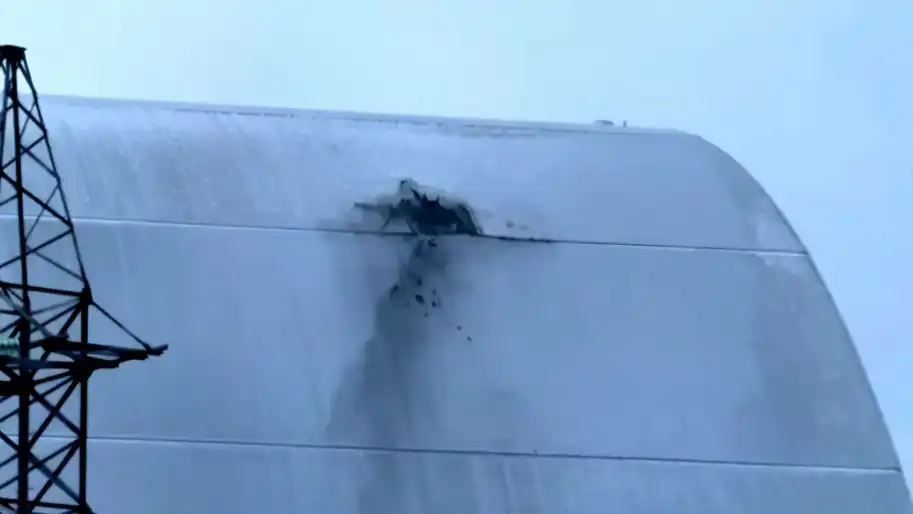

After the attack by a drone of the aggressor state of russia on the confinement at the Chornobyl nuclear power plant, despite significant damage, the radiation at the facility did not change. The external and internal cladding of the isolation structure was damaged, resulting in a hole with a diameter of approximately six meters.
This was stated by the Director General of the International Atomic Energy Agency (IAEA) Rafael Mariano Grossi.
"Ukrainian firefighters worked around the clock in freezing weather to completely extinguish small fires that are still smoldering after Friday's drone strike on the building containing the remains of the reactor destroyed during the Chornobyl nuclear power plant accident in 1986," the report says.
It is stated that the IAEA team based on the scene was granted unrestricted access to the explosion site and conducted a detailed inspection to assess the damage to the New Safe Confinement (NSC), where the drone had punched a hole in the roof of a large arch-shaped structure built to contain any radioactive release from the damaged reactor and protect it from external hazards.
The IAEA experts reportedly saw smoke coming from the roof of the NSC and smelled burning plastic.
“Despite the significant damage caused by the drone strike, the IAEA team was informed that the radiation level at the site had not changed. This was also confirmed by the team’s own measurements, which showed normal dose rates near the NSC compared to those recorded by the IAEA since establishing a permanent presence at the site a little over two years ago,” the report added.
During a tour of the NSC on February 15, the IAEA team observed that a significant area had been affected by the drone strike and subsequent fire. The team confirmed that both the external and internal cladding of the NSC arch had been damaged, resulting in a hole approximately six meters in diameter, and that some equipment and electrical cables had been damaged. However, the structural beams did not appear to have sustained significant damage.
The IAEA team was also shown some of the drone debris remaining at the scene, including parts of the wings. The damaged drone was recovered by Ukrainian specialists and taken away for further analysis.
The team was informed that the plant plans to install additional sensors to measure dose rates and aerosol concentrations near the area affected by the drone. However, this task cannot be completed until the remaining fires have been fully extinguished to avoid damaging the sensors.
As Ukrainian News Agency earlier reported, there is a possibility of a leak of radioactive materials after a drone strike launched by the army of the aggressor country of russia on the Chornobyl nuclear power plant.
Recall, on the night of February 14, a russian strike drone attacked the Chornobyl nuclear power plant. The drone was equipped with ammunition with a high-explosive warhead.
As a result of the attack, the building of the New Safe Confinement was damaged, and a fire also broke out. The fire was quickly extinguished.
President Volodymyr Zelenskyy said that the russian drone was flying at an altitude of 85 meters. Because of this, it was not detected by the radars of the Ukrainian air defense system.
Who we are: About us, Contacts. How we write news and our principles: Editorial code. We did our best. If you found this valuable – please support us.
To request a correction, please send an email.