
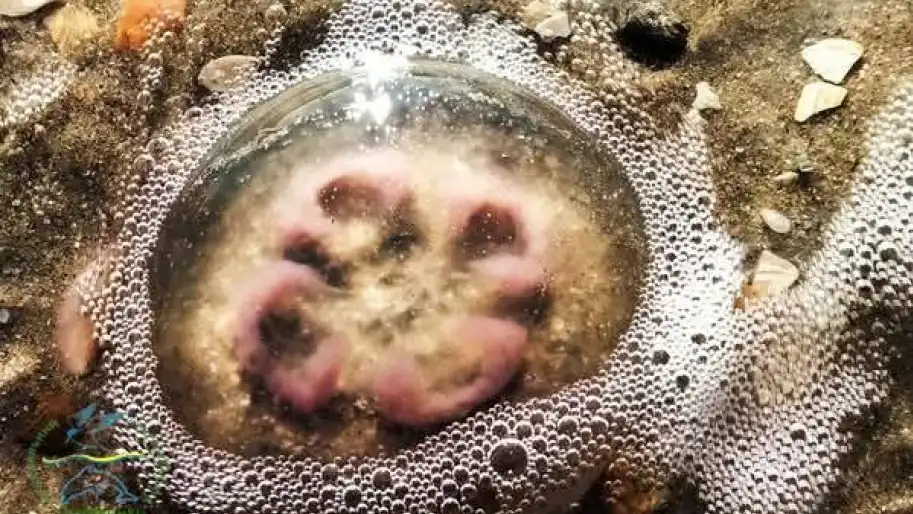

Jellyfish, which were found to be contaminated with fuel oil, washed ashore in large numbers on the coast of the Odesa Region.
This was reported by the head of the scientific research department of the Tuzlivski Lymany National Park, Ivan Rusev, on Facebook.
"For the third week, employees of the Tuzlivski Lymany National Nature Park have continued to monitor the release of fuel oil onto the Black Sea coast within the national park and in areas adjacent to the park. While examining one of the areas of the national park, we discovered 2 km of coastline on which many jellyfish of the Aurelia aurita species were washed ashore," he wrote on Facebook.
On the sand near the water alone, the ecologist counted almost 5,000 small jellyfish ranging in size from 2 to 10 cm. There were more of them in the water on the shallow shelf, but they could not be counted. The ecologist says that this is the first time such a phenomenon has been observed in winter.
According to Rusev, jellyfish are reliable bioindicators for studying the impact of various pollutants on the sea, including neurotoxic compounds, heavy metals, plastic, etc. The jelly-like Aurelia aurita contains mucus with bacteria that consume hydrocarbons, including crude oil. In addition, the mucus of jellyfish can aggregate droplets of various petroleum products from the water column.
"There is a hypothesis that a larger number of live jellyfish leads to a faster consumption of oil products due to nutrients containing nitrogen and phosphorus in their mucus, which supports the growth of specific bacteria. It is known that jellyfish are predators that feed mainly on small planktonic animals. They capture food with their mouths, through which food remains are continuously removed. Presumably, along with plankton, jellyfish also consumed nanofractions of oil products," noted Ivan Rusev.
As Ukrainian News Agency earlier reported, near the western part of the Dzhantsheyskyi and Sasyk estuaries near the Danube Biosphere Reserve, significant areas of spillage were discovered, on which fuel oil spilled from russian tankers was found.
On the beach of the Tuzlivski Lymany National Park, up to 4 kg of fuel oil was collected after the accident of russian tankers in the Kerch Strait, millions of small fractions are still drifting in the Black Sea.
And the day before, it became known that lumps of fuel oil from destroyed russian tankers were seen near the occupied Berdiansk, Zaporizhzhia Region.
On December 15, 2024, the tankers Volgoneft-212 and Volgoneft-239 crashed in the Kerch Strait due to a storm.
According to Greenpeace Ukraine, as a result of the incident, at least 4,300 tons of fuel oil spilled into the waters of the Black and Azov Seas.
Who we are: About us, Contacts. How we write news and our principles: Editorial code. We did our best. If you found this valuable – please support us.
To request a correction, please send an email.