


Daily losses of the army of the aggressor country russia during the ongoing summer offensive campaign have exceeded the losses suffered by the russians in the battles for Bakhmut and Avdiivka. They are considered the bloodiest of all time since the start of the full-scale invasion.
This is stated in the material of The Economist, which was published on July 9.
The increase in losses began to be recorded in May, when the russian army began the so-called "summer offensive". A number of experts, and russians themselves, call this offensive campaign "the last push", the purpose of which is to break the fighting spirit of the Ukrainians and achieve victory.
The reason for the increase in the number of killed russian soldiers is the actions on the ground. Currently, the pace of advance of the russian army is one of the fastest in the past two years.
Despite this, the new russian offensive campaign is still advancing at a rate of about 15 square kilometers per hour. Even if this pace is maintained, it will take the occupiers another 89 years to conquer Ukraine. The capture of the territories of the four regions that russia calls its own will take until February 2029.
The russians are having to pay a price for the relatively high pace of advance. These are the lives of soldiers who are dying and being wounded during numerous attacks on the fortifications of the Ukrainian Defense Forces.
According to monitoring by The Economist, as of July 9, the russian army has lost from 900,000 to 1.3 million people since the start of the full-scale invasion. Of these, from 190,000 to 350,000 have been killed.
At the same time, about 31,000 russians have been killed since May 1 of this year, when the russian summer offensive began.
The Economist published an infographic compiled on the basis of its own monitoring. It shows that the losses of the russian army continue to grow steadily.
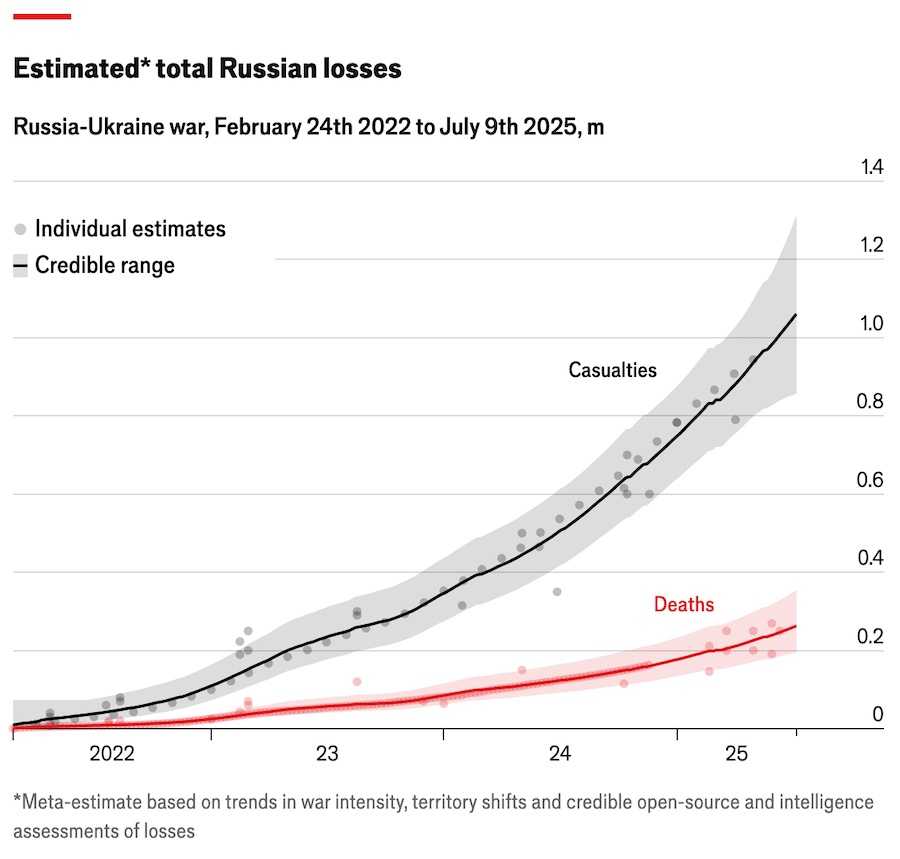 The losses of the russian army according to The Economist journalists. The dead are marked in red, the wounded in gray. Photo: The Economist.
The publication also published an infographic of the losses of the russian army in relation to the pace of its advance. The image shows that the current losses of the russians exceed the losses suffered during the battle for Bakhmut and Avdiivka.
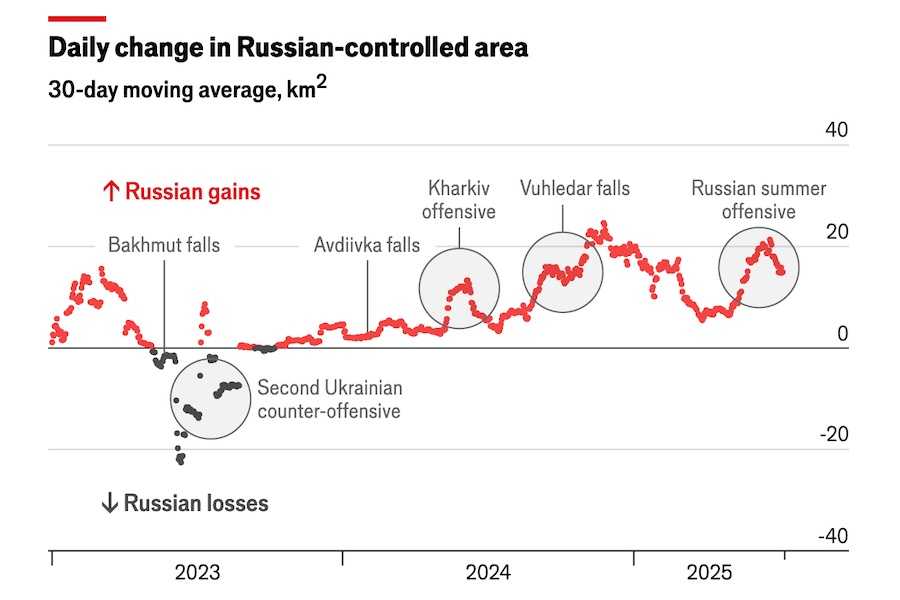 The losses of the russian army in relation to the pace of its advance. Photo: The Economist.
As the Ukrainian News agency earlier reported, on June 30, President Volodymyr Zelenskyy said that the occupiers cannot implement their offensive plan in the Sumy Region.
Recall, on June 26, the Commander-in-Chief of the Armed Forces of Ukraine, General Oleksandr Syrskyi, said that the Defense Forces of Ukraine had stopped the advance of the russians in the Sumy Region.
In addition, at the end of June, the British newspaper The Telegraph published an article in which it wrote that the offensive of the russian army, launched in May, is slowing down and losing momentum.
Who we are: About us, Contacts. How we write news and our principles: Editorial code. We did our best. If you found this valuable – please support us.
To request a correction, please send an email.