

Amidst European leaders calling for increased defense spending and talking about "strategic autonomy" after criticism of Europe by the US, no concrete decisions have been made and steps have been announced as to where the money for this will come from.
The Economist has looked into the issue and named ways to increase defense spending and replace American aid to Ukraine in the event of its suspension.
Thus, currently EU member states spend about EUR 325 billion per year on defense, which is about 1.8% of the bloc's GDP, while back in 2014 NATO set the required value at 2% of GDP. Meanwhile, the russian-Ukrainian war, which is already full-scale, has passed its third anniversary.
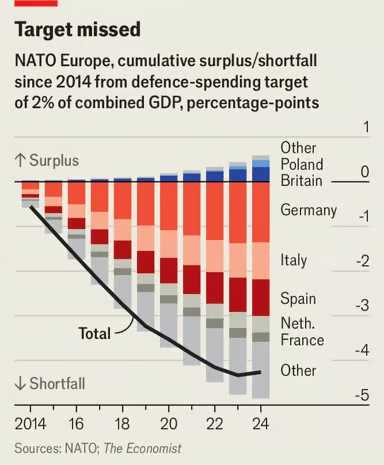 Europe-NATO, cumulative surplus/deficit since 2014 from the target of 2% of GDP for defense spending. Infographic: The Economist
Europe-NATO, cumulative surplus/deficit since 2014 from the target of 2% of GDP for defense spending. Infographic: The Economist
Guntram Wolf of the Brussels-based Bruegel think tank and Alex Burilkov of Leuven University in Lüneburg have calculated that 3.5% of GDP is needed for Europe to be able to defend itself without American help, and in the long term, according to The Economist, spending should be around 4-5% of GDP. Even the 3.5% figure leaves a gap of 1.7% of GDP that needs to be filled.
The publication emphasizes that Europe's spending on supporting Ukraine is equally insignificant. Since January 2022, the EU and its member states have spent EUR 113 billion on financial, military and humanitarian aid, equivalent to just over 0.2% of their GDP over each of those three years, according to data from the Kiel Institute think tank and additional calculations by The Economist.
According to the calculations, in order for Europe to be able to replace American support if it were to be cut off, the EU would have to increase its contribution again by about the same amount. The combined 0.4% of GDP that would need to be spent on Ukraine each year is only half the level at which Denmark already spends on the warring country, and about the same as Finland.
“This shows that it is possible, and that supporting Ukraine is only a small part of a much larger task - increasing Europe’s own defense spending,” the article says.
Total aid allocated to Ukraine, % of GDP 2022-2024 Infographic: The Economist
The publication offers three options for finding the additional 1.9% of GDP needed both to increase defense spending to 3.5% of GDP per year and to replace American support for Ukraine:
- Cutting spending in other areas and/or raising taxes. At the same time, European countries dominate the global rankings of countries with the highest taxes in the world, so further tax increases seem like a bad (and unpopular) idea. Eurozone countries spend about 20% of their GDP on social assistance, pensions and social protection, but cutting social spending would be just as unpopular. Many countries are already under pressure to cut spending or raise taxes to reduce their deficits. France, which has one of the highest social spending in Europe, has already promised to reduce its deficit from 6.1% in 2024 to 4% by 2027. In Germany, a coalition government collapsed last year after failing to agree on sufficient cuts, and the next government will surely face the same problems. Further cuts to national budgets to boost defense spending would be politically painful.
- Borrowing. Countries could run their deficits for a while and agree to adjust the bloc’s fiscal rules. European Commission President Ursula von der Leyen has proposed a “backstop” for defense investment. But the rules do not include such a provision, so another controversial reform would be needed. Germany has already hinted that any exemption from the rules would only apply to countries that spend more than 2% of GDP on defense. That would exclude Italy and Spain. “I can’t imagine Spain spending more than 2% on defense. Spaniards, far from russian aggression, remain indifferent to war,” says Luis Garricano of the London School of Economics.
- Fund defense spending through the EU. After the pandemic hit, the bloc’s EUR 806 billion recovery fund pioneered the concept. The EU would take on debt that would be serviced and eventually repaid from the EU budget. But there are pitfalls. Creating such a fund requires unanimity, and pro-Russian countries such as Hungary and Slovakia are likely to object, although they can be pressured. It would increase the debt burden of the bloc as a whole, even if this debt were not included in national figures. And the EU would need to agree on what to spend the money on and for whose benefit. This will take time.
The publication notes that it is worth considering all options and has proposed a model. So, national governments could tighten their budgets and cut other spending to raise defense and support spending in Ukraine by, for example, 0.3% of GDP per year. This would leave a deficit of “just " around EUR 850 billion in the period up to 2030, which will need to be covered by a combination of higher national deficits and higher EU debt, with a significant impact on the next seven-year EU budget cycle.
"So for advocates of European autonomy like Mr Macron and Mr Merz, it is time to make the case for cutting social spending and subsidies for farmers and to pave the way for greater budgetary integration in the EU. Until then, their calls for strategic autonomy will remain an empty sound," the publication summarized.
As Ukrainian News Agency reported, earlier The Economist published a new issue of its magazine, depicting US President Donald Trump and russian dictator vladimir putin on its cover.
The cover of the magazine shows Trump and putin talking, sitting alone at a large black table. All this takes place against a blood-red background. On the table you can see the inscription "Europe's worst nightmare".
In addition, European foreign ministers said that the region has entered a new era, as US President Donald Trump has radically changed Washington's foreign policy. Despite this, they hope that transatlantic relations can be preserved.
US special envoy Keith Kellogg also believes that Europe will have no place at the table for peace talks on the russian-Ukrainian war.
Who we are: About us, Contacts. How we write news and our principles: Editorial code. We did our best. If you found this valuable – please support us.
To request a correction, please send an email.