
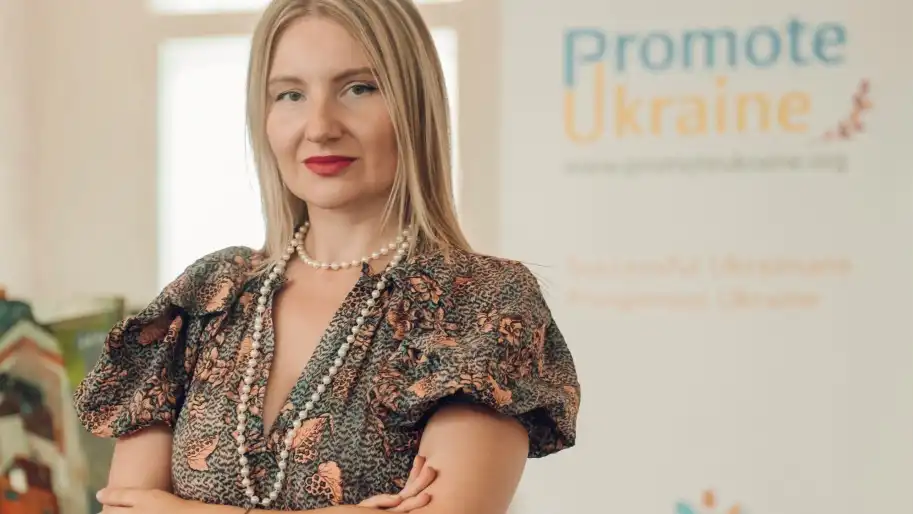

We met with the founder of Promote Ukraine, the Belgian-based NGO, Marta Barandiy, in the European Quarter of Brussels – in the spacious office of the Ukrainian Civil Society Hub, provided to the organization by the European Parliament. The keys to this office, which occupies the entire floor of one of the European Parliament’s buildings, were handed over to Marta Barandiy by the President of the European Parliament, Roberta Metsola (Inauguration of the Ukrainian Civil Society Hub – official press release of the European Parliament).
Marta, how did Promote Ukraine manage to get the keys to the Station Europe building of the European Parliament?
When the large-scale war began, Promote Ukraine was an organization around which about a hundred activists gathered. At that time, we had a history, a brand and an existing infrastructure to ensure communication and support of volunteers with all the necessary resources. However, we did not have a permanent location for meetings and work of a large number of people, and for a quick exchange of information as well, which is the key factor in responding to Russian aggression. So, such a location was a necessity. Therefore, on 25 February we sent a letter to the President of the European Parliament, Roberta Metsola, with a request to provide premises for the work of our activists. Ms Metsola immediately supported the initiative and personally approved it with all the structural divisions of the EP to provide us with the premises. And already on 17 March, Promote Ukraine was handed over a symbolic key to this building.
You noted that Promote Ukraine from the moment of its foundation outlined first of all informational goals. Are you involved in volunteer activities? How do informational and volunteer components correlate in the activities of Promote Ukraine?
Indeed, information work is at the heart of our activity. We have our own information and news web resource, we publish the Brussels Ukraїna Review journal (in a number of languages), we run pages on social networks as well. We constantly communicate with leading politicians in Europe and Ukraine, often acting as a "bridge".
When Russia invaded Ukraine on a full scale on 24 February, we simply could not stay aside. Obviously, we had an extensive network of influential contacts that could be used to collect humanitarian aid in order to transfer it to the military. This is among our advantages, which we began to use from the first day of the Russian invasion. As a result, our purely informational functions were supplemented by the collection and distribution of humanitarian aid, primarily for the Ukrainian army.

Can you tell us about the day on which you made the decision within the organization that you would also deal with humanitarian supplies for the Ukrainian army?
When Russia fired its first missiles at Ukraine on the morning of 24 February, Ukrainian activists in Brussels started texting each other in messaging apps, trying to find answers to dozens of questions. We quickly realized that it had been impossible to solve everything through instant messengers and we would need to meet in person in order to exchange information and communicate effectively.
When we gathered in our office with volunteers, we realized that not even everyone knows each other. So, at first everything was a chaos, everyone took on a variety of tasks – and there were a lot of them, as you can imagine. However, in these six months we have become a real family. Since February 24, our team has increased significantly. Currently, more than 120 volunteers are involved in the activities of Promote Ukraine, 40 of which work on a permanent basis. We structured all the work during this time, divided it into a number of areas, which are dealt with by specialized working groups. One of these working groups is a humanitarian one, dealing with assistance to the armed forces of Ukraine.
How is the work of this humanitarian working group, which ensures the fulfilment of military orders, structured?
Through various channels, we receive requests from Ukraine, mainly for protective equipment and medicines for our military. We work on these requests, we analyze them, carry out fundraising campaigns, co-operate with various partners who transfer money to us, and look for the necessary equipment throughout Europe. When we find it, we organize logistics, and from us it goes to all the "hot spots" in Ukraine. The military always send us photo and video reports, confirm that they have received everything, provide us with acceptance documents.

What kind of equipment do you transfer to the military most often?
More often – these are body armour, plate carriers, unloading vests, helmets, tactical glasses, active headphones, walkie-talkies, knee pads, tactical gloves, military uniforms, tactical shoes, first aid kits, etc. In June, we started buying pickups, SUVs and ambulances for the needs of the Armed Forces of Ukraine.
Can you name the military units which received humanitarian aid from you?
In total, more than 30 military units in Ukraine have already received humanitarian aid from Promote Ukraine. Among the recipients are the Main Intelligence Directorate of the Ministry of Defence, the Department of the State Guard of Ukraine, the Security Service of Ukraine, the NABU special forces, the Azov SSO regiment, the 93rd Mechanized Brigade "Kholodnyi Yar", the 28th Mechanized Brigade named after the Knights of the Winter Campaign, the 128th Mountain Assault Brigade, the 36th Marine Infantry Brigade named after Rear-Admiral Mikhailo Bilinskyi, 72nd Mechanized Brigade named after the Black Zaporozhians, 73rd Marine Special Operations Centre named after Chief of Staff Antin Golovatyi, 57th Separate Motorized Infantry Brigade named after Otaman Kost Gordienko.

You mentioned that Promote Ukraine had started working on humanitarian programmes for the army quite recently. How comfortable are you working in the area where large funds and corporations with significant budgets, experience and well-established logistics are yet?
In my opinion, there will never be too much help in time of war – and everyone should do the best they can. Indeed, compared with large humanitarian organizations and funds with specific focus that have long specialized in helping the army, our volumes are comparatively small. But in the meantime, we are learning to raise money, work with large donor funds, develop logistics, look for contractors and build even more systematic processes for organizing assistance to the Ukrainian army.
Regarding how we work side by side with other organizations, I will say that it is very comfortable. A large number of humanitarian organizations, charitable foundations, corporations and individuals systematically helping the army have already rallied around the "Ukrainian issue". In the six months since the start of the full-scale Russian invasion, a powerful international public ecosystem of assistance to the Ukrainian army has formed – all key participants know each other either directly or through of one person as maximum. We all help each other as best we can: consultatively, logistically, financially.
Can you give some examples?
Oh sure. For example, together with the KOLO Charitable Foundation, as part of the #UkraineNeedsYou joint project, we donated an ambulance to a military hospital in Kharkiv this summer. And recently, one of the hospitals in Brussels donated valuable medical equipment (diagnostic tables, sterilizers, oxygen generators, lamps, etc) to a hospital in Poltava. The management of the hospital in Brussels chose Promote Ukraine to ensure the logistics and proper legal processing of this cargo.
Moreover, as I have already said, private individuals also turn to us with offers of assistance. So, in the very first days of the war, we were approached by a person who organized a fundraiser in the United States. It was important for this person to have guarantees that the collected funds would be used for their intended purpose – for the needs of the army. With these funds, our volunteers ensured the purchase of several dozen high-quality bulletproof vests (produced in Sweden) and their delivery directly to military units, from which we had relevant requests at that time. Also in early March, with the funds raised by this man in the United States, we purchased and handed over 50 sets of plate carriers and unloading vests to a military unit defending the Kyiv region.

The war in its current phase has been going on for half a year. Most charities and volunteers report that it has become more difficult for them to raise funds for humanitarian needs. How can you comment on this? Do you feel the fatigue of Europeans from the war in Ukraine? Has it become more difficult for you to work?
At first glance, indeed, humanitarian aid is becoming less and less. People are already donating less money, because everyone who wanted to help Ukraine financially has already done so and cannot transfer funds all the time. In the first months, we received charitable contributions mainly from large foundations, corporations, private companies, individuals. We collected money through social networks during charitable public events (for example, the Ukrainian picnic in Brussels). Now these fundraising models are no longer as effective.
At the same time, I would like to assure you that the world community is ready to continue financing Ukrainian independence and our fight against the aggressor. The world understands that Russia is evil and threatens all civilized mankind.
There are indeed resources to support Ukraine, however the general models of access to them are changing. I assure you that the world community will continue to help Ukraine and the Ukrainian army. And we are now working with international partners to receive new tranches for humanitarian needs. And I am sure that soon we will be able to talk about our new projects for the Ukrainian army.
Who we are: About us, Contacts. How we write news and our principles: Editorial code. We did our best. If you found this valuable – please support us.
To request a correction, please send an email.