
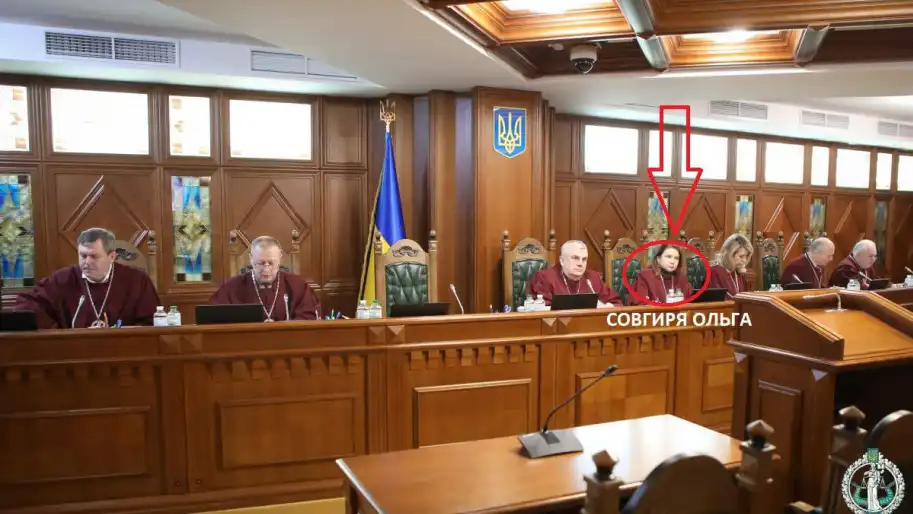

A constitutional complaint, as a separate type of constitutional appeal in the hands of individual employees of the Constitutional Court of Ukraine (CCU), can create corruption risks and lead to potential abuses in the justice system. The Corruption Whistleblowers Center came to this conclusion after analyzing the activities of CCU judge Olha Sovhyria and her assistant Viyacheslav Pleskach.
Serhii Kozlov, the head of the Corruption Whistleblowers Center, reported this in his blog on the Censor.NET website, the Ukrainian News agency reports.
Kozlov notes that since 2018, he has sent more than 20 constitutional complaints to the CCU, which concerned, among other things, compliance with the Basic Law of the provisions of the Code of Administrative Procedure and the Civil Procedure Code, as well as the constitutionality of the laws On Access To Public Information and On Advocacy and Advocacy Activities.
As it turned out, until 2022, Pleskach was an assistant to Ukrainian parliamentarian Olha Sovhyria. After she was scandalously appointed a CCU judge, he got a job as a consultant in her patronage service, as a CCU judge.
According to Center experts, this may indicate an existing conflict of interests between Sovhyria and Pleskach, and the increase in the number of complaints from the latter to ten over the past year, in their opinion, may indicate possible abuses and manifestations of corruption.
"That is, the facts testify to a direct connection between Olha Sovhyria's work in the CCU and the "constitutional activity" of her assistant. At the same time, the conflict of interests is obvious. And many questions arise regarding the purposes for which more and more new complaints appear, about which the CCU judge could not fail to know," the publication states.
In favor of this version is the fact that constitutional complaints from Pleskach are considered in an accelerated mode, within two weeks, while the average term of other complaints is 30-60 days or more.
Later, investigators found out that Pleskach's mother, Hanna Pleskach, also filed constitutional complaints. In particular, she challenged the constitutionality of Section 1 of Article 90 of the Criminal Procedure Code of Ukraine. Olha Sovhyria then announced her self-recusal, by the way, precisely because of a possible conflict of interests with Pleskach; however, the CCU preferred not to see it and refused the recusal.
According to the investigators, this could have been done in order to "legitimize" Olha Sovhyria's participation in the consideration of other complaints, some of which related to advocacy.
"One cannot ignore the matter of what the purpose of such "activity" is. Why does Olha Sovhyria use associated persons to assess the constitutionality of legislative norms? And why does the CCU allow her to "conflict-free" consider the constitutional complaints of her assistant? The main question in this situation is if the judge really stands guard over the Constitution if they act in someone's interests and create the prerequisites for "revision" of provisions of the law that are "inconvenient" for someone?" the blogger wonders and hopes that these facts will become the subject of investigations from anti-corruption bodies such as the National Anti-Corruption Bureau (NACB), Special Anti-Corruption Prosecutor's Office (SACPO), National Agency on Corruption Prevention (NACP), and High Anti-Corruption Court.
Who we are: About us, Contacts. How we write news and our principles: Editorial code. We did our best. If you found this valuable – please support us.
To request a correction, please send an email.