
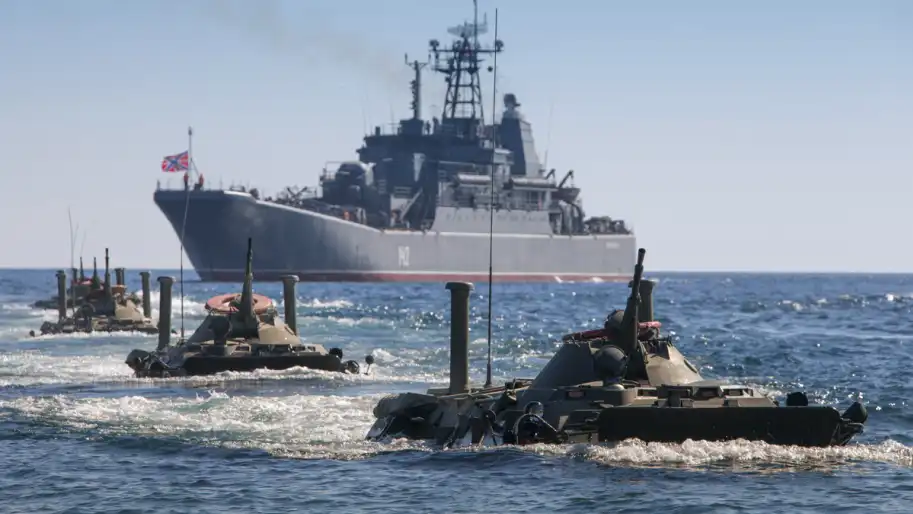

At the beginning of the full-scale invasion in 2022, russian troops were unable to conduct a naval amphibious operation in southern Ukraine because they were unable to create suitable conditions on land. The enemy was also wary of damage to its ships when approaching the Ukrainian coast.
This was stated by the Commander of the Naval Forces of Ukraine, Vice Admiral Oleksii Neyizhpapa, in an interview with Ukrainian Pravda.
According to him, the amphibious operation is one of the most difficult naval operations.
"All branches of the fleet are involved in its implementation. The first, of course, are the landing ships, directly the marines. But these are also fire support ships, this is aviation,” he said.
The Vice Admiral emphasized that for the amphibious landing you need to dominate both in the air and at sea. At the same time, he emphasized that at that time the enemy had such dominance.
"However, a naval amphibious operation, as a rule, is conducted in the direction of the enemy's main attack. It begins when appropriate conditions are created on land," Neyizhpapa said.
He recalled that after a full-scale invasion, the enemy advanced to Mykolaiv, then went northwest, bypassing Mykolaiv in the direction of Voznesensk, to enter the rear of the Odesa Region. Neyizhpapa emphasized that if the Ukrainian 80th Brigade of Airborne Assault Forces had not stopped the enemy near Voznesensk, conditions would have been created for the russians to launch an amphibious operation in the Black Sea operational zone.
"But the Naval Forces did not stand still. We carried out a mine defense barrier in the areas accessible for the landing. From the first days, the artillery unit of the Marine Corps and other brigades, which were stationed in Odesa at that time, were brought into the area of the firing positions. We strengthened the radio engineering, radar reconnaissance with the involvement of both radio technical posts and Bayraktar unmanned systems to detect enemy landings," he said.
The Vice Admiral noted that the Naval Forces were preparing for such enemy actions. So, according to him, the landings did not take place because the conditions on land were not created at that time, in the first place.
"Secondly, you know this story, when we first hit the frigate Admiral Essen with Neptun missiles. And then there was the same cruiser Moskva. And the enemy realized that just to come to our shores without sinking will be very difficult. That's why, of course, it refused the naval landing operation," he concluded.
It will be recalled that earlier it was reported that the russian invaders would try to land a landing force during a probable new offensive. The threat exists in the North and South of our country.
Who we are: About us, Contacts. How we write news and our principles: Editorial code. We did our best. If you found this valuable – please support us.
To request a correction, please send an email.