
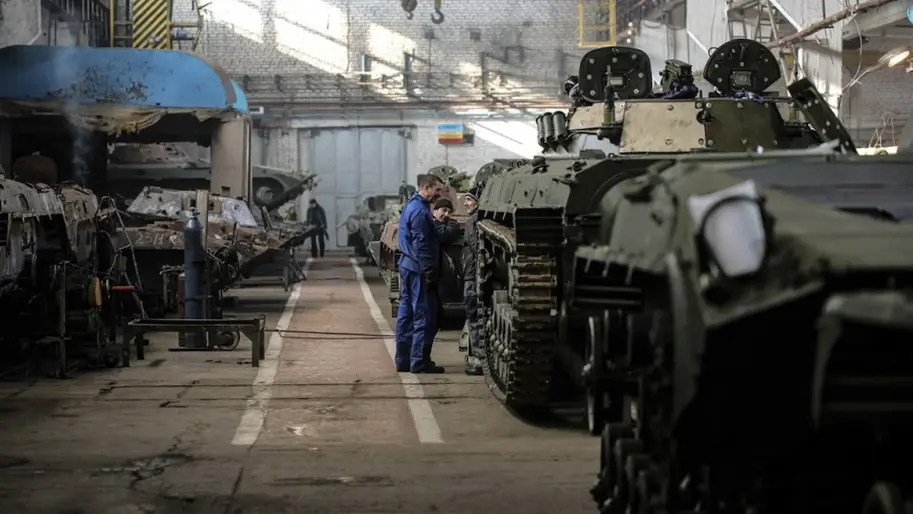

The leadership of russia, the aggressor nation, has realized that stepping up the mobilization of human, industrial, and economic resources is the only way to turn the tide on the battlefield and continue the offensive at the same pace as before.
The Financial Times (FT) reported this, citing its own sources.
Since the start of its full-scale invasion, russia has relied primarily on its numerical and firepower superiority over Ukraine on the battlefield, while simultaneously attacking infrastructure targets deep behind enemy lines.
Emil Kastehelmi, co-founder of the Finnish analytical project Black Bird Group, told the FT that under current conditions, the old tactics Moscow has relied on no longer allow for significant gains, and it has not yet been able to find new ones.
The russian command continues to rely on assaults involving large numbers of infantry, occasionally supported by armored vehicles. This tactic has undergone some changes: now, small groups of soldiers are launching attacks, often in deadly attempts to find gaps in Ukrainian defense lines.
Ukraine’s successes in waging war using unmanned aerial vehicles have turned the tide in Kyiv’s favor.
“Robotization has significantly reduced the importance of troop numbers, which has shifted the course of events in Kyiv’s favor. You need 10,000 or 20,000 drone operators, not hundreds of thousands of soldiers sitting in trenches. So the face of war is changing,” an unnamed combatant told the FT.
The drone war has also significantly eroded russia’s numerical advantage. According to Ukrainian officials, in nearly half a year, the Russian army has lost more soldiers on the battlefield than it has been able to recruit into its ranks.
“The Russian state is either struggling to find belated answers to the enemy's innovative new solutions or not finding them at all,” an unnamed source told the publication.
While Ukraine has expanded the scale of its strikes using drones and missiles, isolating russian troops on the front lines and cutting off supply lines, russia’s elite “Rubicon” drone unit has still been unable to develop similar capabilities, the source added.
“They're technically backward, can't scale it up and don't have [connectivity]. It's very telling,” the FT quoted the source as saying.
Ukraine’s new drone campaign is centered on striking targets in a mid-depth zone about 150 km behind the front lines. Since May, hundreds of drones of all types have been flying toward the so-called “land corridor” leading to Crimea. Moscow is trying to respond to these new challenges by launching a large-scale campaign to recruit new members into drone units, such as “Rubicon.”
However, this transition comes with its own difficulties. According to three representatives of Western intelligence agencies, russia’s defense sector is operating practically at the limits of its capacity, and record-low unemployment is making it difficult to attract qualified workers to the high-tech sector.
According to these sources, production has largely reached a dead end outside the fields of unmanned systems and long-range weapons—the very sectors to which russia is directing the most resources.
“The military-industrial complex has reached a plateau. They have exhausted all their production capacity. It’s impossible to increase output without investment, and that would take years,” said one of them.
Russian dictator vladimir putin and his top officials are forced to insist that russia still holds the upper hand in the war, while downplaying the increasingly devastating effects of Ukrainian military strikes. The russian dictator devotes most of his time to closely monitoring the course of military operations and receives reports from Valery Gerasimov, Chief of the General Staff of the russian Armed Forces, sometimes even twice a day, according to two former kremlin officials.
“He believes it’s a matter of time. It may happen sooner or later, but he will get his way. Putin is heavily influenced by the military, who are very skillfully leading him by the nose. He understands this, but he truly believes them and allows them to do so. If I listened to Gerasimov’s reports three times a day from dawn to dusk, I, too, would perceive reality differently,” one of the publication’s sources said.
Another source for the publication emphasized that in moscow, the prolonged military operations have made it clear: increasing the mobilization of human, industrial, and economic resources is the only way out.
“The question is what form this will take and how they will disguise it,” said the publication’s source.
As the Ukrainian News agency earlier reported, on May 27, Ukrainian President Volodymyr Zelenskyy stated that russia is preparing for an additional mobilization, for which it has stepped up the issuance of mobilization orders.
It should be noted that, according to analysts at the US-based Institute for the Study of War (ISW), a new large-scale mobilization in russia will not help change the situation on the battlefield but will only lead to a deterioration in the quality of the russian army.
Who we are: About us, Contacts. How we write news and our principles: Editorial code. We did our best. If you found this valuable – please support us.
To request a correction, please send an email.