
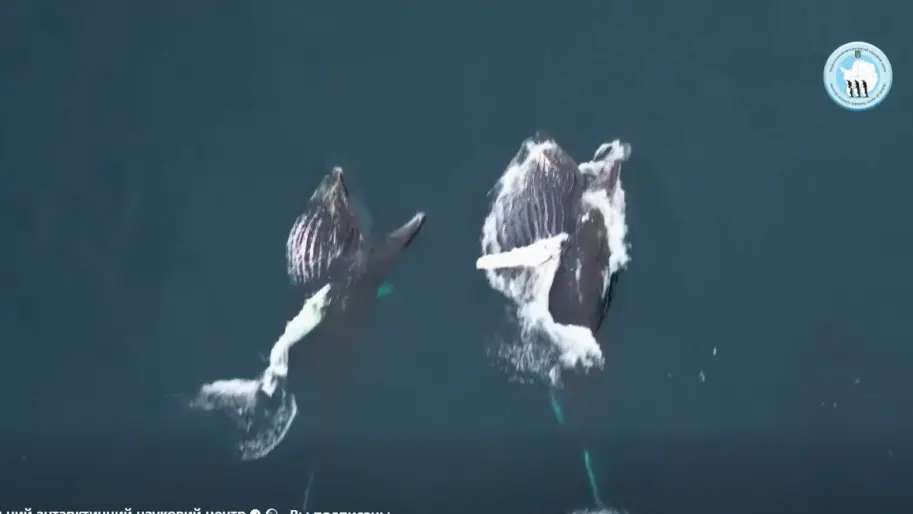

Ukrainian polar explorers from the National Antarctic Science Center have shared new footage from Antarctica that has once again drawn attention to humpback whales. This time, scientists have shown one of the key feeding methods of these sea giants - the so-called lunge feeding.
"We see that our readers really like humpback whales. Everyone was especially impressed by their bubble hunting. So we continue to fall in love with these giants and tell about another type of their behavior - lunge hunting," the National Antarctic Science Center reported.
According to the polar explorers, this type of hunting is one of the main ones for humpbacks. The whale accelerates sharply and with its mouth wide open enters the area of prey accumulation, capturing a huge volume of water along with marine organisms. Thanks to the throat folds that extend from the chin to the belly, the oral cavity is able to expand significantly.
"By stretching, the throat folds allow the whales to capture from 18 to 56 thousand liters of water at a time," the scientists note.
After that, the whale closes its mouth and uses muscles and tongue to push the water through the baleen plates, which hold small prey. In Antarctica, the main food of humpbacks is krill. Each whale has from 270 to 400 baleen plates on each side of the upper jaw, the length of which reaches 60-90 centimeters.
The center also recalled that lunging hunting is used by most species of baleen whales, while bubble hunting is unique to humpbacks and is considered an acquired behavior that is passed down from generation to generation.
"Bubble nets are used only in certain feeding areas, in particular in Antarctica, while lunging hunting is the most common for humpback whales. They often combine different strategies for the most efficient food extraction," the report says.
According to research using special tags, during such hunting, humpbacks can accelerate to 2 m/s, and at peak speed - up to 3 m/s.
The National Antarctic Research Center promised to tell in more detail about the methods of researching whales and show Antarctic life through their "eyes" in the near future. Zoya Shvydka provided the video for the publication, and biologists Oksana Savenko and Vadym Tkachenko participated in the preparation of the material.
As a reminder, Ukrainian meteorologists from the Akademik Vernadsky station recorded a new climate anomaly - the water temperature this year has never dropped below the freezing point.
Who we are: About us, Contacts. How we write news and our principles: Editorial code. We did our best. If you found this valuable – please support us.
To request a correction, please send an email.