
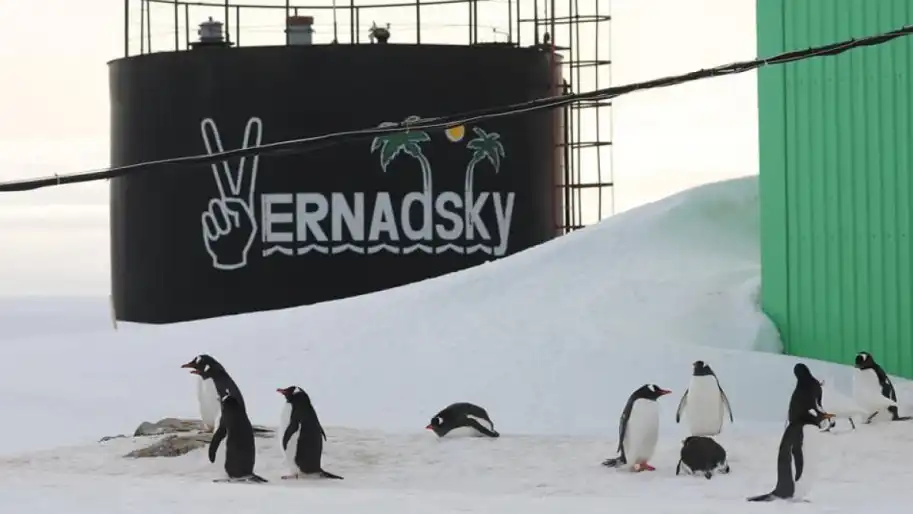

Ukrainian meteorologists from the Akademik Vernadsky station have recorded a new climate anomaly - the water temperature has never dropped below the freezing point this year. This was reported by the National Antarctic Research Center.
"This year, the sea water temperature in the area of our station has never dropped below the freezing point, i.e. -1.8°C (recall that salt water freezes at a lower temperature than fresh water)," the report says.
This happened for the first time in the entire period of sea water temperature observations, which have been ongoing at Vernadsky since 2002.
In 2024 and 2023, the number of days when the temperature dropped below -1.8°C was minimal - 4 and 10, respectively.
"This is probably another confirmation of warming in our Antarctic region. After all, over the past decade, the number of such days has exceeded 40 only once, while over the previous decade it reached even 148," explained Denys Pishniak, head of the Department of Atmospheric and Geocosmic Physics of the National Academy of Sciences of Ukraine.
Our polar explorers can see the impact of this trend on nature with the naked eye. During the current Antarctic winter (when it is summer in Ukraine), no permanent ice formation has formed around the Argentine Islands, where the Vernadsky is located. Therefore, the water area has been open for boat trips almost all year round.
A similar situation was observed in several previous winters, although until the beginning of the 2020s this almost never happened.
"Moreover, since the beginning of Ukrainian Antarctic expeditions, the 7 km distance between our Galindez Island and the coast of Antarctica could be covered on skis in winter, crossing the frozen Penola Strait. Now this is impossible. And the last time our polar explorers recorded a sufficient thickness of ice to cross Penola was in 2019," scientists say.
Previously, the permanent ice cover around Galindez was formed as a result of the freezing of drifting iceberg fragments, drifting multi-year and single-year ice, and local ice cover. Prolonged frost and cold water "cemented" all this into a surface suitable for movement throughout the visible water area.
In recent decades, the permanent cover has formed less and less frequently and more fragmentedly, scientists say.
"This year, new ice was only in places between our and neighboring islands, but in small areas and not for long. Although this is not indicative for the ocean, because in narrow straits, desalinated water accumulates, which freezes faster. We remind you that sea ice is a very important part of the Antarctic ecosystem. In particular, the life of many animals is closely related to it," the scientific center added.
We remind you that the first penguin chick of the season hatched at the Vernadsky station - biologists are recording record-breaking early dates.
Who we are: About us, Contacts. How we write news and our principles: Editorial code. We did our best. If you found this valuable – please support us.
To request a correction, please send an email.