


The aggressor country of russia is actively using numerous armored vehicle storage bases to make up for losses in tanks, armored vehicles and artillery systems. Over the almost four years of the war, pre-war stocks of equipment at such facilities have decreased by almost 40%.
This is evidenced by the latest updated calculation of such equipment, which is conducted by OSINT analyst Jompy.
On Tuesday, October 7, Jompy published updated tables with a list of equipment that continues to remain in russian storage bases. These data are based on satellite images of facilities where the preserved equipment is located. Some armored vehicles are stored in closed rooms, and therefore the figures below do not reflect the full picture. Data from open sources or other OSINT analysts are also used.
Jompy divided all the equipment at the storage bases into three conditional categories that characterize the condition of the equipment: "decent", "poor" and "worse". Thus, the "decent" category includes equipment that was sent for conservation relatively recently or was stored in good conditions, which did not affect its condition much. And the "terrible" category includes equipment that has been stored outdoors for decades.
According to Jompy, before the full-scale invasion, there were about 7,300 tanks of various models (from T-54/55 to T-90) at the storage bases. As of 2025, there were almost 2,900 of them left. At the same time, we are talking only about the "poor" and "terrible" categories. The analyst estimates the remaining vehicles in conservation at 39% (Remaining total).
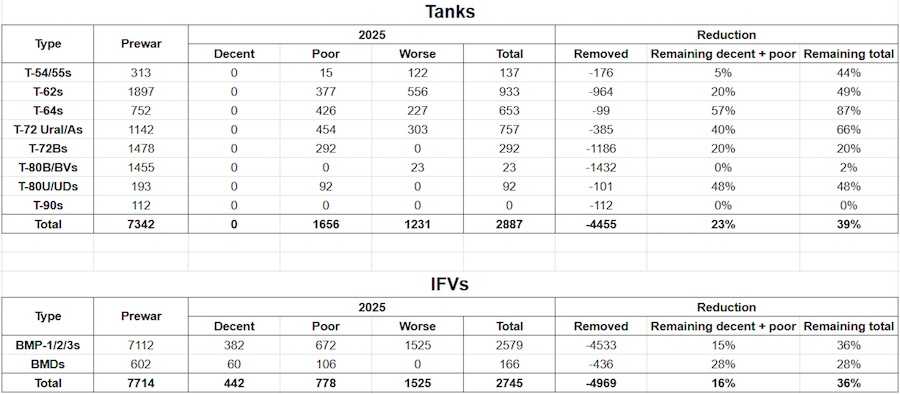 Photo: X (Twitter) / @Jonpy99.
Before the war, there were just over 7,300 infantry fighting vehicles (IFVs) in storage bases. According to the analyst, this year about 2,700 vehicles remained in storage. The total balance was 36%.
As for armored personnel carriers, out of the pre-war 11,200 units, by 2025 about 5,000 vehicles (45%) remained in storage bases.
 Photo: X (Twitter) / @Jonpy99.
The balance of artillery systems in storage was 39% (9,119 out of 23,602 pre-war units). These are mortars, self-propelled and towed howitzers, rocket systems and anti-aircraft artillery.
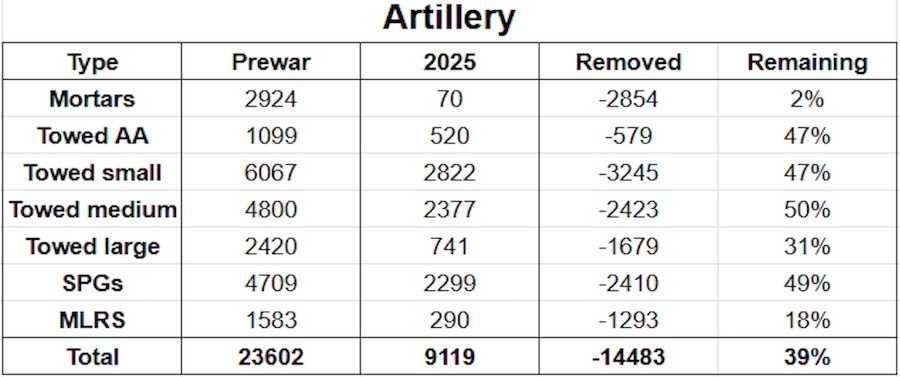 Photo: X (Twitter) / @Jonpy99.
Reduction of equipment stocks and their quality - do not indicate anything in the current conditions
Jompy's colleague in OSINT - Waffentraeger analyst - wrote that the reduction of preserved stocks at russian storage bases does not mean that the russian army will soon be left without equipment. He draws attention to the fact that in many cases the hulls of destroyed tanks, only if they were burned (this weakens the steel), can be restored. According to him, there is evidence that the russians use relatively rusty hulls as material for deep modernization.
A report from BTRZ 61, SPb. Modernization of the T-72B to the level of the T-72B3 - modification of the hull for the new driver's workplace (suspended from the roof of the hull), modification of the hull for installation of a new engine, newer over-track shelves. pic.twitter.com/yA0DTrzywT
— Andrei_bt (@AndreiBtvt) November 6, 2023
The analyst emphasizes that the restoration of such equipment is extremely uneconomical, since it is cheaper to build a new tank. But restoration takes much less time than building a new machine.
Restoring equipment that is in terrible condition will negatively affect the pace, but will not lead to a complete stoppage of supplies. This means that russia will be forced to save even more on tanks in the future than, for example, in 2023-2024, when supplies of restored equipment to the troops were sufficient.
In addition, due to the active use of drones, the russians have reduced the use of armored vehicles to a practically minimum. And although recently it is still possible to see the use of equipment, Waffentraeger believes that russia now has a relatively small but surplus stock of tanks that are stored "for some purpose."
"Unfortunately, it is too early to rejoice over the loss of russian tanks; instead, we will continue to watch reserves disappear and burn in the fields of Ukraine for some time. The positive point is that the russian federation will be forced to save metal at the expense of manpower," the analyst writes.
As Ukrainian News Agency earlier reported, in September 2024, the Dutch analytical project Oryx stated that the russian army's losses in tanks and infantry fighting vehicles exceeded 10,000 units.
And in June 2024, the German publication Süddeutsche Zeitung (SZ) wrote that there were fewer and fewer tanks at russian storage bases. The journalists suggested that if the intensity of the fighting (at the time of publication of the material) remained the same, the tank reserves would last for another 2-3 years.
Who we are: About us, Contacts. How we write news and our principles: Editorial code. We did our best. If you found this valuable – please support us.
To request a correction, please send an email.