
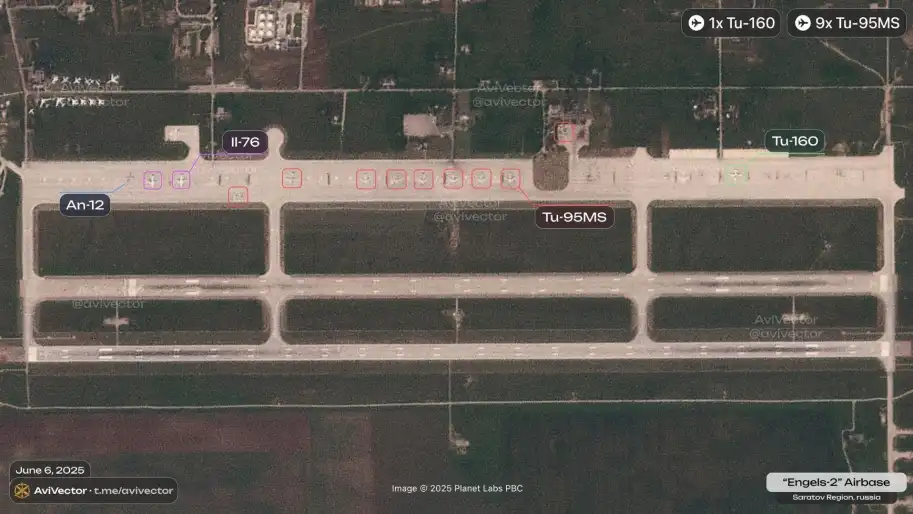

After the special operation Spider Web conducted by the Security Service of Ukraine, russia began a large-scale relocation of its strategic bombers from the European part of the country to the east and south.
This is evidenced by the analysis of the Ukrainian OSINT researcher AviVector.
According to him, by June 5, seven Tu-160s had left the Belaya airfield (Irkutsk Oblast), and all available Tu-160s and Tu-95MS had left the Olenya base (Murmansk Oblast).
The aircraft were then distributed to other bases:
- 2 Tu-160s — stationed in Anadyr (Chukotka)
- 3 Tu-160s — relocated to Borisoglebsk (Tatarstan)
- 3 Tu-160s — transferred to Kamchatka, to Yelizovo
- 11 Tu-22M3s from Olenya — arrived at the Ukrainka airfield (Amur Oblast)
- 4 Tu-95MSs from the Engels-2 airbase (Saratov Oblast) were also sent there
- 6 Tu-22M3s were transferred to Engels-2 instead
- 4 more Tu-22M3s landed on June 9 at the Mozdok airfield in North Ossetia.
This relocation is probably due to fears of new attacks on air bases and an attempt to disperse strategic aviation to increase its security.
As a reminder, on June 1, the Security Service of Ukraine conducted a unique special operation, as a result of which four strategic air bases in russia were hit: Olenya, Ivanovo, Dyagilevo and Belaya. According to the head of the SSU Vasyl Maliuk, who personally led the operation, more than 40 russian strategic aircraft were hit. The SSU reported that as a result of these actions, about 34% of russian cruise missile carriers were disabled, which is estimated at approximately USD 7 billion.
Who we are: About us, Contacts. How we write news and our principles: Editorial code. We did our best. If you found this valuable – please support us.
To request a correction, please send an email.