
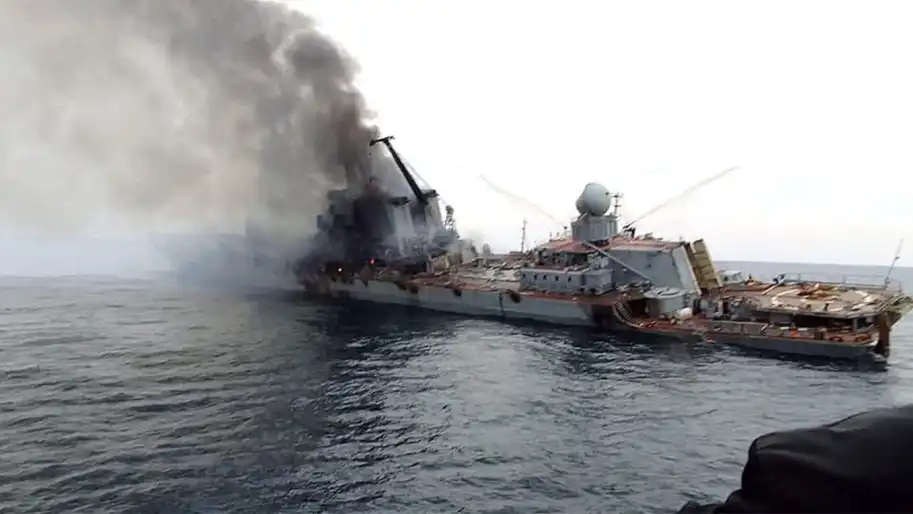

The United States was angry over the Ukrainian devastating strike on the then symbol of russian power, the Moskva cruiser, which was carried out without warning from the American side at the beginning of cooperation after a full-scale war.
This is stated in the material of The New York Times "The Partnership: The Secret History of the War in Ukraine".
The article reports that in mid-April 2022, American and Ukrainian naval officers were conducting routine reconnaissance when something unexpected appeared on their radar screens. According to a former senior American officer, "The Americans say: 'Oh, that’s the Moskva! The Ukrainians say: Oh my God. Thanks a lot. Bye.'"
The Moskva cruiser was the flagship of the russian Black Sea Fleet, the Ukrainians sank it.
The NYT argues that the sinking was a signal of triumph, a demonstration of Ukrainian prowess and russian ineptitude; but at the same time, the episode reflected the disjointed state of Ukrainian-American relations in the early weeks of the war.
“For the Americans, there was anger, because the Ukrainians hadn’t given so much as a heads-up; surprise, that Ukraine possessed missiles capable of reaching the ship; and panic, because the Biden administration hadn’t intended to enable the Ukrainians to attack such a potent symbol of Russian power,” the article says.
According to the publication, when American generals offered help after russia’s full-scale invasion of Ukraine, they allegedly ran into a wall of mistrust. During their first meeting, the then commander of Ukraine’s ground forces, Colonel General Oleksandr Syrskyi, told the Americans: “We’re fighting the Russians. You’re not. Why should we listen to you?”
However, General Syrskyi quickly changed his mind: the Americans could provide battlefield intelligence that his men could never obtain.
The NYT describes the complex relationship and system of interaction between the American and Ukrainian sides. In the early days, General Donahue and a few aides, armed only with telephones, transmitted information about the movements of russian troops to General Syrskyi and his staff. It is alleged that even this temporary arrangement “touched a raw nerve of rivalry” between the Ukrainian military – between Syrskyi and his boss, the commander of the Armed Forces of Ukraine, General Valeryi Zaluzhnyi. According to Zaluzhnyi’s supporters, General Syrskyi was already using this relationship to gain advantage.
In addition, the situation was further complicated by General Zaluzhnyi’s tense relationship with his American counterpart, General Mark Milley, chairman of the Joint Chiefs of Staff of the Armed Forces of Ukraine.
In telephone conversations, General Milley could question Ukrainian requests for equipment. He can dispense advice on conducting combat operations based on satellite intelligence on the screen of his office in the Pentagon. Then there would be an awkward silence before General Zaluzhnyi would hang up. Sometimes he would simply ignore the American’s calls.
To keep the conversation going, the Pentagon set up a complicated phone system: Milley’s aide would call Maj. Gen. David S. Baldwin, commander of the California National Guard, who would call Ihor Pasternak, a Los Angeles airship manufacturer who had grown up in Lviv with Oleksii Reznikov, then Ukraine’s defense minister. Mr. Reznikov tracked down General Zaluzhnyi and told him, in General Baldwin’s words, “I know you’re mad at Milley, but you have to call him.”
This fractious alliance turned into a partnership “in a rapid cascade of events.”
At an international conference on April 26 at Ramstein Air Base in Germany, General Milley introduced Mr. Reznikov and a deputy of Zaluzhnyi to Generals Cavoli and Donahue.
“These are your guys right here. You have to work with them. They will help you,” he said.
Then the building of trust began. Reznikov agreed to speak with General Zaluzhnyi. He said that after returning to Kyiv, “we organized the composition of a delegation” to the German city of Wiesbaden: “And so it began.”
A New York Times investigation shows that the United States was much more closely and broadly involved in the war than previously thought. At critical moments, this partnership was the backbone of Ukrainian military operations that, according to US estimates, killed or wounded more than 700,000 russian soldiers. Side by side in the mission’s command center in Wiesbaden, American and Ukrainian officers planned Kyiv’s counteroffensive. The massive intelligence-gathering effort by American intelligence officers determined the overall battle strategy and relayed precise targeting information to Ukrainian soldiers on the ground.
One European intelligence chief recalled being shocked to learn how deeply his NATO colleagues were involved in Ukrainian operations.
“They are part of the kill chain now,” he said.
Time and again, the Biden administration has authorized covert operations it had previously prohibited. American military advisers have been sent to Kyiv and later allowed to travel closer to the war zone. Military and CIA officers in Wiesbaden helped plan and support a campaign of Ukrainian strikes in the russian-annexed Crimea. Eventually, the military, and then the CIA, were given the green light to launch pinpoint strikes deep inside russia.
Who we are: About us, Contacts. How we write news and our principles: Editorial code. We did our best. If you found this valuable – please support us.
To request a correction, please send an email.