
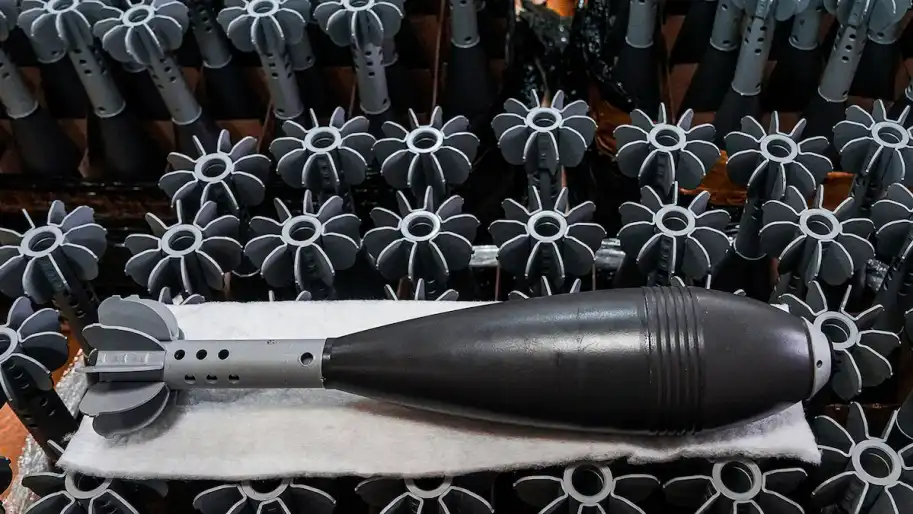

In early November, the Ukrainian military began to complain about defective 120-millimeter mines produced by Ukroboronprom that were delivered to the front. Currently, the Ministry of Defense of Ukraine has stated that it is investigating the reasons for their abnormal operation. Meanwhile, the media have found out the details of the scandal.
Thus, the Ukrainian military provided TSN with a number of videos with defective 120-millimeter mines that do not explode and do not reach enemy positions. According to the soldiers, the mines do not explode after being fired, get stuck in the mortar barrel or fall just next to it.
The military name three problems with the said mines: the fuse does not work, which prevents the mine from exploding; a poor-quality ejector cartridge, which should ensure its release from the barrel; wet powder due to packaging.
Recall that the first complaints about defective mines appeared in early November. Then the military announced the receipt of a batch of 120 mm mortar mines that did not explode - only 1 burst per 10 shots.
The Ministry of Defense of Ukraine today, November 26, announced that it has been investigating the causes of the abnormal operation of 120-millimeter mines for the third week. Currently, the Ministry of Defense has suspended the use of the specified batches of ammunition in the Defense Forces, as well as their issuance to combat units. It was stated that the batch of delivered ammunition was withdrawn for further research, and imported mines will be supplied instead.
According to ZN.UA, this is a recall of at least 100,000 mines. At the same time, the media reported that in January 2024, the military representative of the Ministry of Defense checked the capacity of the plant that produced these mines.
The ZN.UA editorial office has a document in which the military representative pointed out the risks:
- supplies of components and raw materials of critical import (powder, explosives);
- training of qualified personnel, production areas and additional technological equipment;
- uninterrupted work of personnel and power supply.
It was also indicated that the plant had not mastered the serial production of the M-12 fuse (a part on the very head of the mine, which is responsible for the final explosion upon impact). However, in the end, a positive conclusion was signed, and regarding 120-mm mines it was indicated that the plant can produce 300,000 pieces per year, taking into account the workload.
Before signing the contract, the Defense Procurement Agency clarified with the military representatives the assessment of the plant's capacity. On February 9, the Defense Procurement Agency received a conclusion - taking into account the workload, the plant can produce 670,000 mines per year. And on February 14, the Defense Procurement Agency concluded a large contract for the supply of 120-mm mines.
After another request, the Defense Procurement Agency received assurances that since the military leaders had fully inspected this plant in 2023, an additional inspection in full was not required, and "the enterprise as a whole is able to fulfill its stated obligations and timely repay the advance payment provided under state contracts for the supply of products for the needs of the Armed Forces of Ukraine."
At the same time, the parts regarding production areas and qualified personnel and a mention of the lack of serial production of the M-12 subversive disappeared from the report .
In June, the first 120-mm mines left the plant. It is noted that there were no reports of problems with them at the time. Then there was a break in supplies for a couple of months, and in September they resumed. Then the problems began to be voiced. The publication reported that during the firing from September 18 to November 10, the following was recorded:
- mines deviated from the aiming point by 100–600 meters in range;
- there were cases of mines not coming out of the mortar barrel;
- mines not exploding in the target;
- mines fell on a flight path at a distance of 10–150 meters from the mortar;
- when changing the sight, the mine incorrectly changed the flight range;
- isolated cases of the metal part of the mine not coming out of the tube, and gunpowder burning out in the barrel.
The publication reported that only on November 21, the Ministry of Defense convened a large meeting on this issue with the participation of representatives of the Office of the President under the leadership of the provisional minister Ivan Havryliuk.
According to the minutes of the meeting, published by ZN.UA, the Main Directorate for Technical Evaluation and Quality Control of Armaments and Military Equipment was instructed to check 100% of all batches and consider the possibility of increasing the number of shots during the check. That is, before that, mines were accepted based on checking a small number of shots and not from all batches.
It is indicated that "technical" claims were also made at the meeting - it was stated that all mines should be supplied with standard M-12 fuses. As it turned out, the mines were equipped with other B-429 fuses.
The Central Research Institute of Armaments and Military Equipment was also instructed to develop a program and methods for checking powder charges for these mines, taking into account the influence of the external environment (from -3 to +60C°).
As the Ukrainian News agency earlier reported, on November 20, journalist Yurii Butusov published another video in which defenders complain that ammunition from this manufacturer is of low quality.
Who we are: About us, Contacts. How we write news and our principles: Editorial code. We did our best. If you found this valuable – please support us.
To request a correction, please send an email.