
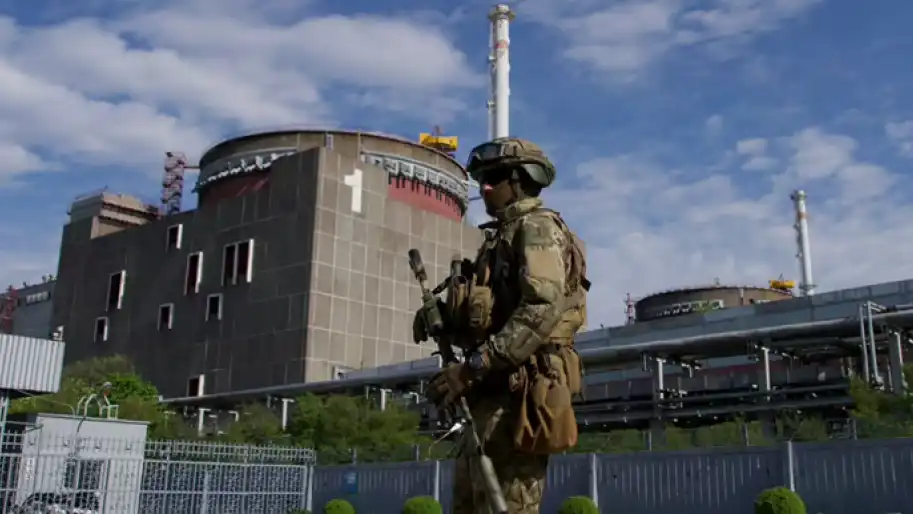

The IAEA complained about anti-personnel mines in the buffer zone on the territory of the Zaporizhzhia NPP between the internal and external fences of the facility in a closed area inaccessible to the station's operating personnel.
This was announced in the report of IAEA director Rafael Grossi.
"ISAMZ continues to report the presence of armed men (whom the russian federation claims are members of the russian National Guard and some chemical, biological, radiological and nuclear weapons specialists) and military equipment such as armored personnel carriers, military logistics vehicles and armored vehicles with installed weapons. ISAMZ reported that the armed military did not allow it to enter the western part of the turbine halls," he said.
Also, the russian invaders do not allow experts from the IAEA mission to the western part of the turbine halls of the Zaporizhzhia NPP. Therefore, they cannot confirm whether there are any problems or materials in these parts that could potentially affect the nuclear safety or security of the plant.
Also, ISAMZ continues to face "limitations in providing timely and appropriate access to all locations and information related to nuclear and physical nuclear security, which may have implications for the Agency's assessment of the overall situation."
"During the reporting period (from May 25 to August 30, - ed.) ISAMZ was not granted access to all places related to nuclear and physical nuclear security - such as the western part of the turbine halls, the isolation gate of the cooling reservoir of the Zaporizhzhia NPP and the open switchgear of 330 kV Zaporizhzhia NPP", Grossi's report states.
The mission also saw anti-personnel mines in the buffer zone between the facility's inner and outer fences in a closed area inaccessible to station operational personnel.
The invaders told the IAEA that these mines were part of a physical defense system.
Also in the report, Grossi said that in some cases IAEA experts were able to talk to the operators of the main control panel about their permissions and experience, but in most cases ISAMZ faced restrictions imposed by Zaporizhzhia NPP (the russian occupation administration on Zaporizhzhia NPP, - ed.), and could not openly interact and exchange information with operators.
As Ukrainian News Agency earlier reported, Ukraine agreed with the International Atomic Energy Agency to extend the agency's monitoring mission to key substations, on which the stable operation of nuclear power plants depends.
A massive attack by the russians on August 26 led to the shutdown of four nuclear units.
Who we are: About us, Contacts. How we write news and our principles: Editorial code. We did our best. If you found this valuable – please support us.
To request a correction, please send an email.