
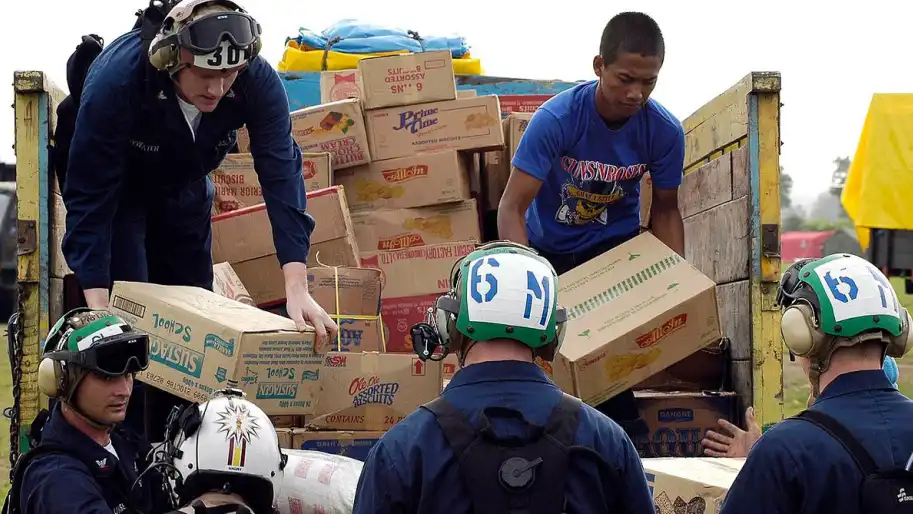

Over 13.5 million Ukrainians have received humanitarian aid from international organisations. Yet every delivery of this aid has become a matter of life and death – both for those transporting it and for those awaiting it.
More than two years of Russia’s full-scale war against Ukraine have posed an unprecedented challenge to the international humanitarian system. At the same time, they have demonstrated remarkable solidarity – dozens of countries and organisations have united to help Ukrainians survive and maintain human dignity during the conflict.
Aid Statistics: What We Know
According to the United Nations Office for the Coordination of Humanitarian Affairs (OCHA), by the end of 2022, 13.5 million Ukrainians had received aid from various international agencies. Approximately 2.4 million people were provided with shelter and essential items, while another 630,000 received clothing and winterisation support. Nearly 6.9 million people received water and hygiene supplies, and 8.9 million received food or medical assistance. By 2024, over 8 million people, including those in frontline regions, were able to access humanitarian support thanks to the combined efforts of Ukrainian NGOs, local volunteers, international organisations, and UN agencies.
The most active organisations supporting Ukrainians include the United Nations High Commissioner for Refugees (UNHCR), the United Nations Children’s Fund (UNICEF), the International Organization for Migration (IOM), the World Food Programme (WFP), the United Nations Office for the Coordination of Humanitarian Affairs (OCHA), as well as the International Committee of the Red Cross and the Ukrainian Red Cross Society. Since March 2022, the WFP alone has injected over USD 1.3 billion into Ukraine’s economy through local procurement and direct cash assistance, supporting economic activity and jobs.
Danger for Convoys and Volunteers
Delivering aid has become increasingly dangerous. Over the past 12 months, more than 40 attacks on humanitarian warehouses, distribution points, and partner vehicles, including WFP convoys, have been recorded. In October, the Russian army attacked a UN humanitarian mission in Kherson: four white, marked vehicles were transporting aid to civilians. One vehicle was completely destroyed by fire, another was severely damaged, but fortunately, no one was killed.
Such incidents are becoming more frequent. On 4 September, the Russian Ministry of Defence announced a strike on demining mission staff near Chernihiv, describing it as a “strike on UAV units of the Ukrainian Armed Forces.” The Ukrainian Ombudsman called on the international community to respond immediately.
The humanitarian crisis in Ukraine is simultaneously a crisis of civilian protection. Civilians are suffering serious violations of international humanitarian law and human rights. According to verified data, from 2022 until the end of October 2024, almost 39,000 civilians were affected, including more than 12,000 deaths, of which over 2,400 were children (Human Rights Monitoring Mission in Ukraine, Protection of Civilians in Armed Conflict, October 2024).
Rocket attacks on energy infrastructure and constant threats from strike drones make it difficult for humanitarian organisations to provide aid to the most affected areas. The most severe obstacles are observed in nine frontline regions in the north-east, east, and south of Ukraine, where high-intensity fighting, shifts in territorial control, and evolving enemy tactics complicate the delivery of vital operations. From January to October 2024, 238 incidents limiting humanitarian access were recorded, 95 of which affected personnel, facilities, and property, leading to the temporary suspension of critical operations. During this period, nine humanitarian workers were killed and 40 injured, compared to 10 killed and 29 injured in 2023 (OCHA, Ukraine: Humanitarian Access Snapshot, September to October 2024).
What Is the Situation with Humanitarian Support Today?
Despite the risks, international support continues. Recently, the Netherlands announced a EUR 200 million aid package for humanitarian initiatives, infrastructure recovery, energy security, and social protection in affected regions. A coordination cluster will open in Kyiv for Dutch tech companies assisting in reconstruction.
Currently, the complexity of humanitarian missions in Ukraine also stems from the scale of human losses. According to the OHCHR, over 5 million people face moderate or severe food insecurity. In frontline regions, one in three Ukrainians lacks adequate access to food, and even where food is available, many cannot afford it. For example, in Pokrovsk, the last shop closed on 12 August this year, and the city has been without centralised water supply, heating, or electricity for over six months. According to the head of the Pokrovsk military-civil administration, humanitarian aid delivered by military personnel involved in evacuation remains the only source of provisions. While around 1,300 people remain in the city, access is almost impossible due to constant shelling.
Despite attacks, damaged infrastructure, and delivery challenges, humanitarian organisations continue providing life-saving support. For instance, the World Food Programme and the Ukrainian Red Cross, in partnership with the International Committee of the Red Cross, implement programmes supporting rural communities in Kharkiv and elderly residents in Kherson. In March alone, Red Cross volunteers distributed over 43,000 food parcels in Kherson.
What Awaits Humanitarian Missions Next?
Ukraine faces not only the direct consequences of war but also challenges in ensuring effective and safe humanitarian aid delivery. For such assistance to continue saving lives, humanitarian workers risking their lives must have proper protection guarantees. This includes safe delivery routes, international oversight of humanitarian law compliance, and operational coordination between government and international organisations.
Despite the scale of aid already provided, Ukrainians’ needs remain extremely high and diverse. According to OCHA, in 2025 millions of people are planned to be reached across sectors: from food security and livelihoods to health, shelter, water, sanitation, education, and civilian protection, including mine action. At the same time, aid delivery is often hindered by the security situation.
Matthias Schmale, Humanitarian Coordinator of OCHA in Ukraine, reported that multiple attacks, including drone strikes, caused deaths, numerous injuries, and damage to humanitarian assets in 2024. He emphasised that operations continue to improve access to affected people while ensuring the safety of those delivering aid, in line with humanitarian principles.
Even considering isolated access restrictions and delays, humanitarian operations in frontline areas continue thanks to active use of the UN Humanitarian Notification System, local permits, and direct contacts with authorities. At the same time, dependence is growing on local volunteers, civilians, and local authorities during the final stages of aid delivery in high-intensity conflict zones.
To overcome these challenges and ensure timely information for the humanitarian community, structures such as the Humanitarian Access Working Group will continue monitoring access violations. Additionally, international NGOs will facilitate aid delivery by providing technical logistics expertise, free shared logistics services, and ensuring assistance reaches the most hard-to-reach areas.
Without ongoing support, the crisis is expected to deepen, affecting community recovery prospects. Effective and timely aid requires close coordination among partners, including standardised databases, information management, and systematic monitoring and analysis. In this context, active engagement of Ukrainian organisations and strengthening their authority and capacity remain crucial to ensuring quality and effective humanitarian interventions.
Who we are: About us, Contacts. How we write news and our principles: Editorial code. We did our best. If you found this valuable – please support us.
To request a correction, please send an email.