

At the beginning of July 2025, while Ukraine has been repelling the most intense Russian ballistic and drone attacks for several consecutive months, a stunning piece of news arrived from Washington. POLITICO reported that the Pentagon, at the initiative of its new chief of policy, Elbridge Colby, had suspended deliveries of critically important weapons to Ukraine, including air defense missiles and precision munitions. The decision, which had been made back in early June but was implemented only now, struck like thunder out of an already clouded sky—not only over Kyiv but also for much of the American establishment and allied partners.
The paradox of the situation is striking. Just a week ago, President Donald Trump, after meeting with Volodymyr Zelenskyy at the NATO summit, appeared more sympathetic to Ukraine's plight and publicly speculated about the possibility of providing additional Patriot systems in response to a Ukrainian journalist who shared that her husband was currently fighting on the front line. And suddenly—a complete halt.
All of this has immediately laid bare the deep fissures within the Trump administration and provokes the logical question: is this a deliberate and cold-blooded shift in U.S. strategy, or the result of chaotic internal power games in which Ukraine has become merely a bargaining chip? It seems the answer combines elements of both.
"Chaos in the White House": Anatomy of a Rift
The Pentagon's decision triggered a chain reaction on both sides of the Atlantic. Members of Congress were the first to flare up, and the outrage came not only from Democrats but also from influential Republicans who have traditionally supported aid to Ukraine.
The Chairman of the House Foreign Affairs Committee, Republican Michael McCaul, did not mince words: "I think this was all done by the Pentagon's policy chief, this Colby. We effectively don't have a National Security Advisor. I'm not even sure [Secretary of State] Rubio was consulted… There are internal divisions in the White House." His comment pointed to the central problem: a key national security decision had been made by a small circle inside the Pentagon, bypassing the State Department, the National Security Council, diplomats in Kyiv, and most importantly, without consulting Congress.
Other Republicans quickly joined the criticism. Joe Wilson stated that "the Pentagon is undermining the president's 'Peace Through Strength' policy" and called on the Secretary of Defense to reverse the decision. Brian Fitzpatrick, a member of the Intelligence Committee, sent Trump an official letter demanding an emergency briefing for Congress.
From the Democrats, the reaction was even sharper. Marcy Kaptur, co-chair of the Congressional Ukraine Caucus, directly accused Colby of actions that "will undoubtedly lead to the needless deaths of many Ukrainian soldiers and civilians." Senator Jeanne Shaheen pointed to an obvious contradiction: "Just last week President Trump promised to find additional air defense systems for Ukraine, but Pentagon chief Pete Hegseth and his deputy Colby appear to be ignoring the president."
The White House tried to put out the fire by releasing a statement that the decision had been made "to put America's interests first." But when pressed on when exactly the president was informed, there was no clear answer—only fueling suspicions that the administration is in disarray, and that the once-powerful National Security Council, reduced to a bare minimum, has lost its coordinating role.
The resulting power vacuum, it turns out, was swiftly filled by ambitious and ideologically driven figures. And chief among them has been Colby himself.
The Architect of the "Pause": Who Is Elbridge Colby?
To understand the logic behind this seemingly chaotic decision, it is necessary to understand who Elbridge Colby is. Unlike many of Trump's appointees, he is no newcomer to Washington. He is an experienced strategist, an intellectual, and one of the main authors of the 2018 National Defense Strategy (NDS). It was this document, during Trump's first term, that officially declared the end of the era of the War on Terror and named the United States' new top priority as "interstate strategic competition," specifically confrontation with China and Russia.
However, for Colby, these two threats have never been equivalent. He is a consistent proponent of the "geopolitical realism" school and for years has promoted a single core idea: the main existential threat to the United States is China, and the war in Ukraine is a dangerous distraction of resources and attention from the main theater of operations in the Indo-Pacific region.
His views did not appear overnight. You can trace their evolution through his own public statements:
- 2022: After the full-scale invasion, he spoke cautiously, calling for "limited assistance" so as not to "turn this into an endless war" and to avoid depleting U.S. arsenals.
- 2023: His rhetoric grew harsher. In an interview, he declared: "Russia is not going to march to the Rhine or the English Channel. There is a significant buffer in Eastern Europe. Strategically, it's more important to prepare for China." He insisted that Europe must take on the primary burden of supporting Ukraine.
- 2024: He became categorical. "We cannot fight on two fronts—against Russia in Europe and China in Asia. If we want to avoid war with Beijing, we need to reduce spending on Ukraine."
- 2025: Already serving in the Pentagon, during Senate hearings he confirmed that support for Ukraine would be "reviewed to align with U.S. priorities."
Thus, the decision to suspend arms deliveries is not a spontaneous move but the first practical implementation of the "Colby Doctrine." Every Patriot missile sent to Ukraine, in his view, is a missile that will be missing to defend Taiwan. Every artillery shell is one less shell available for a potential conflict with China.
Adding to this calculus are recent developments involving Israel and Iran, which only further reinforce the argument for a U.S. strategic pivot.
A Patron at the Top: How Colby Gained Such Power
A logical question arises: how was one man, even in a senior position, able almost singlehandedly to pivot U.S. policy on arms deliveries to Ukraine, provoking outrage even among the president's own allies? The answer lies in the support Colby enjoys at the highest level.
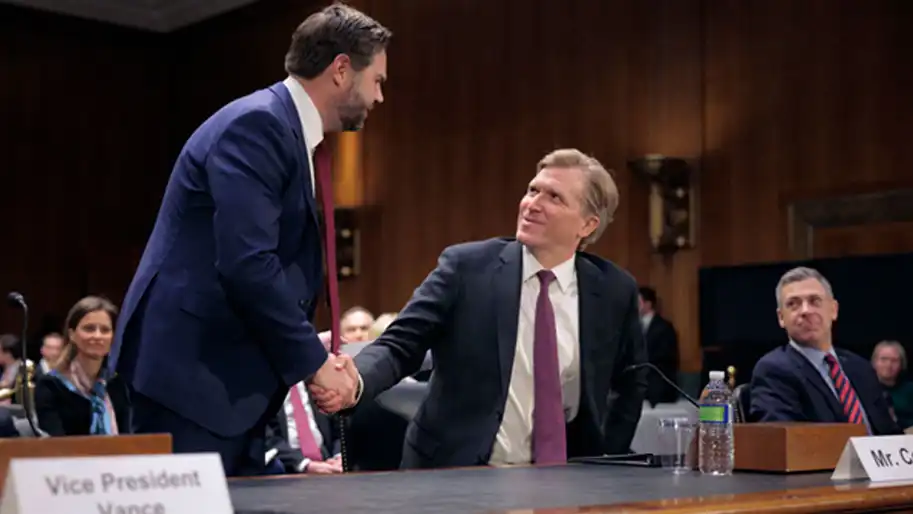
A telling moment came during the Senate committee hearings in March 2025 on his confirmation. To support Colby, Vice President J.D. Vance personally attended the proceedings. As observers noted, the presence of a vice president at hearings of this kind is exceedingly rare. It was a clear signal to the entire Republican Party: Colby is part of our team, and his appointment is critically important.
Like Colby, Vance is part of the "realist" and isolationist wing of the Republican Party. Colby is widely regarded as the "strategic brain" shaping defense policy, while Secretary of Defense Pete Hegseth plays a more ceremonial and administrative role.
In addition, Colby skillfully took advantage of the "hollowed-out" state of government institutions. As one former Pentagon official put it, "Colby understands how paperwork moves through the building, unlike most people working there now." Armed with experience, deep knowledge of bureaucratic procedures, and powerful political cover in the person of the vice president, he was able to concentrate enormous influence in his hands and advance a decision that had been in preparation since March.
A "Shortage" of Weapons—or a Shortage of Political Will and Sense?
The official explanation for the "pause" is concern over U.S. stockpiles, which allegedly have reached a critically low level. However, analysts and journalists quickly called this narrative into question.
The Wall Street Journal editorial board called it "political hypocrisy" and "a hostile act that plays into Putin's hands." Siddharth Kaushal, an expert at the RUSI think tank, explained that the shortage is "relative, not absolute." For example, production of Patriot missiles increased by 30% in 2024, and to replenish its own reserves, the United States has been actively relying on allied manufacturing capacity, including Japan's. The problem is not the absence of weapons but rather rising demand and a shift in priorities.
Moreover, this step has troubling parallels with the past. In 2019, the Trump administration already froze $214 million in military aid to Ukraine, attempting to pressure Kyiv over the matter of Joe Biden's son. At the time, the U.S. Government Accountability Office ruled that blocking funds already allocated by Congress due to political disagreements violated the law (the Impoundment Control Act).
The current situation, some fear, risks repeating that scenario and should arguably trigger a new investigation in Congress.
In this way, all the talk of empty warehouses is simply a convenient smokescreen covering a fundamental policy shift Colby is driving: America is pivoting toward China and the Middle East—leaving Europe and Ukraine to sort things out on their own.
Consequences for Kyiv and a "Plan B"
For Ukraine, the consequences of this decision are direct and extremely dangerous. The suspension of interceptor missile deliveries leaves Ukrainian cities more vulnerable to Russian missile terror. As expert Tom Karako aptly noted: "Air defense won't win you a war, but the lack of it will let you lose one quickly." A shortage of artillery shells and precision munitions will further complicate the situation on the front line.
This latest crisis once again proves that relying on a single—however powerful—ally is risky. Under the Trump administration, the United States is becoming an unpredictable partner. For Kyiv, activating a "Plan B" is now a matter of strategic survival and proactive engagement. The plan must include three main directions:
- Developing domestic defense production: Ukraine already covers a significant portion of its needs, but manufacturing must be scaled up—especially in ammunition, drones (deep strikes, swarms, interceptors), ballistic components, barrels, and electronic warfare.
- Deepening partnerships with Europe: Joint production programs with the United Kingdom, Denmark, Norway, Germany, France, and other countries should offset potential disruptions in U.S. assistance.
- A new "transactional" strategy with the U.S.: Kyiv has already declared readiness to buy weapons, including 10 Patriot systems. This is an attempt to reframe relations from "aid" to "commercial partnership," which may be more acceptable to the administration. Additionally, it is critical to argue—directly in Washington, working with the administration and supportive members of Congress and the Senate—that Ukraine's defeat would cost America far more in every sense, not only in spent interceptors and shells.
The Ukrainian side has already responded. The Foreign Ministry summoned the U.S. chargé d'affaires, John Hinkel. Deputy Foreign Minister Maryana Betsa stressed that any delay in air defense support "will only encourage the aggressor to keep waging war." Meanwhile, Ukraine's Ministry of Defense said it had not yet received official confirmation of any change in delivery schedules. The Defense Ministry has requested urgent talks with American counterparts to clarify the situation.
Official Kyiv is already working to arrange a phone call between Presidents Trump and Zelenskyy in the coming days.
Conclusion
The Pentagon's decision to freeze assistance is neither a technical pause nor a bureaucratic error. It is the first clear note in a new foreign policy symphony conducted by Elbridge Colby, with Vice President J.D. Vance as its patron.
The chaos and confusion this move has sparked show that within the Trump administration, there is a fierce internal struggle over what the future of American policy will look like. Ukraine has landed in the epicenter of this battle, becoming a hostage to ideological doctrines and political ambitions in Washington.
The era of stable, bipartisan support appears to be ending. It is time to deal with reality. Ukraine's survival depends not only on the courage of its soldiers but also on the country's ability to adapt to the new landscape, strengthen its own capabilities, and work to ensure that the voices of clear-headed allies in the U.S. can still outweigh the influence of the "Colby Doctrine."
Who we are: About us, Contacts. How we write news and our principles: Editorial code. We did our best. If you found this valuable – please support us.
To request a correction, please send an email.