
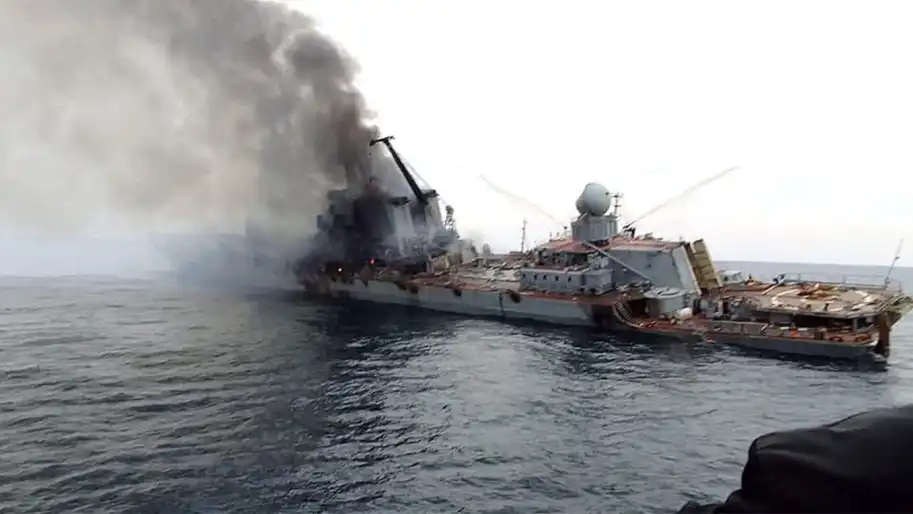

During the few years of the war, russia has left dozens, if not hundreds of billions of dollars on the battlefields in Ukraine - namely, more than 15,000 tanks, aircraft, ships, artillery pieces, missile systems, IFVs and APCs, command posts and communication points, unmanned aerial vehicles, supply trucks, etc.
According to experts of the Oryx website, recording documented losses of the parties, the russian army lost 15,063 pieces of equipment by the end of March. Of these, it "gave" almost a fifth to the enemy: Ukrainian troops captured 2,935 units. Two-thirds (10,615) were destroyed, another 692 were damaged, 821 were abandoned.
The real scale of losses may be greater, since not all cases are recorded. For example, according to the estimates of the Armed Forces of Ukraine (AFU), russia lost 342 aircraft and 325 helicopters. Oryx gives figures about three times smaller - 107 and 135, respectively.
"Although the Ukrainian data may be overstated, the losses of the Russian Air Force have really increased a lot recently. Having lost many aircraft and helicopters at the beginning of the war, Russia could not establish dominance in the sky and began to keep aviation a little further from the front. But in recent months, aircraft have begun to actively use glide bombs against Ukrainian positions, especially in Avdiivka, which can be launched from a distance of up to 70 km. Since January, the Russian Air Force has regularly carried out more than 100 airstrikes a day, and in the four days before the fall of Avdiivka on February 17 - almost 160," calculated Konrad Muzyka, director of Polish Rochan Consulting.
Losses also increased.
"Ukraine has become more aggressive at the risk of using Patriot launchers near the front line to hit Russian aircraft," said Justin Bronk, Senior Research Fellow at the Royal United Services Institute (RUSI).
As President Volodymyr Zelenskyy said recently, since the beginning of February, the Armed Forces of Ukraine managed to shoot down 15 russian military aircraft, seven of them in the last days of February and early March.
In addition, the Armed Forces of Ukraine shot down two A-50 "flying radars" this year (Oryx confirms this), and another was seriously damaged as a result of a drone attack on a military airfield in Machulishchy, the association of former Belarusian security forces BYPOL reported, which claimed responsibility for this action. These are very serious losses: in total, in russia, according to the Military Balance database of the International Institute for Strategic Studies, there were 10 A-50 daily long-range radar detection and control aircraft.
The loss of those used in the war in Ukraine significantly worsened the situational awareness of the crews of combat aircraft, wrote the intelligence of the Ministry of Defence of UK. According to it, in early March, russia suspended A-50 flights near the front line.
Another area of success of the Armed Forces of Ukraine, which failed last year to conduct a successful counteroffensive on land, is the war at sea. With the help of naval drones and missiles, Ukraine, which does not have its own fleet, destroyed about a third of the ships of the Black Sea Navy, effectively making it irrelevant in the war. Four ships were damaged last weekend alone - three landing and reconnaissance ships.
Last year, the russian army mainly occupied the defense, although it carried out two bloody offensive operations, which lasted for several months and culminated in the capture of Bakhmut in May 2023 and Avdiivka in February 2024. Therefore, the total loss of equipment in the second year of the war was halved compared to the first. The mark of 10,000 units, according to Oryx, was overcome by russia in early April 2023.
Ukraine has lost almost three times less equipment, according to Oryx estimates - 5,454 units. Despite the offensive, which lasted about half a year, in which the attacker usually loses more defensive, the Armed Forces have lost 2,290 units over the past year, or more than two times less than the armed forces of the russian federation.
The russian leadership is not worried about the losses.
"After excessive defense spending in Soviet times, Russia has a lot of tanks left," says Nick Reynolds, the Research Fellow for Land Warfare at RUSI.
"In addition, it has sixfold increased their production compared to pre-war time," said Pavel Luzin, an expert on russian foreign and defense policy, but it is discussed: most of it is not the release of new equipment, but the modernization of the old one (for example, T-62 withdrawn from service in 2010), “overhaul, addition of sights, thermal imagers, computers, onboard systems, etc."
"Before the war, Russia had about 3,200 tanks in service and about 10,000 in storage," Luzin notes. Almost the entire pre-war reserve, or 2,875 tanks, according to Oryx, was lost.
Russia is still able to maintain the intensity of hostilities by parsing some of the stricken tanks for spare parts and modernizing those taken from stocks. But after some time problems will begin with this too, Luzin believes. Not everything can be restored.
Who we are: About us, Contacts. How we write news and our principles: Editorial code. We did our best. If you found this valuable – please support us.
To request a correction, please send an email.