
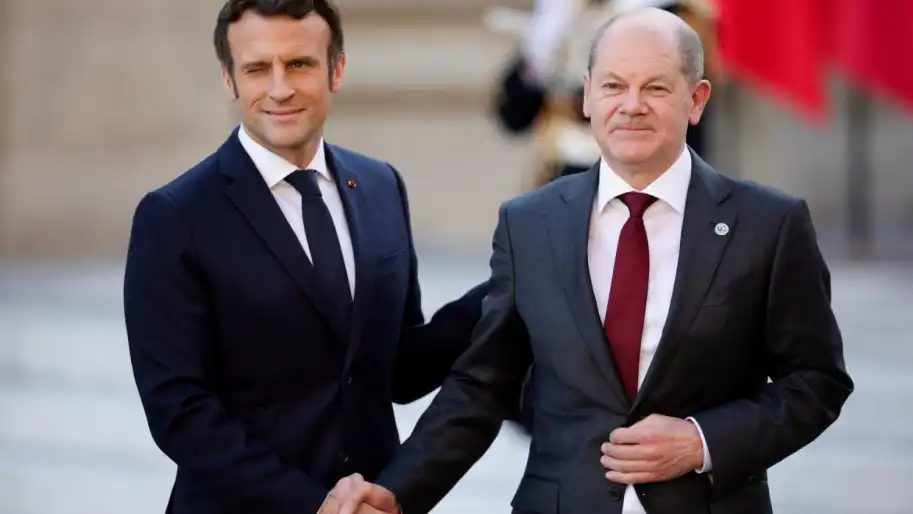

On Friday, March 15, French President Emmanuel Macron will travel to Berlin to meet with German Chancellor Olaf Scholz in an attempt to ease tensions over Ukraine. They will be joined by Polish Prime Minister Donald Tusk.
Senior German and French officials have told this to Politico.
According to a German official, Tusk will join the French and German leaders later in the day, marking the first meeting of the Weimar Triangle -- a dialogue format between the three countries -- since Tusk became Poland's prime minister again in December.
It is said that they intend to demonstrate unity after a tense period when Franco-German friction over Ukraine turned into open hostility.
The publication notes that long-simmering tensions began to boil at the end of February when Macron refused to rule out sending Western troops to fight in Ukraine, promising to do "everything possible so that russia cannot win this war." At the same time, Scholz, in turn, ruled out the use of ground forces by European countries.
A few days later, Macron appeared to respond directly to Scholz, and Politico notes: "Europe is clearly facing a moment when it will have to stop being cowards." German Defense Minister Boris Pistorius responded that Macron's comments were "something that doesn't really help solve the problems we have when it comes to helping Ukraine."
Meanwhile, close aides of Chancellor Scholz note that they do not get along with Macron. In Berlin, Macron is perceived as a monarchist figure who is better at voicing grandiose visions than implementing them.
Macron is due to arrive at the chancellery in Berlin around noon on Friday for bilateral talks with Scholz. The meeting between Macron and Scholz will be followed by a tripartite discussion with Tusk.
Officials in Tusk's government are said to have expressed sympathy for Macron's tougher rhetoric. Polish Foreign Minister Radoslaw Sikorski recently said the presence of NATO troops in Ukraine "is not unthinkable."
A senior German official said no concrete decisions or announcements were expected from Friday's talks, which were intended to send a new signal of unity.
As the Ukrainian News agency earlier reported, Polish Prime Minister Donald Tusk called for a serious approach to russian dictator vladimir putin's statements about increasing russia's self-sufficiency and putting the country's economy on military lines.
Meanwhile, Politico noted that France is creating an alliance of states potentially ready to send their troops to Ukraine. First of all, we are talking about the Baltic countries.
Who we are: About us, Contacts. How we write news and our principles: Editorial code. We did our best. If you found this valuable – please support us.
To request a correction, please send an email.