
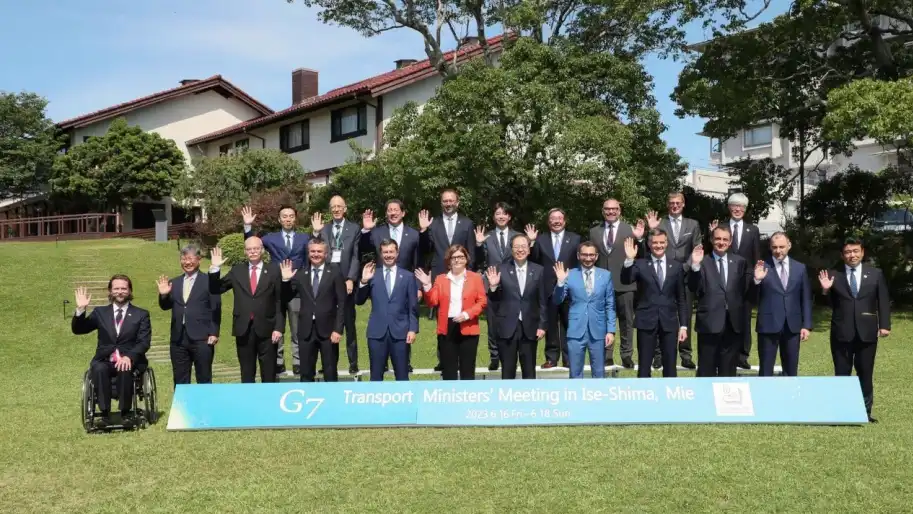

The Ministers of Transport of the G7 States (U.S., Canada, UK, France, Germany, Italy and Japan), following the meeting in Japan, adopted a joint Declaration, which condemned Russia's destruction of global supply chains, and also confirmed its intention to contribute to the restoration of the destroyed infrastructure of Ukraine. Deputy Prime Minister and Minister of Reconstruction of Ukraine Oleksandr Kubrakov wrote about this on his Facebook page.
In particular, according to him, the parties condemned attempts to undermine the navigation of civilian ships in the Black Sea and damage to the Ukrainian transport infrastructure.
"To mitigate the consequences of these actions, the G7, in cooperation with the Donor Coordination Platform, will support the restoration of Ukraine's transport infrastructure and will contribute to the development of alternative logistics routes for the export of Ukrainian products," Kubrakov wrote.
"Disrupted supply chains, obstruction of navigation in the Black Sea, artificial blocking of Ukrainian agro-export provoke aggravation of humanitarian problems in the world and cause an increase in food prices. Our global task is to resist Russian aggression and support the development of world logistics. We have a common understanding with the G7 states that support for the restoration and development of Ukraine's transport infrastructure is fundamental here. Without working transport routes in Ukraine, the global logistics architecture will be at risk," Kubrakov said during the speech.
Also, the G7 Ministers of Transport agreed to intensify international efforts to develop the EU program Ways of Solidarity. It provides financial support for projects for the development of alternative logistics routes for the export of Ukrainian food. It concerns the development of the Danube port cluster, border infrastructure on the border with the EU and Moldova, the report says.
In addition, the G7 Ministers of Transport stressed the importance of stable work of the Grain Initiative and the development of sustainable transport links between Europe and Asia, bypassing Russia. In particular, special attention will be paid to the development of the Middle Corridor and the Central Trans-Caspian Network.
Kubrakov at a meeting with the G7 Ministers of Transport said what Ukraine managed to do to restore logistics after the start of the Russian invasion. "First of all, we managed to turn the Danube port cluster into a powerful logistics hub in a short period of time. In addition, we already have a "transport visa-free regime" with the European Union, we are developing road and railway border infrastructure on our western borders," said the Deputy Prime Minister.
"If by February 24, 2022, almost 60% of all trade passed through seaports, now most export imports are transported by rail and trucks across our western border. This was also a challenge for neighboring countries. Blocking agro-export by land against the background of an unstable grain corridor could turn into a food disaster for the world.
We are already seeing many people in Africa and Asia facing hunger precisely because of the Russian sabotage of the Grain Initiative. The world has lost at least 20 million tons of agricultural products for the entire existence of the agreement," the Deputy Prime Minister added.
Recall that on June 16-18 in Japan, with the participation of Deputy Prime Minister for the Restoration of Ukraine Oleksandr Kubrakov, a summit of the Ministers of Transport of the G7 States took place. It discussed, in particular, the challenges posed by Russia before the world logistics, and ways to respond to them.
Who we are: About us, Contacts. How we write news and our principles: Editorial code. We did our best. If you found this valuable – please support us.
To request a correction, please send an email.