
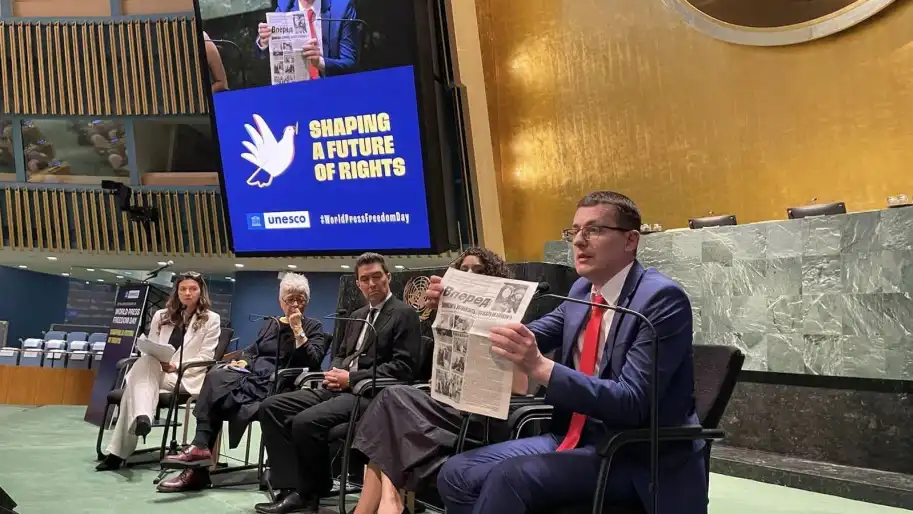

As part of events on the occasion of World Press Freedom Day held in New York, the President of the National Union of Journalists of Ukraine (NUJU), Sergiy Tomilenko, addressed the world community to demand that Russia release UNIAN journalist Dmytro Khyliuk, all illegally convicted Crimean Tatar journalists, and Vladyslav Yesypenko and Iryna Danylovych convicted in Crimea.
The NUJU President announced this in a corresponding statement posted on his official page on Facebook.
"These days, using the example of Evan Gershkovich, we can see that totalitarian Russia is ready to apply its tried and tested repressive practices to every independent journalist! It was extremely honorable for me to call on the world to support Ukraine and Ukrainian journalists from the UN General Assembly's rostrum, inform about the investigation into Russian war crimes, and emphasize the need to boycott and prosecute Russian propagandists. On the occasion of World Press Freedom Day, I am in New York at the invitation of UNESCO headquarters. Here are the key points of my speech, which was about the role of journalists and the media in protecting human rights during this unjust war, in which Russia kills civilians every day," wrote Tomilenko.
Before traveling to New York to participate in official events, the NUJU President asked colleagues, well-known investigators, and editors of small local front-line newspapers, human rights activists, such as Nobel Peace Prize laureate Oleksandra Matviichuk, to give him advice on what to announce in New York. Tomilenko informed his international colleagues about the aspects that Ukrainian media people and society as a whole are most concerned about.
"Children. The first thing I would like to talk about is kidnapping. Forced deportation of children from temporarily occupied territories from the Kherson Region, Mariupol, and Kharkiv Region, intimidation of children and attempts to "re-educate" them in special camps, forging documents, for example, permission from parents to take children for an alleged vacation. Journalists reconstruct these war crimes in detail, often becoming the only hope for parents to return their children to their families. This was told to me in detail by my colleague Tetiana Popova, who conducts interviews with children who managed to be rescued from captivity. The verified investigations of the forced deportation of Ukrainian children contributed to the International Criminal Court issuing an arrest warrant for Putin and his henchmen.
During the war rights of thousands and thousands of people are violated on a large scale. So journalists and the media increase the chances of each victim for their story being heard.
Documenting war crimes by journalists helps establish the truth and brings the guilty to justice. For instance, today, local media Obrii Iziumshchyny is the source of information for police and prosecutor investigations into the crimes of local collaborators during the Russian occupation of the city of Izium. Since journalists and the media document war crimes, the Russian army considers Ukrainian journalists (as well as international ones) as its targets.
There are numerous testimonies about targeted attacks on cars marked with the inscription PRESS, deliberate killings of journalists who worked on the front line, attacks on publishing houses, arrests, kidnappings, torture, depriving media workers of the opportunity to conduct independent professional activities in the temporarily occupied territories. The case of Svitlana Zalizetska, a journalist from occupied Melitopol, is illustrative. She managed to leave the city disguised as an ambulance nurse. But the occupiers captured her elderly 75-years father, demanding Svitlana return to cooperate with them.
Since the beginning of the big war, the occupiers have killed at least 57 media workers, including professional journalists, civilian victims, and Heroes in the ranks of the Armed Forces... The latest victim is Bohdan Bitik, a Ukrainian fixer for the Italian edition of La Repubblica, who was killed by the Russians last week in Kherson.
At least one Ukrainian journalist, who was kidnapped last March, is still being held in Russia. This is Dmytro Khyliuk, a journalist for the national news agency UNIAN from Kyiv. We demand that Russia release him and all illegally convicted Crimean Tatar journalists, as well as Vladyslav Yesypenko and Iryna Danylovych, convicted in Crimea!"
Sergiy Tomilenko said he wants to thank international partners - primarily the International and European Federations, the UNESCO headquarters - for supporting the NUJU's network of Journalists' Solidarity Centers that assist hundreds of journalists at a critical time. In particular, it provides media workers with bulletproof vests and helps with equipment.
"I also want to draw attention to one of the major priorities of the NUJU: the support for local newspapers in the de-occupied and front-line territories. The Russians are destroying other infrastructure and shooting peaceful cities. Ukrainians there cannot consume television or radio news, or online media. And the traditional press is the only source of important local information. The NUJU was able to provide support to 25 local front-line newspapers. A unique example is the Vpered newspaper, which is still delivered to Bakhmut by volunteers and soldiers these days. It contains information that actually saves lives..."
"We have to talk about the role of brave journalists during the war and added that we must also talk about the responsibility of propagandists for inciting war. Journalists must boycott propagandists and not allow them to use their journalistic status! A tribunal should punish propagandists," the NUJU President summarized.
"Our duty is to protect journalists and our profession. Journalists are important!" Tomilenko emphasized.
Who we are: About us, Contacts. How we write news and our principles: Editorial code. We did our best. If you found this valuable – please support us.
To request a correction, please send an email.