

After the invasion of Ukraine, Russia and some of its accomplices were repeatedly accused of stealing grain and agricultural land. Now Ukrainian officials say that Russia is also stealing the forest.
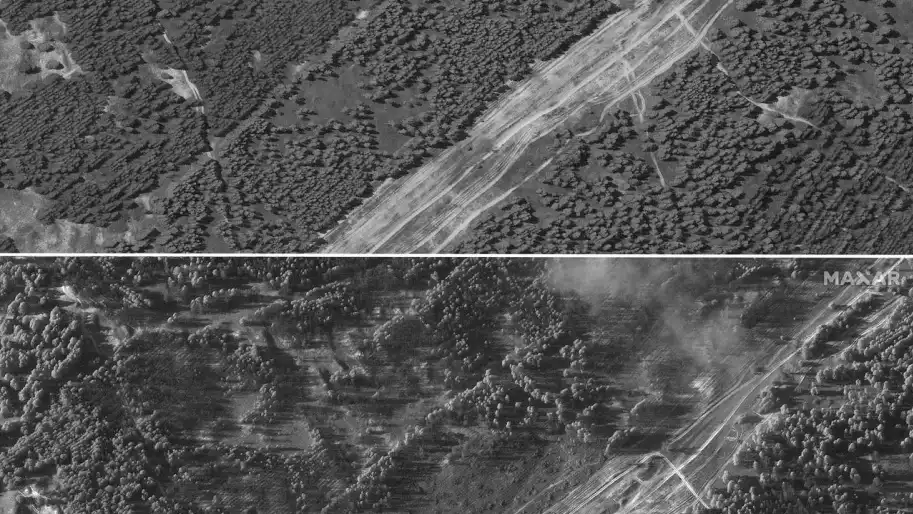
According to Ukrainian state institutions and forestry experts, hectares of forest were cut down for commercial gain or to strengthen defense positions without compensation. Satellite images show swaths of former forests left treeless after the invasion.
The alleged expropriation is yet another sign that the war has caused widespread damage to Ukraine's natural resources and provided some Russians and their affiliates an opportunity to make money.
The State Bureau of Investigation of Ukraine (SBI) announced that it is investigating the expropriation of a forest by Russian troops and local Ukrainian "collaborators" in the northern district of Kharkiv. The State Forestry Agency of Ukraine additionally reports that the Russians and those cooperating with them, including the new Kremlin-appointed local authorities in the east of the country, are carrying out arbitrary logging in various parts of the country.
Deforestation in places where the Russians exported wood was massive, says Denys Mankovskyi, the head of the SBI department, who visited some of the deforested areas.
According to Ukrainian military intelligence, in March 2022, a few days after the Russian invasion, Russian Defense Minister Sergey Shoigu wrote a letter to President Vladimir Putin requesting permission to harvest timber during the military operation.
Wood not used for defense will be sold to finance the military operation, the letter said.
"The total cutting down of green areas is another terrible crime of the occupiers," the Ministry of Defense of Ukraine said in a statement accompanying the letter's publication.
The Russian government did not respond to a request for comment.
The State Forestry Agency of Ukraine announced that it had discovered examples of illegal logging in the Kyiv Region, the northern regions of Sumy, and the Kharkiv Regions Russia occupied at the beginning of the war. Among the trees cut down are oak, pine, hornbeam, and ash. Such wood has a variety of uses, including construction and furniture making.
The State Forestry Agency said it is difficult to determine the full extent of illegal logging in liberated parts of the country, as some forests are littered with landmines and unexploded ordnance. The official letter of the State Forestry Agency also states that forests were damaged due to hostilities, including fires and forestry equipment was destroyed, damaged, or stolen. The condition of some forests is likely to limit the amount of timber harvested from them.
The SBI of Ukraine has arrested and charged with treason several former forestry officials who they suspect helped conduct logging for Russia in the Kharkiv Region.
In one case, a Russian military commander appointed a new director of a local state-owned forestry enterprise and ordered them to organize a regular supply of wood, the SBI reported.
The suspect was apprehended after he fled, the SBI said.
The FBI, which investigates corruption and war crimes, said it was primarily focused on the defendants' role in supplying timber to Russian defense positions. Illegal logging in the de-occupied territories of Ukraine was also investigated.
In southern Ukraine, along the east bank of the Dnieper River near the city of Kherson, in September, Russian troops began showing up in open trucks in forest plantations, says a former forestry official who worked in the area before fleeing during the occupation.
While Russian soldiers told local residents that the wood was cut for firewood to keep Ukrainians warm, it was instead sold locally or shipped to Russia, the former official said. Officials say the Russian military initially used local forestry officials to manage the process before bringing in people from Crimea and Russia.
Satellite images of the areas pointed to by the former forestry official, provided by Maxar Technologies, show large-scale logging that has taken place since the Russian invasion.
Andrew Guild, a British forestry consultant, said the photos indicated that loggers targeted specific areas of possibly more valuable timber species in managed forests, including oak and pine, rather than simply destroying the entire timber area.
In some eastern regions of Ukraine controlled by Russia, the new local government has recruited former state forestry companies and is openly selling timber on social media such as Telegram, said Brian Milakovsky, a researcher who has studied the impact of the war on Ukraine's forestry and economy.
Russia itself is one of the world's largest exporters of wood. According to the World Bank, China is typically its top customer, while Europe and the U.S. are big buyers. Now the West has imposed sanctions on Russian timber.
Authors: Alister McDonald and Serhiy Bosak
Translation: Serhiy Bosak
Who we are: About us, Contacts. How we write news and our principles: Editorial code. We did our best. If you found this valuable – please support us.
To request a correction, please send an email.