
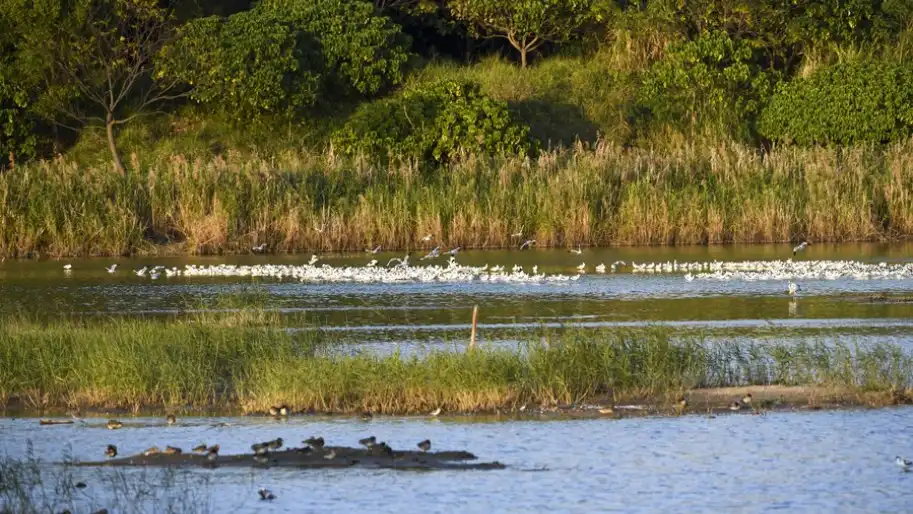

Chinese scientists have found that if the global temperature rises by 1.5°C to 2°C, the function of wetlands, as greenhouse-gas sinks, will reduce by more than half. This was reported by The Xinhua News Agency.
Wetlands have a high potential for mitigating climate change because of their large carbon stocks. However, whether and where wetlands will act as a greenhouse-gas sink or source under warming is uncertain.
Researchers from the Institute of Atmospheric Physics under the Chinese Academy of Sciences integrated data from warming simulations conducted at 167 independent natural wetland sites between 1990 and 2022. They studied the response of the net exchange of three greenhouse gases to warming.
The study, published in the journal Nature Climate Change, shows that if the global temperature rises by 1.5°C to 2°C, the function of wetlands as greenhouse gas sinks will weaken by about 57%, and its role in mitigating climate change will greatly weaken.
In wetlands dominated by vascular plants such as shrubs and grasses, the warming increased the sink of carbon dioxide. In wetlands dominated by mosses, lichens, and other cryptic plants, however, the warming raised the emission of carbon dioxide.
The warming also increased the net emission of methane and nitrous oxide of the wetlands regardless of their dominant plants, according to the study.
"The Paris Agreement aims at keeping global warming below 2°C above pre-industrial levels and striving for a lower limit of 1.5°C. In this context, our study on the change of wetlands as greenhouse-gas sinks will help to better cope with global climate change", – said Xu Xiyan, one of the researchers.
Who we are: About us, Contacts. How we write news and our principles: Editorial code. We did our best. If you found this valuable – please support us.
To request a correction, please send an email.