
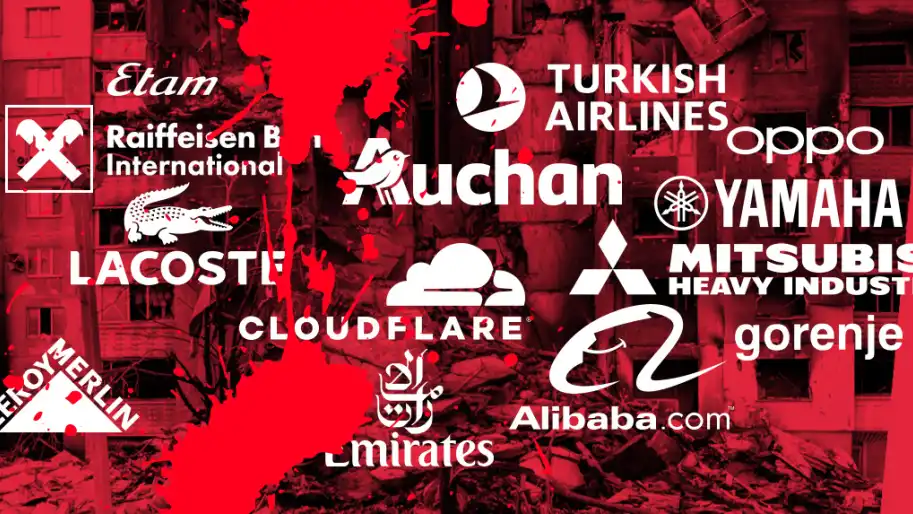

The struggle with russia has entered a decisive stage but not for everyone. Something must be done with such companies as Raiffeisen, Credit Europe, Unicredit, OTP, Auchan, Metro, Benetton, Calzedonia, Etam and Lacoste. They continue to work in the russian federation, financing the economy of the aggressor country.
Here, for example, is the Austrian Raiffeisen Bank. Back in March 2022, it announced that it was considering leaving russia. And here it is still there. The Austrians say that it is difficult for them to leave, that the authorities of the russian federation do not allow them. But the fact remains: under the same conditions, some international banks left russia, while others did not.
Moreover, the scandal surrounding the russian Raiffeisen Bank recently gained publicity. Quote: "It turned out that the russian Raiffeisen website has a section called "Restructuring", which lists programs for deferring payments on loans for ‘those who find themselves in a difficult situation’". According to the bank, one of such "difficult situations" is the participation in war against Ukraine. In addition, in its informational materials, the bank recognizes the existence of the "republics" of the "LPR" and "DNR". And the bank calls the war in Ukraine a "special operation".
The main Raiffeisen Bank received numerous appeals from Ukraine regarding the need to close business in the russian federation. In particular, the National Bank of Ukraine appealed to him. But there they simply wrote back saying that they do not support the russian aggression and "obey the legislation of the russian federation". In fact, it is manipulation. The US Treasury Department's Office of Foreign Assets Control (OFAC) believes that the Raiffeisen Bank International office plays an important role in the economy of the terrorist state.
It can be said that ignoring international sanctions is the common behavior for the Austrian companies that are connected with russia through numerous business contacts. According to the Yale School of Management, only one (!) company from this country stopped operating in the russian federation, while many remained (see screenshots).
For almost a year, the head office of Raiffeisen remained indifferent to appeals. Only an inspection initiated by the US Treasury prompted it to think about the abnormality of collaboration with the russian federation.
The behavior of the Italian UniCredit is similar. He continues to conduct business simultaneously in Ukraine and russia. He even ignored the appeals of the European Central Bank. At the level of statements, the Italians say that they have "strong intention of leaving russia in an orderly and decisive manner" but have chosen the way to simply reduce the volume of operations. Apparently, it is possible – to be loyal but not in a hurry.
The Hungarian OTP Bank, which also has a subsidiary in Ukraine, continues to conduct operations in russia. In particular, it gives credit holidays to russians who go to Ukraine to kill the Ukrainians.
From non-banking businesses, we have examples of the large retailers – the French Auchan and the German Metro. Their stores continue to operate both in Ukraine and in russia. By helping russia, they support the same war. In particular, the National Anti-Corruption Agency recently included Auchan in the list of international sponsors of terrorism.
What positive examples of the behavior of international companies do we have? According to the Yale School of Management, there are more than a thousand of them. Among them are such brands as Hilton, Miele, Knauf, Adidas, Levi's, Intel, AMD, IBM, Hyundai, BP, Cisco.
As for banks, under the same conditions, the British HSBC, the French Societe Generale and the Czech Home Credit BV stopped doing business in the aggressor state. Citibank has long hesitated but from the second quarter of 2023 it will stop providing most financial services.
Even strange things happen. In particular, the well-known PariMatch bookmaker left russia in March 2022. It was surprising to expect such a step from a representative of the gambling business, especially since it probably earned tens of millions of dollars a year in the russian federation.
For comparison, the German chemical giant Henkel AG announced a year ago that it planned to stop operations in russia. Instead, it merely spun off its russian business into a separate entity, Lab Industries; that is, renamed it. In a way, I understand: 11 plants with sales volumes of about €1 billion per year - that's an argument. But still, it's really weird. Gaming business PariMatch had courage to lost a huge amount of money but the German company with a seemingly high level of corporate responsibility did not.
The case went even further. Recently, Alexander Schallenberg, the minister of the Ministry of Foreign Affairs of Austria, justified it by the fact that not only the Austrians stayed in russia – up to 10% of international companies did so. He said that few people in the world support sanctions against the russian federation.
Indeed, according to a recent study by the Swiss University of St. Gallen, by the end of 2022, about 18% American subsidiaries, 15% Japanese firms and only 8.3% companies of the European Union left Russia. Among the Western companies, remaining to work in russia, the largest share is the German companies, it’s 19.5%. 12.4% are owned by the Americans, 7% of companies are Japanese. We will not remind you about the covert sale of components for russian weapons by the US and European companies.
Also, Moral Ratings Agency , the British analytical center, found out that some of the largest companies in the world, instead of withdrawing business from russia, announced the write-off of their assets in this country. But this does not mean that assets are lost. Simply, after the end of the war, their value will be increased back.
In order to defeat russia faster, Ukraine must defeat it economically. So, we have to put pressure on international companies that want to keep their businesses in the russian federation. At the beginning of the war, there were 2,405 companies working in russia, the owners of which are 1,404 companies from the EU and G7 countries. We have to leverage them.
In particular, it is necessary to raise the question of granting the ‘honorary’ status of a sponsor of terrorism not only to Auchan but also to the rest of the international companies operating in the russian federation. Let it even lead to the disappearance of Moment glue (manufactured by Henkel) from stores.
It would also be appropriate to raise a question about the work of Raiffeisen, Unicredit, OTP Bank and ING banks in Ukraine. And if Citibank does not leave the russian market, this question concerns it as well. Recently, the National Bank of Ukraine proposed to the Verkhovna Rada a draft law on the nationalization of banks that have come under sanctions. Perhaps, the implementation of sanctions against Raiffeisen, Unicredit, OTP Bank and ING Bank will finally force international groups to stop collaborating with russia.
Who we are: About us, Contacts. How we write news and our principles: Editorial code. We did our best. If you found this valuable – please support us.
To request a correction, please send an email.