
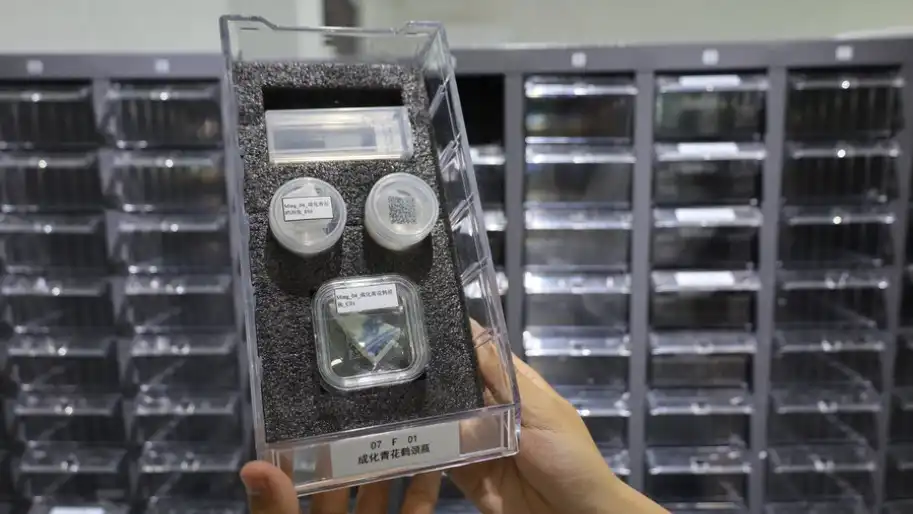

China will establish a "gene bank" of ancient ceramics in east China's Jiangxi Province, based on data from nearly 20 mln pieces of ceramics specimens accumulated in some 40 years, authorities announced. This was reported by The Xinhua News Agency.
"Over a hundred pieces of "gene" information can be traced through just a piece of ancient ceramic fragment, offering details about the body, glaze, pigment, to name a few", – said Weng Yanjun, president of the Jingdezhen Imperial Kiln Institute in the city of Jingdezhen, a world-famous "porcelain capital."

The site of the kiln relic in Jingdezhen, east China's Jiangxi Province. Photo by Xinhua.
According to Weng, it is also expected to restore the firing process and raw material formula of ancient ceramic specimens.
Researchers will use X-ray fluorescence analyzer and other modern sophisticated equipment to make "gene" specimens with both the physical and digital forms. It is scheduled to complete the first batch of nearly 10,000 ancient ceramics specimens in just a year and a half.

Combined file photo shows the restoration process of a ceramic seat from the Ming Dynasty (1368-1644) at Jingdezhen Imperial Kiln Institute in the city of Jingdezhen, east China's Jiangxi Province. Photo by Xinhua.
"After the completion of the gene bank, we'd like to share the data with academic institutions at home and abroad, to foster research projects on global ceramics civilization, and build an international platform for ceramics culture exchange", – said Weng.
The gene bank will be co-built by the Jingdezhen Imperial Kiln Institute, Peking University, Tsinghua University, the Palace Museum and the Shanghai Institute of Ceramics under the Chinese Academy of Sciences.
Who we are: About us, Contacts. How we write news and our principles: Editorial code. We did our best. If you found this valuable – please support us.
To request a correction, please send an email.