
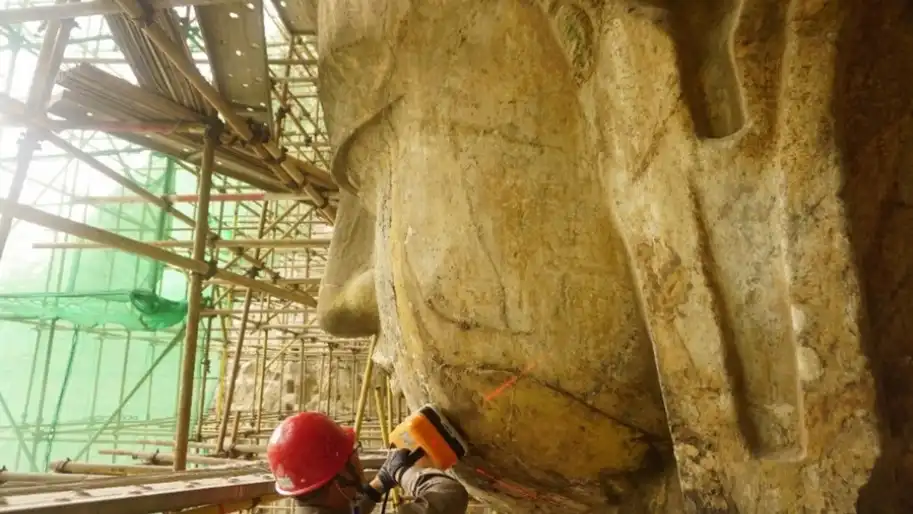

Archaeologists have found gold and silver elements and colored glass on Buddhist statues at the Longmen Grottoes, a UNESCO World Heritage site, in central China's Henan Province. This was reported by The Xinhua News Agency.
The findings, among other scientific and archaeological achievements, have been made since a reinforcement and protection project of the Fengxiansi Cave of Longmen Grottoes was launched in December 2021, said the Longmen Grottoes research institute.
Based on advanced technologies, archaeologists found gold and silver elements on the face of Vairocana Buddha, a giant statue that was built in the Tang Dynasty (618-907).
"It suggests that skills such as gilding had probably been used in the construction of the Vairocana Buddha", – said Shi Jiazhen, president of the institute.
On the body surface of the giant Buddha, archaeologists also found the remains of green, red, black and other colored pigments, indicating that the statue was probably "wearing colorful clothes" at that time.

The right eye of a Bodhisattva statue at the Fengxiansi Cave of Longmen Grottoes in central China's Henan Province. Photo by Xinhua.
Moreover, colored glass eyeballs made of silica and lead were discovered on a Bodhisattva statue to the right side of the Vairocana Buddha. The eyeballs are arc-shaped and about 0.5 centimeters in thickness.
"The glass showed dark green after cleaning, which was rare during the Tang Dynasty", – said Ma Chaolong, an official of the institute.
"The new findings are of great significance to the study of decoration characteristics, workmanship and preservation of statues in Fengxiansi Cave", – Shi added.
Who we are: About us, Contacts. How we write news and our principles: Editorial code. We did our best. If you found this valuable – please support us.
To request a correction, please send an email.