
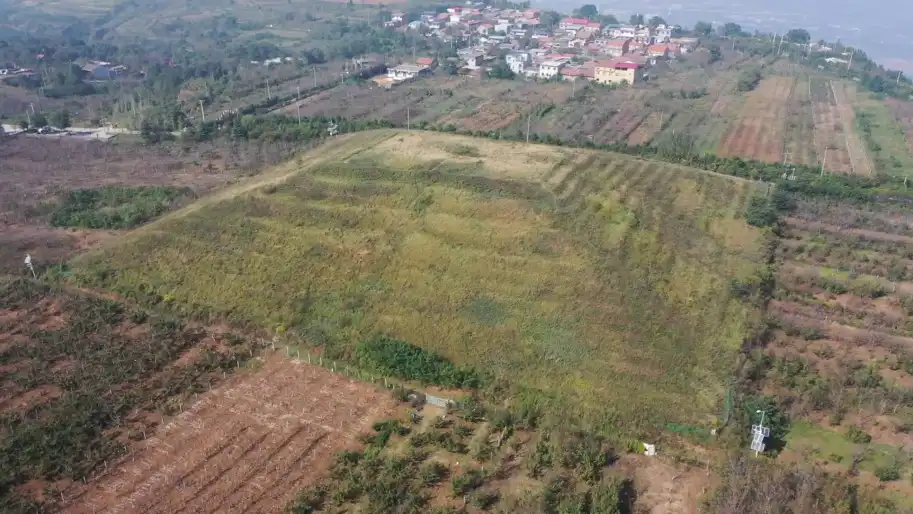

A large-scale mausoleum in Xi'an, capital of northwest China's Shaanxi Province, has been identified as belonging to Emperor Wendi of the Western Han Dynasty (202 BC-AD 25). This was reported by The Xinhua News Agency.
According to the local authorities, the mausoleum, located in Jiangcun Village on the eastern outskirts of Xi'an, is surrounded by more than 100 ancient tombs and outer burial pits.

Mausoleum of Han Dynasty. Photo by Xinhua.
The mausoleum has no grave mound but has four ramps leading to the entrance of the burial chamber placed 2 to 4.5 meters underground. The chamber, with its base 27 to 30 meters below the ground, is 74.5 meters long and 71.5 meters wide.
Excavation has been carried out in the area since 2017, with numerous relics unearthed including dressed pottery figurines, crossbows, and official seals.

Mausoleum of Han Dynasty. Photo by Xinhua.
The discovery of the mausoleum puts an end to a long-running rumor, which had it that Emperor Wendi's tomb is situated in a nearby location called Fenghuangzui, just north of Jiangcun Village.
The rumor emerged due to the discovery of an ancient stone tablet with inscriptions in Fenghuangzui.

Mausoleum of Han Dynasty. Photo by Xinhua.
However, archaeologists did not find any signs of construction in Fenghuangzui during their investigation and concluded that the area is nothing more than a naturally formed loess ridge.

Mausoleum of Han Dynasty. Photo by Xinhua.
Emperor Wendi, with the personal name Liu Heng, was famous for his frugality and benevolence. Under his more than 20 years of rule, the dynasty's economy prospered while the population saw an expansion.
Produced by Xinhua Global Service.
Who we are: About us, Contacts. How we write news and our principles: Editorial code. We did our best. If you found this valuable – please support us.
To request a correction, please send an email.