
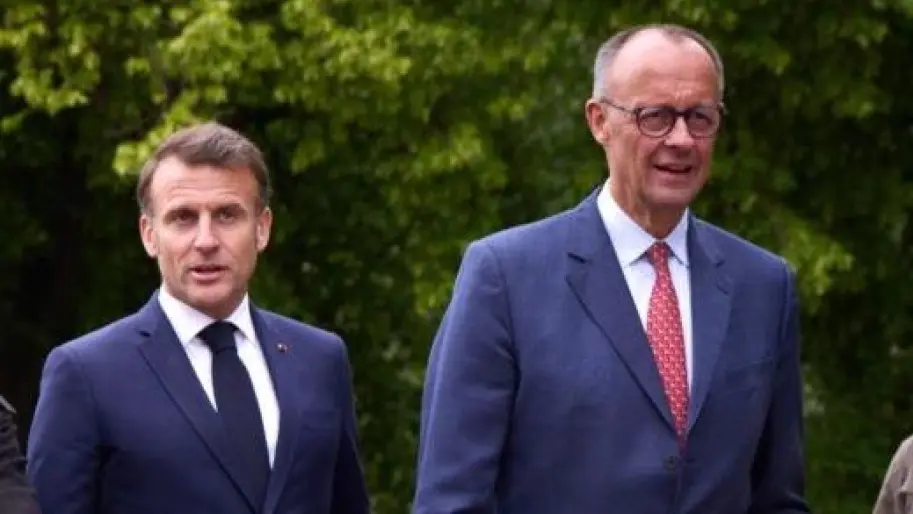

French President Emmanuel Macron and German Chancellor Friedrich Merz have opposed the EU's decision to engage in dialogue with russian dictator vladimir putin amid the war in Ukraine, which has led to a standoff between the leaders of Europe's two largest countries and much of the rest of the bloc, Politico reported, citing sources.
Five diplomats and EU officials familiar with the closed-door talks said the French President and German chancellor were dismissive of efforts by European Council President António Costa to reach out to the Kremlin at a night summit in Brussels, according to the three officials. Other leaders have sided with Costa, the publication said.
The row highlights a latent tension at the heart of the EU over how to approach russia and who should speak for Europe.
Leaders from some of the most staunchly anti-russia countries, as well as Denmark and the Netherlands, have backed Macron and Merz, with some showing unprecedented fury at Costa, the three officials said.
"The European Union cannot assume the role of mediator in these negotiations. The assumption that alternative channels or non-public diplomatic paths are needed is false… History provides a clear warning against trying to establish alternative negotiation mechanisms with dictators," Estonian Prime Minister Kristen Michal told the publication.
The EU has been debating for months whether it should even engage with putin, and if so, who should lead them. The issue has gained urgency after US President Donald Trump struck a preliminary peace deal with Iran and signaled at the G7 summit in France earlier this week that his attention was turning back to Ukraine.
Costa's chief of staff, Pedro Lourdes, has contacted officials in Moscow twice in the past few weeks, according to five officials. As the US-led effort to end russia's war against Ukraine appears to have reached a dead end, European capitals are divided over how much diplomacy should be prioritized over helping Ukraine achieve victory on the battlefield.
"The first question is whether putin wants to negotiate. Until then… no one but Costa can represent the European Union. If he [putin] shows a willingness to negotiate, then in my opinion we will have to decide again how we proceed," Belgian Prime Minister Bart De Wever told the publication, following the talks.
The summit on the evening of June 18 highlighted several fault lines: in addition to the differences between Costa and the E3 (Britain, France, Germany), Italy and Poland (which form the informal "E5") were unhappy that they were not included in the previous talks between the E3 and Ukrainian President Volodymyr Zelenskyy on the eve of the summit, two officials said.
Other EU officials questioned why the European Council should take on the role of the bloc's representative, rather than the European Commission or the EU's foreign policy arm.
According to a diplomat from a leading European country who was aware of the discussions, Merz conveyed to his fellow leaders that while Costa represented the EU, he should not act as a mediator. While Merz sought to avoid open conflict with Costa at the negotiating table, he made his position clear "in other ways," the diplomat said.
However, Costa, the diplomat said, had acted "extremely unprofessionally" by concealing the extent of his contacts with russia, which only became known through media reports on Wednesday.
According to a European diplomat who is involved in the matter, some countries were "furious" about the attempts to establish contacts with russia. Three other diplomats said several leaders only learned about the calls after they were reported in the media and were outraged.
Costa's team said the contacts "were only intended to establish a channel of communication so that, when the time comes, there will be a diplomatic channel with russia to protect the interests of the EU," adding that they were "brief" and devoid of substance.
One diplomat noted that Costa's office had indeed informed Germany, France, the United Kingdom and the European Commission before the calls took place. However, three other diplomats said Berlin had not been warned.
As Ukrainian News Agency earlier reported, Macron said that after Trump came to power, he believed that Ukraine would lose a war with russia, which is why he insisted on making peace as soon as possible. However, over time, he became convinced that the predictions of his entourage were false.
Who we are: About us, Contacts. How we write news and our principles: Editorial code. We did our best. If you found this valuable – please support us.
To request a correction, please send an email.