
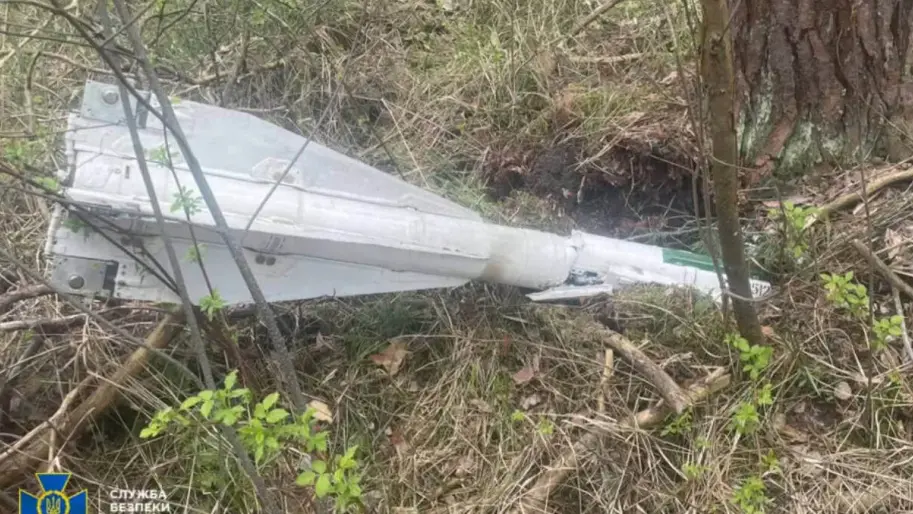

Yurii Ihnat, the head of the communications department of the Ukrainian Air Force, commented on the information about the increased radiation background on the fragments of russian R-60 missiles, which the occupiers use together with drones to attack Ukraine. According to him, these are old Soviet missiles with depleted uranium in the warhead.
Ihnat stated this on the air of Novyny.LIVE.
The Air Force spokesman urged Ukrainians not to panic over reports of radioactive components in these munitions.
"This is an alloy, inactive uranium there... This is a standard alloy used in this old Soviet missile," Ihnat explained.
The day before, the Security Service of Ukraine (SSU) reported the detection of an increased radiation background on the wreckage of the R-60 missile near the village of Kamka in the Chernihiv Region. According to the investigation, the invaders used the missile together with a modified Geran-2 drone, which is an analogue of the Shahed-136.
The SSU stated that during radiation reconnaissance near the wreckage, an excess of gamma radiation was recorded - about 12 μSv/h, which poses a danger to human health.
According to the special service, the warhead of the missile contained striking elements from depleted uranium, identified as Uranium-235 and Uranium-238.
"The SSU, together with units of the State Emergency Service and the Defense Forces of Ukraine, brought the warhead of the missile to a safe condition and transported it to the radioactive waste storage site," the special service reported.
The SSU also urged Ukrainians not to approach the wreckage of drones, missiles, and other ammunition, especially if they are damaged or burned, due to the possible release of dangerous radioactive dust.
Who we are: About us, Contacts. How we write news and our principles: Editorial code. We did our best. If you found this valuable – please support us.
To request a correction, please send an email.