
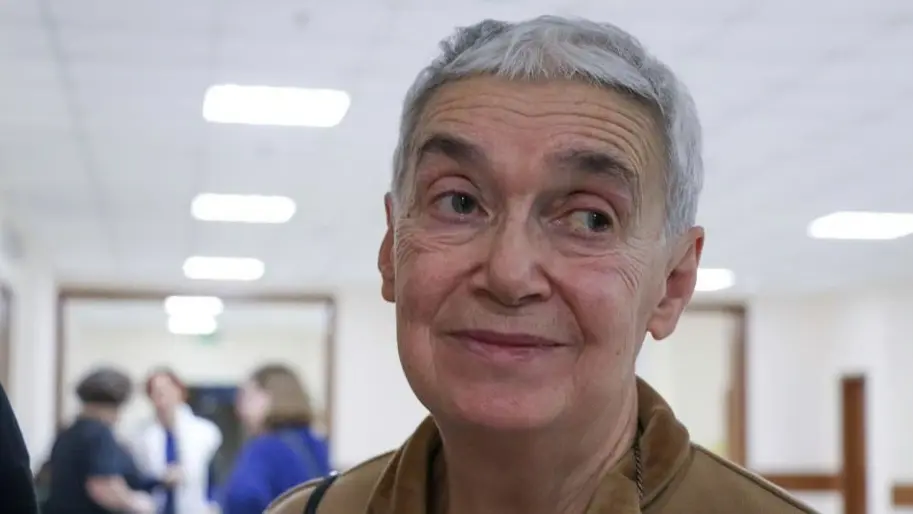

Human rights activist and dissident Nina Litvinova took her own life due to the war in Ukraine and her inability to help political prisoners in russia. This is evident from her suicide note, an excerpt of which was published by the activist’s cousin, journalist Masha Slonim.
"I have to go; life has become unbearable for me. Ever since Putin attacked Ukraine and has been killing innocent people, and here he has been endlessly imprisoning thousands of people who are suffering and dying there simply because, like me, they are against the war and against the killings. <...>
I tried to help them, but my strength has run out, and I suffer day and night from my powerlessness. I am ashamed, but I have given up. Please forgive me," Litvinova wrote.
It was reported by the publication "Novaya Gazeta Europe."
Slonim noted that her cousin’s suicide was reported by the russian state propaganda outlets RIA Novosti and Gazeta.ru. They also mentioned that the human rights activist left a suicide note, but did not publish its contents.
"Of course, no one is going to publish the note. It lays out the reasons for her departure all too clearly, and we decided to reveal the real reasons: Putin killed her!" Slonim wrote.
Who was Nina Litvinova?
The human rights activist was the granddaughter of Maxim Litvinov, the Soviet Union’s People’s Commissar for Foreign Affairs, and the sister of Pavel Litvinov, a participant in the August 25, 1968, demonstration on Red Square against the Soviet invasion of Czechoslovakia.
For over forty years, Nina Litvinova worked at the Institute of Oceanology of the russian Academy of Sciences, where she studied the biology of ophiuroids—a class of bottom-dwelling echinoderms—published a number of scientific papers, and described several new species of these animals.
Since the 1960s, the human rights activist has helped political prisoners, Memorial noted in its obituary. During the Soviet era, she read and distributed self-published works, attended trials, traveled to visit her brother and other dissidents in exile, and delivered letters, books, and care packages.
For the past eight years, Litvinova traveled to Petrozavodsk for the trials of historian Yuri Dmitriev, attended hearings in the cases of “Memorial” co-chair Oleg Orlov and director Yevgenia Berkovich, and also helped many little-known political prisoners.
“It was precisely this quiet and almost imperceptible support for the persecuted that was her consciously chosen strategy. For Nina Litvinova, refusing to participate in official lies and providing daily assistance to political prisoners were natural acts that did not require glorification,” Memorial noted in its obituary.
Who we are: About us, Contacts. How we write news and our principles: Editorial code. We did our best. If you found this valuable – please support us.
To request a correction, please send an email.