
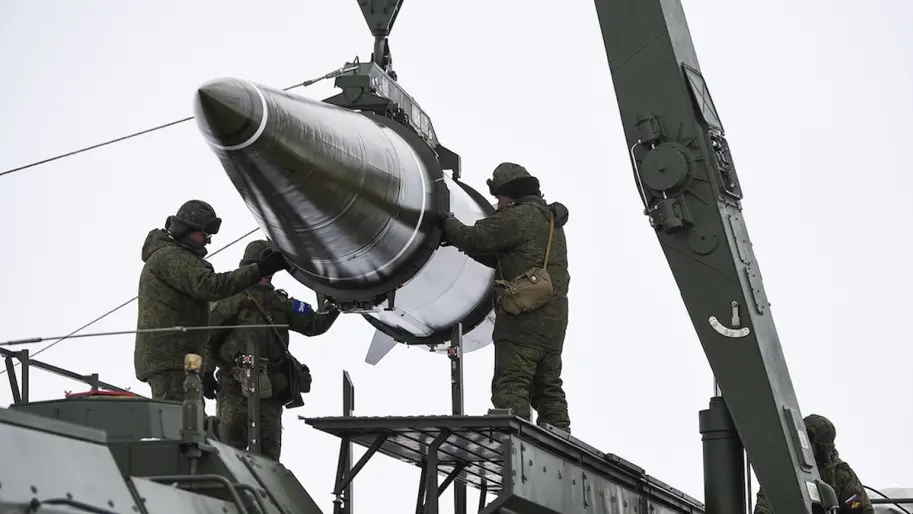

Ukraine’s strikes on facilities belonging to the military-industrial complex of the aggressor state, russia, have disrupted the production of Iskander-M ballistic missiles. This is reported in an article by Militarnyi.
Procurement documents obtained by the portal indicate that the manufacturer of Iskander-M ballistic missiles and Kinzhal aeroballistic missiles — the Machine-Building Design Bureau — has received an order to produce 1,202 missiles in 2024–2025. The company was to manufacture 589 Iskander-M missiles in 2024 and 643 missiles in 2025.
According to the Ukrainian Air Forces, the russians used 302 ballistic missiles in 2024 and 511 missiles in 2025. These include Iskander-M, S-300/S-400, and North Korean KN-23/24 missiles. From January to April of this year, 291 missiles were used.
"Given that KN-series missiles accounted for approximately one-third of all launches in 2024, the number of missiles used is significantly lower than the order volume for Iskander-M missiles alone during 2024–2025," the report states.
According to information from the Defense Intelligence, from July 2025 to mid-April 2026, the level of Iskander-M missile stocks in the russian federation stood at 200–250 units. This rules out the hypothesis that a significant portion of production was diverted to reserves.
At the same time, an analysis of debris from russian missiles showed that a significant portion of them was manufactured shortly before the strike was launched. This may indicate that the Russians are unable to meet their production targets. The reason for this is likely the consequences of Ukrainian strikes and the impact of sanctions.
The portal compared the timelines of ballistic missile launches with known Ukrainian strikes on facilities that are part of the ballistic missile supply chain. They showed that even sustained strikes did not lead to a sharp decrease in the frequency of missile launches.
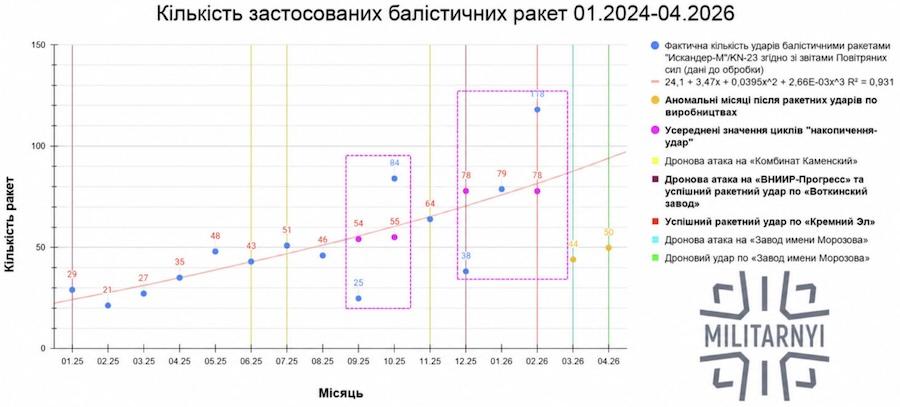 Photo: Military.
"However, it cannot be claimed that the UAV attacks caused no damage, since the graph of ballistic missile use already reflects the situation under constant pressure. Without them, production rates could be even higher," writes Militarnyi.
As the Ukrainian News agency earlier reported, on May 6, the publication NV, citing the Defense Intelligence, reported on russia’s missile stockpiles.
As a reminder, on March 11, the Ukrainian military used Storm Shadow missiles to strike the Kremniy-El plant in the Bryansk Oblast of the russian federation. It manufactures electronic components used in the production of Iskander-M missiles.
And on February 20, Ukrainian FP-5 Flamingo cruise missiles struck the Votkinsk Plant in the Udmurt Republic of the russian ederation. This facility manufactures Iskander-M and Topol-M missiles.
Who we are: About us, Contacts. How we write news and our principles: Editorial code. We did our best. If you found this valuable – please support us.
To request a correction, please send an email.