
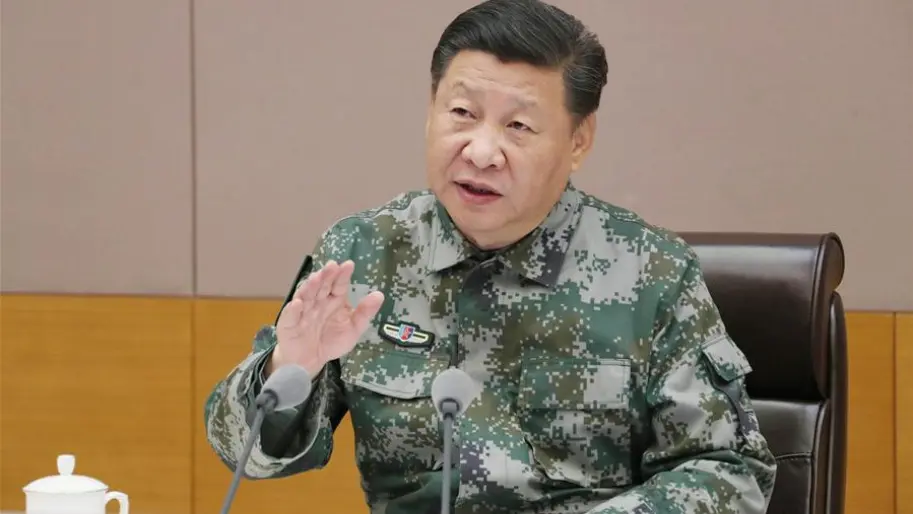

Chinese leader Xi Jinping, who has spent more than a decade rebuilding the People's Liberation Army of China into a global military power, has launched a major purge of his own military leadership. Amid a rivalry with the United States and rising international tensions, Beijing is facing one of the deepest political crises in the military under Xi.
During a recent session of China's parliament, state television showed only a handful of generals in the room, down from dozens of high-ranking military officials a year earlier.
Speaking to officers, Xi Jinping publicly warned of the dangers of disloyalty in the ranks of the army.
"There should never be anyone in the military who has a split heart towards the party," the Chinese leader said.
Analysts believe that Xi has effectively lost trust in the generals he promoted and tasked with modernizing the Chinese military.
"When Xi uses the words 'split heart,' they have a lot of meaning," explained Chien-Wen Kou, a professor at National Chengchi University in Taiwan.
According to him, the phrase comes from ancient Chinese treatises that warned rulers against betrayal by generals:
"Even his most trusted and important confidants have fallen. Who else can win his trust?"
During his 13 years in power, Xi Jinping has transformed the Chinese military into one of the most powerful in the world. China has actively developed aircraft carriers, hypersonic missiles, and a nuclear arsenal.
However, at the same time, suspicions of corruption, nepotism, and possible centers of influence within the military have increased. What began as an anti-corruption campaign has escalated into a sweeping purge of dozens of high-ranking officers.
The culmination was the downfall of General Zhang Youxia, one of Xi's closest aides and the commander-in-chief of the Chinese military. Analysts say the conflict between the two arose after Xi tried to promote General Zhang Shengmin, the head of military investigations, to a position that would have put him on a par with Zhang Youxia.
Zhang Shengmin opposed the move and was fired a few months later. Last week, a Chinese military court sentenced two former defense ministers to death, with a two-year suspended sentence, for bribery. Analysts see it as a demonstration of how far Xi Jinping's campaign has gone.
"This is Xi Jinping's army. Why is he tearing down what he built?" said Daniel Mattingly, an associate professor at Yale University.
"Something has changed profoundly," he added.
According to experts, the Chinese leader is increasingly concerned not only with corruption, but also with the possibility of losing control over the security forces.
Xi has repeatedly cited the collapse of the USSR and the fall of regimes in the Middle East, where the army refused to support power during crises. That is why the Chinese leader is strengthening political control and ideological training in the military.
"Absolute loyalty to the party is based on the word 'absolute'," Xi has emphasized in internal speeches.
After a new wave of dismissals, Xi Jinping has launched a large-scale campaign of "ideological rectification" and "revolutionary forging" of the army.
State television footage shows officers taking notes on the Chinese leader's speeches, while General Zhang Shengmin, the chief curator of military investigations, is sitting next to him. Analysts believe that political loyalty has now become more important to Xi than combat effectiveness.
"Xi is trapped in a contradiction between 'red' and professional," said former Pentagon official Drew Thompson, referring to the conflict between ideological commitment and military competence.
Who we are: About us, Contacts. How we write news and our principles: Editorial code. We did our best. If you found this valuable – please support us.
To request a correction, please send an email.