
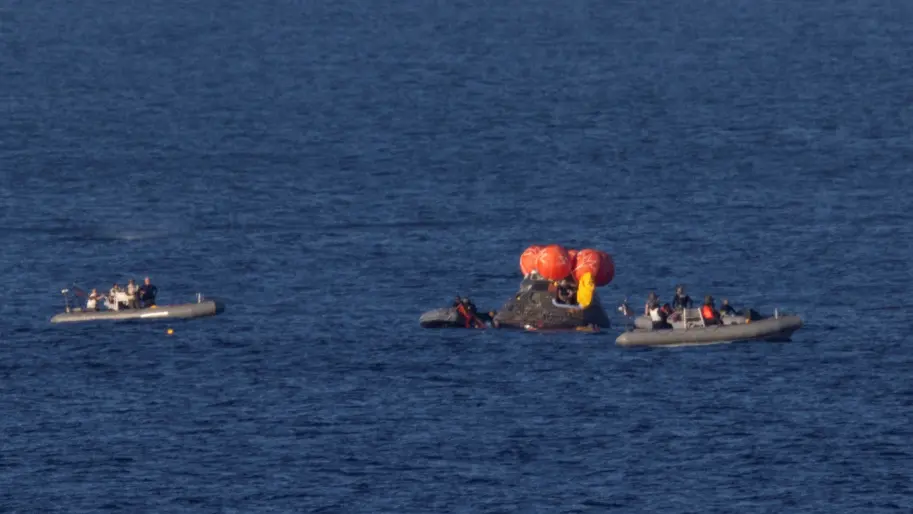

The Artemis II astronauts have safely returned to Earth, completing their nine-day mission. The crew splashed down in the Pacific Ocean at around 3 am Kyiv time. All team members are doing well.
This was reported by NASA's official Facebook page.
"We are back in business of sending astronauts to the Moon," NASA Administrator Jared Isaacman said. "This is just the beginning."
The Artemis II crew successfully re-entered the atmosphere after a planned but nerve-wracking six-minute loss of contact. On April 6, the spacecraft reached its maximum distance from Earth - 250,000 miles - during a flyby of the Moon, breaking the previous record for the farthest human spaceflight.
The Orion spacecraft returned home. The crew capsule crashed into the ocean off the coast of San Diego. Although the speed was only 32 km/h, the astronauts say the landing was like hitting a solid wall. After the impact, the capsule began to rock violently on the waves. For the crew, who had spent 10 days in zero gravity, where the body becomes unused to weight and load, these rocking motions were extremely painful.
Five airbags around the base of the capsule deployed automatically, keeping Orion upright and stable. A doctor inside the capsule confirmed that all four crew members are feeling well.
All four crew members are currently aboard the USS John P Murtha, a warship based in San Diego that has a floodable cargo bay large enough to accommodate the Orion capsule.
Each astronaut will be examined by doctors who will check their pulse, blood pressure, brain and nervous system responses, and balance.
The balance system in the inner ear gets used to weightlessness, so astronauts often feel dizzy when they return home.
The first British astronaut, Helen Sharman, who herself went through this, said that it took her about 20-30 steps before she could walk in a straight line. Even lifting a finger, she said, was surprisingly difficult.
In the coming days, the crew will return to Houston, where they are being carefully checked.
How the human body reacts to the radiation environment of deep space outside the Earth's magnetic shield is one of the key questions that the Artemis 2 mission is designed to answer.
Who we are: About us, Contacts. How we write news and our principles: Editorial code. We did our best. If you found this valuable – please support us.
To request a correction, please send an email.