
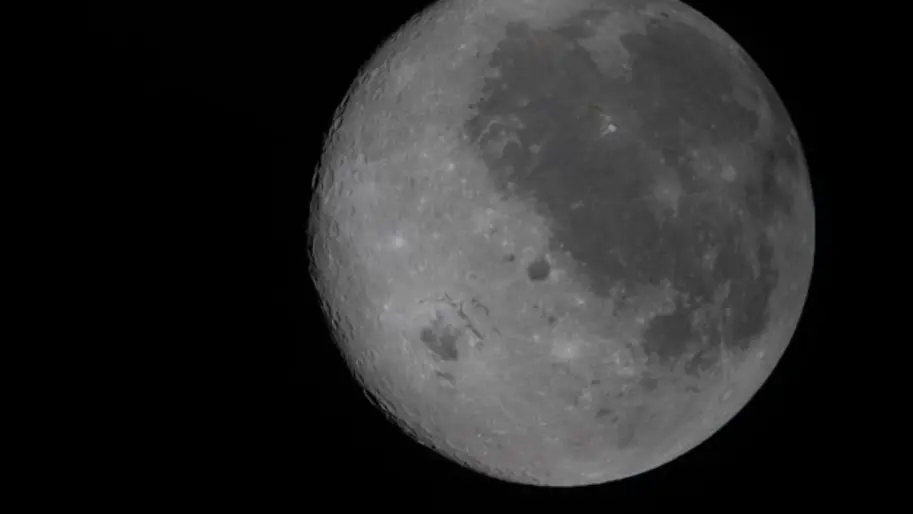

The Artemis 2 mission astronauts have released new images of the Moon, showing both the familiar visible side and a small part of the far side, including the Orientale Basin.
This was announced by NASA on April 6.
For the first time, the crew members were able to see the far side of the Moon with their own eyes and photograph it. The published photos show the visible side with dark "seas" on the right, and the part that is not visible from Earth on the left.
Make new friends, but keep the old.
— NASA (@NASA) April 6, 2026
A new photo captures the Moon's near side on the right (the side we see from Earth, identifiable by its dark splotches) and its far side on the left. The Artemis II crew are the first to see the far side with human eyes. pic.twitter.com/Z8QaZ6J9iA
According to CNN, the mission's actual flyby of the Moon will take place on the sixth day after launch from Cape Canaveral, but on the third day, the astronauts were able to capture "unprecedented views."
Among the unique objects in the photo is the Orientale Basin, a crater about 965 kilometers wide, which has previously been seen only by robotic vehicles. This zone separates the visible and far sides of the Moon.
"The Moon that we look at is not at all like the one you see from Earth," admitted astronaut Christina Koch. She added that many more similar moments are expected during the flyby.
On the shoulders of giants... 🧑🏼🚀
— NASA (@NASA) April 7, 2026
The Artemis II crew aboard Integrity have officially traveled farther into space than any humans before, passing the record set during Apollo. Our live coverage continues:https://t.co/do2p0Gvxdu
What is known about the Artemis II mission
Artemis II is the second flight of NASA's eponymous program, but the first to carry humans aboard the Space Launch System (SLS) and the Orion spacecraft, Integrity. The four astronauts embarked on a looping journey around the Moon and back.
The crew includes Commander Reid Wiseman, Pilot Victor Glover, Specialist Christina Koch, and Canadian Astronaut Jeremy Hansen of the Canadian Space Agency.
The mission will last about ten days. During this time, the team will fly around the Moon, but landing on its surface is not planned.
Artemis II was the first manned mission to the Moon since the Apollo program ended in 1972. The last humans to land on the Moon were Apollo 17; no humans have even flown near the Moon since then.
The Artemis II crew has already set a record for the farthest distance from Earth traveled by a manned lunar mission.
Who we are: About us, Contacts. How we write news and our principles: Editorial code. We did our best. If you found this valuable – please support us.
To request a correction, please send an email.