
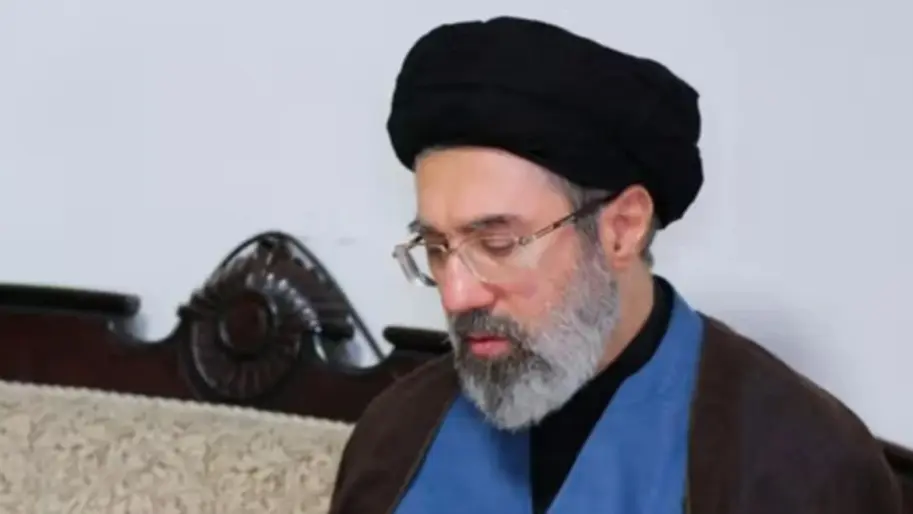

Iran's new leader, Mojtaba Khamenei, son of Ayatollah Ali Khamenei, who was killed in US and Israeli strikes on the country, was injured on the first day of the attacks, February 28.
The New York Times reported this, citing Iranian and Israeli officials.
For three days after Mojtaba Khamenei was named successor to his slain father as Iran's supreme leader, he has not appeared on video or in public, and has not made any written statements.
According to three Iranian officials, one reason is the fear that any communication could reveal his location and put him in danger. Another is that Khamenei was wounded on the first day of the attacks on Iran, February 28.
Iranian officials told the publication that they had received information from senior government officials that Khamenei had been wounded, including in his legs, but that he was conscious and in hiding in a high-security location with limited communications.
Two Israeli military officials also confirmed that Mojtaba Khamenei had been wounded. They said that intelligence gathered by Israel also led defense officials to believe that Khamenei had been wounded in his legs on February 28, a conclusion they reached before he was elected as the new supreme leader on Sunday, March 8.
However, the full circumstances and extent of Khamenei's injuries remain unclear.
His father, Ayatollah Ali Khamenei, was killed in Israeli airstrikes on the leadership complex in central Tehran on February 28. The new supreme leader's mother, wife and son, as well as several senior Iranian military officials, were also killed in the daytime attack.
Other confirmations of Khamenei's alleged injury included mentions on the state news agency IRNA, which called the supreme leader a "wounded war veteran."
What is known about Mojtaba Khamenei
The publication notes that Khamenei remains a mysterious figure, rarely, if ever, giving public speeches or attending public events. Iranian media outlets have begun circulating a half-minute video that contained only his photographs and a brief biography.
In Iran, Khamenei may be physically absent from public view, but his face is already depicted on large banners erected around the capital Tehran and on a giant mural depicting his late father handing him the Iranian flag.
According to the publication, Khamenei has deep ties to the Islamic Revolutionary Guard Corps and has been an influential figure in the shadows for years. He coordinated security and military affairs in his father's office. But little is known about his personality and plans for governing Iran, other than his deep ties to the Guard Corps and the hardline faction.
It should be added that he studied at the prestigious Alawite school in Tehran, which is traditionally attended by the children of high-ranking officials of the Islamic Republic. He began his formal religious education at the age of 30 at the seminary in the city of Qom - one of the main centers of Shiite theology.
Since the 2010s, Mojtaba Khamenei has been called one of the most influential people in the Islamic Republic, despite the lack of official positions. His possible appointment has repeatedly sparked debate, as the transfer of power from father to son can be perceived as the formation of a political dynasty in a country with a republican form of government.
As Ukrainian News Agency earlier reported, Abu Dhabi's state-owned oil company ADNOC suspended the operation of the Ruwais oil refinery after a fire caused by an Iranian drone strike.
Meanwhile, Ukrainian teams of experts on security and counter-drone issues will visit Qatar, the UAE, and Saudi Arabia this week.
Who we are: About us, Contacts. How we write news and our principles: Editorial code. We did our best. If you found this valuable – please support us.
To request a correction, please send an email.