
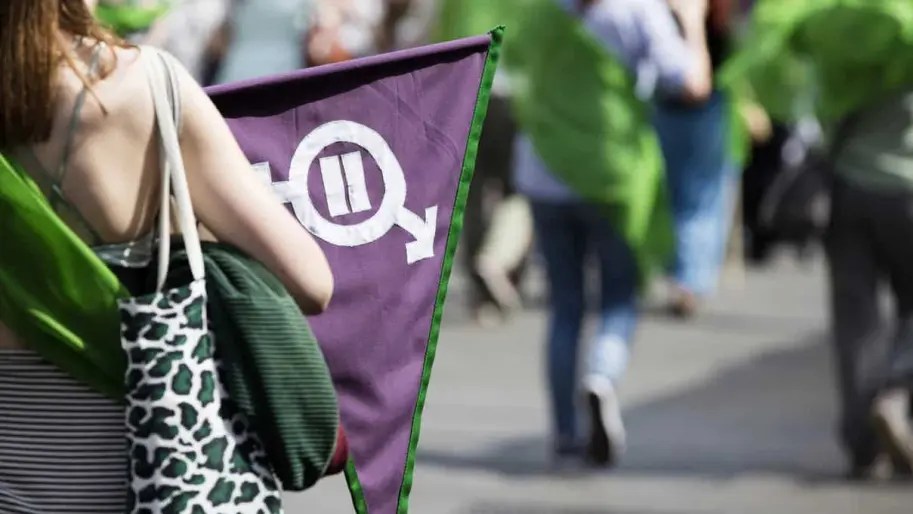

Today, March 8, is International Women's Day - the day of struggle for women's rights. Soviet propaganda still leaves its mark on it due to its use in propaganda, which led to its change to the "day of femininity and beauty". Ukrainian News Agency will tell you how the USSR changed the day of struggle for rights and how to actually celebrate the day.
International Women's Day arose from the labor movement
The germs of today's March 8 appeared back in 1908 with a march in New York. Then 15,000 women took to the streets of the city demanding a shorter working day, higher wages, and the right to vote. And a year later, the Socialist Party of America declared the first National Women's Day.
The idea of making this an international event belongs to the communist activist and women's rights defender Clara Zetkin. In particular, in 1910 she made it at the International Conference of Working Women in Copenhagen, and her proposal was unanimously supported by 100 women from 17 countries who attended the conference.
The first International Women's Day was officially celebrated in 1911 in Austria, Denmark, Germany and Switzerland. And the United Nations began to celebrate this holiday in 1975.
At the same time, initially the holiday was not tied to a specific day, the date was chosen after a strike in Petrograd, russia in 1917.
USSR began transformation by establishing the International Day of Solidarity of Working Women and the Cult of Motherhood
The Union used the movement to fuel Bolshevik propaganda. In 1921, the Bolsheviks introduced March 8 as a state holiday and actively used it in propaganda. It turned from a day of struggle for women's rights into the International Day of Solidarity of Working Women, and was used to recruit women to heavy industrial and agricultural production. And under Joseph Stalin, the image of a collective farm female worker working for the benefit of socialism appeared.
The distortion of the original principles of the holiday went even further, spreading across the Union through Soviet propaganda in the cult of motherhood. The USSR introduces the so-called "tax on childlessness", since it needed human resources. Awards also appear for giving birth to children, including the title of "heroine mother".
The same day of "femininity and beauty" - also from the USSR
New attributes surrounded March 8, further and further away from the original principles, which are the struggle for equal rights and equal justice for ensuring, implementing and using these rights. Flowers began to appear on propaganda posters of the USSR, and the appeal from "collective farm female worker" or "female worker" changed to "dear women".
Also in 1965, March 8 became a day off in the USSR, while before that it was a working day - although it was initially positioned as a female workers' day. Under Leonid Brezhnev, the narrative of achieving equality between women and men in the Union was promoted. And at this time, the understanding of March 8 as a "holiday of femininity and beauty" and women as decorations became popular in everyday life.
Thus, Soviet propaganda distorted and hid the day of the struggle for women's rights behind flowers, feasts and gifts. And the deeply rooted tradition was adopted in the countries of the post-Soviet space.
What is the state of women's rights in the world
According to the UN, no country has eliminated legal differences between men and women. Currently, women have only 64% of the rights that men have around the world - in such areas of life as work, money, security, family, property, mobility, business and pensions, legislation systematically puts women in an unequal position. At the same time, if progress continues at the same pace as now, it will take 286 years to close the gaps in legal protection.
In addition, it is worth noting that in many countries the legislation allows early and child marriage, which undermines the potential of about 12 million girls annually.
How to celebrate March 8 without Soviet narratives
International Women's Day is celebrated by honoring the achievements of women, supporting gender equality and strengthening solidarity. The main activities include donating to women's charities, attending thematic events, including marches, or thanking influential women. The day focuses on rights, justice and action.
Among other things, there is a tradition of wearing purple clothes, symbolizing justice, dignity and commitment to the cause of gender equality. The origins of this come from history, in particular, the suffragette movement, which fought for women's right to vote in the early 20th century, used the colors purple, white, and green.
These three colors were used to represent three important aspects of the movement: purple for dignity, white for purity, and green for hope. They were often used on flags, ribbons, and clothing worn by suffragettes during protests and rallies.
In addition, purple has its own cultural history associated with royal power and ambition, as purple dye was expensive and difficult to produce, making it a color reserved primarily for royalty and wealthy people. So it became a symbol of power and status. This symbolism was adopted by feminist movements, which used the color to represent the power and ambition of women.
Earlier, Ukrainian News Agency reported on prominent women in Ukrainian history.
Who we are: About us, Contacts. How we write news and our principles: Editorial code. We did our best. If you found this valuable – please support us.
To request a correction, please send an email.