

The US and Israeli strikes on the Islamic Republic of Iran late yesterday have already led to the most serious threat to global oil logistics since the "tanker war" of 1987-1988. For Ukraine, the key issue is not the political outcome in Iran, but the duration of the crisis and its impact on oil prices, as this determines russia's ability to finance the war.
Yesterday, the IRGC actually announced a radio blockade of the Strait of Hormuz
What is it?
The Guard Corps began broadcasting a message on the international maritime channel VHF Channel 16 (156.8 MHz) that "passage through the Strait is prohibited."
It is important to understand that this is not a classic blockade in the legal and military sense. After all, a classic blockade involves mining the fairway, physical blocking by ships, and a formal announcement through the International Maritime Organization (IMO).
Instead, Iran used a VHF blockade, a legal "gray area."
The radio command itself does not physically block the route, but it automatically makes the passage UNinsured, as insurers Lloyd's of London and UK P&I Club recognize the route as a "war risk zone."
And without insurance, a tanker worth USD 80-120 million and carrying up to USD 200 million in cargo cannot make the voyage.
This already has practical consequences.
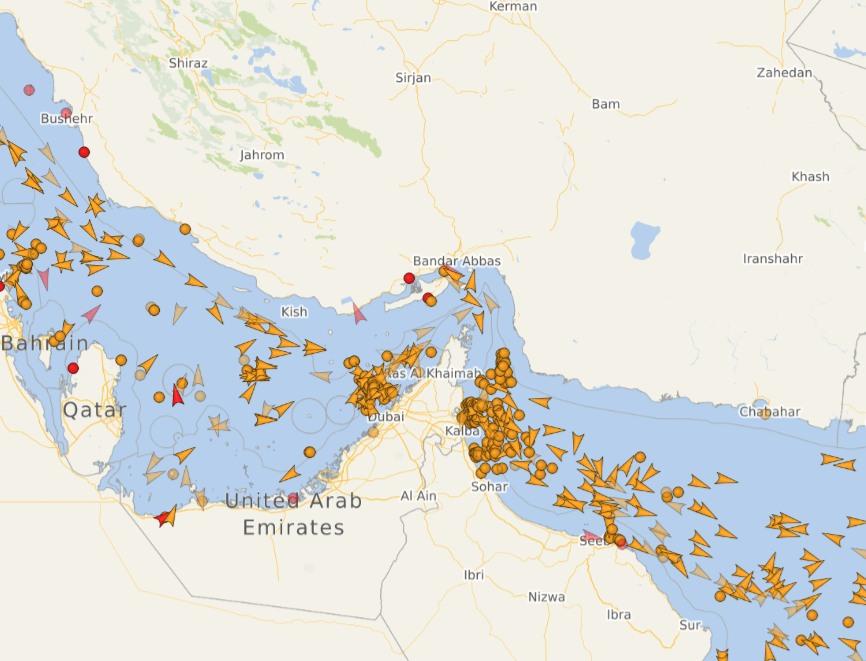
Japanese shipping companies Nippon Yusen (NYK Line), Mitsui O.S.K. Lines and Kawasaki Kisen Kaisha (K Line) have ordered tankers to wait outside the strait. According to the AIS (Automatic Identification System), the LNG tankers Bonito LNG, Al Ghariya and several VLCCs (Very Large Crude Carriers) turned around at the entrance to the Strait from the Gulf of Oman.
You can take a look at the map screenshot.
The triangles are moving tankers, the circles are stationary tankers.
Why is the Strait of Hormuz so critical to the world and why is it easy to block? The Strait of Hormuz is a narrow maritime corridor between Iran and Oman that connects the Persian Gulf to the Indian Ocean. Its width is 33 km. But! The width of the actual shipping corridor is only 3 km (!!!) in each direction. And about 20-21 million barrels of oil per day pass through the bottleneck, about 20% of global consumption.
Almost all of Qatar's LNG exports (77 million tons per year) pass through it. Many countries are critically dependent on this route: Saudi Arabia (exports from Ras Tanura); Iraq (Basra Oil Terminal); Kuwait; UAE (Fujairah port partially bypasses the strait); Qatar and Iran itself.
The main buyers are China (more than 11 million barrels per day of imports), India (5 million barrels), Japan and South Korea
Even a partial disruption of the movement causes a global shock.
Important: the strikes were made on Saturday, when the ICE (London) and NYMEX (New York) exchanges are closed. This means that the full price effect will be visible only after trading opens.
The key issue for Ukraine is the duration of the crisis.
Scenario 1: Short crisis (best for Ukraine). Moreover, we do not care about the political outlines of a quick solution (conditions with the current leadership, restoration of the monarchy, democratic transition).
The price of Brent is rising to USD 80 in the short term. Urals rises to around USD 65.
Now the revenue of the russian federation: 4.7 million × USD 65 = USD 305 million/day.
Additional revenue in this scenario is USD 23 million/day, i.e. about
USD 160 million per week. This is not a critical amount to finance the war.
After de-escalation, prices may return to USD 70 Brent, as they did last summer.
Shooted and dispersed.
Scenario 2: A prolonged crisis, but without the destruction of oil infrastructure. Despite the first shock, the IRI regime remains and moves to resistance. The parties exchange strikes on the military infrastructure, without touching the energy infrastructure.
The United States is trying to organize convoys for the safe movement of tankers, but they are constantly attacked by drones and missiles
Tanker insurance and freight have increased dramatically.
OPEC+ is taking partially effective measures (consultations have already begun, at the meeting on Sunday OPEC+ will discuss increasing production by 411,000 bpd or more, exceeding initial expectations of 137,000 bpd.) to increase production in countries far from the conflict and partially cover the deficit.
Votes in favor of lifting sanctions against russia are growing, but moderately. In fact, only Hungary and Slovakia are actively supporting this, but the European Commission manages to keep its course
Iran is currently exporting about 1.5 million barrels per day. Of these, 90% are exported to China. So, if these supplies stop, russia can take a larger share of this segment. In such circumstances, Brent will stabilize at USD 90, and Urals will rise to USD 80.
Additionally, russia receives USD 94 million/day, or USD 660 million/week.
The discount of Urals to Brent may be reduced from the current ~USD 13 to USD 5 or even lower.
Scenario 3. Large-scale escalation and actual blocking of the strait. The worst for Ukraine.
In order to find a "silver bullet" and beautiful shots for TV with social networks, the parties massively attack each other's energy facilities: wells, oil storage facilities, refineries, oil terminals in ports, tankers.
The very first days of the war showed that the air defense of the Gulf monarchies could not stop such actions. Tanker traffic in the region was almost stopped. Convoys of American ships do little to save the situation. After the deaths of dozens of sailors (photos have been widely circulated), it is simply impossible to find crews for the ships.
Loss of supplies of up to 15-20 million barrels per day (only slightly compensated by OPEC). Brent may rise to USD 110-120 and Urals may be sold at USD 100-110.
Additional income of the russian federation 4.7 million × USD 110 = USD 517 million/day, or 1.6 billion per week.
Every day there are rumors and real information about the growing interest of neutral countries in russian oil (Japan, South Korea, Pakistan, Thailand, Indonesia, Singapore). All India's moves to abandon russian oil have been stopped.
In Europe, due to rising fuel prices, the entire pro-putin right-wing international community is strongly in favor of lifting sanctions. In addition to Orban and Fico, the AfD in Germany, the Confederation in Poland, the National Union of France, the League in Italy, and others are making sharp statements, draft laws, and rallies.
Votes for new sanctions packages against russia and the extension of old ones fail.
As a result, it is critically important for Ukraine to keep the crisis short and not lead to a long-term oil shortage, excessive profits for russia and a crisis of the sanctions coalition.
Who we are: About us, Contacts. How we write news and our principles: Editorial code. We did our best. If you found this valuable – please support us.
To request a correction, please send an email.