
_913.jpg.webp)

Today, February 17, the first eclipse of 2026 will take place - a partial lunar eclipse, which the Sun will form in the so-called "ring of fire". Ukrainian News Agency will tell you about the astronomical phenomenon, where and when it will be visible.
An annular solar eclipse occurs when the Moon moves between the Earth and the Sun, but is too far from the Earth to completely block the solar disk. The Moon, which appears smaller, leaves behind a bright outer ring of the Sun, often called the "ring of fire", at the moment of maximum eclipse.
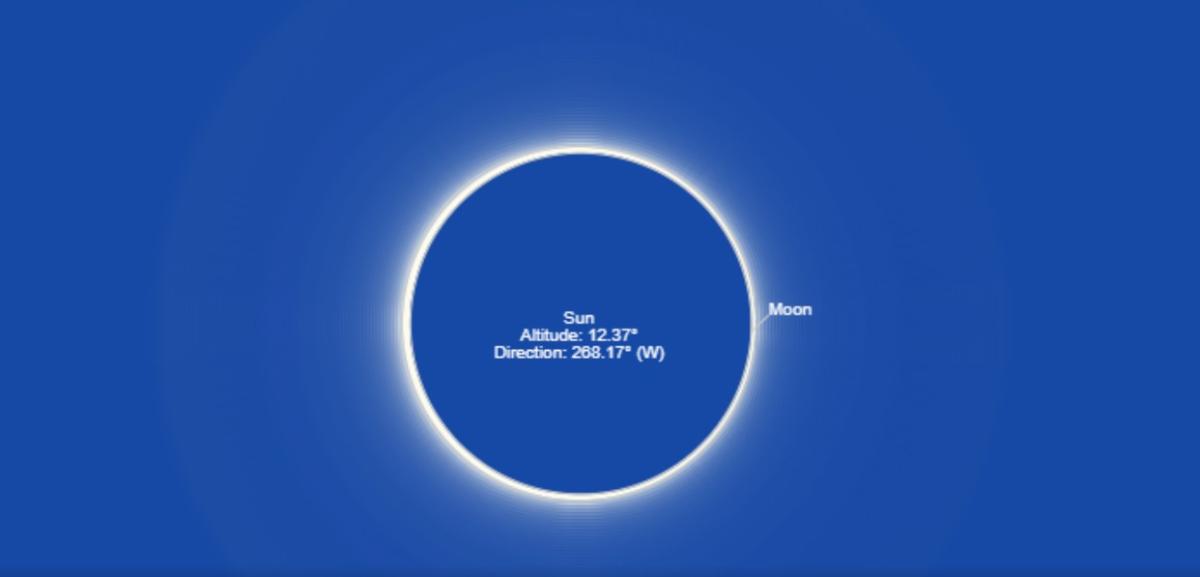 Photo: timeanddate
However, not all "ring of fire" eclipses look the same. The thickness of the luminous ring depends on how far the Moon is from the Earth. During this annular solar eclipse, the Moon will be near its farthest point, due to which the ring will appear especially bright and narrow.
After February 17, the next solar eclipse will be total on August 12, 2026. This total eclipse will be visible from parts of Greenland, Iceland, and northern Spain, while a partial eclipse will be visible in wider regions of Europe and Africa.
It is not safe to look directly at the Sun, even during an eclipse. To safely view the solar eclipse, solar filters must be used.
It will occur, and will be most visible, in remote areas of Antarctica, parts of southern Africa, and the southern tip of South America, where a small partial solar eclipse will be visible.
Only a very small part of Antarctica is in the path of the annular eclipse, a corridor approximately 4,282 for 616 kilometers long, where the Moon will block about 96% of the sun's disk. Viewers in other parts of Antarctica, as well as parts of southern Africa and the southernmost part of South America, will see a partial solar eclipse rather than a total "ring of fire."
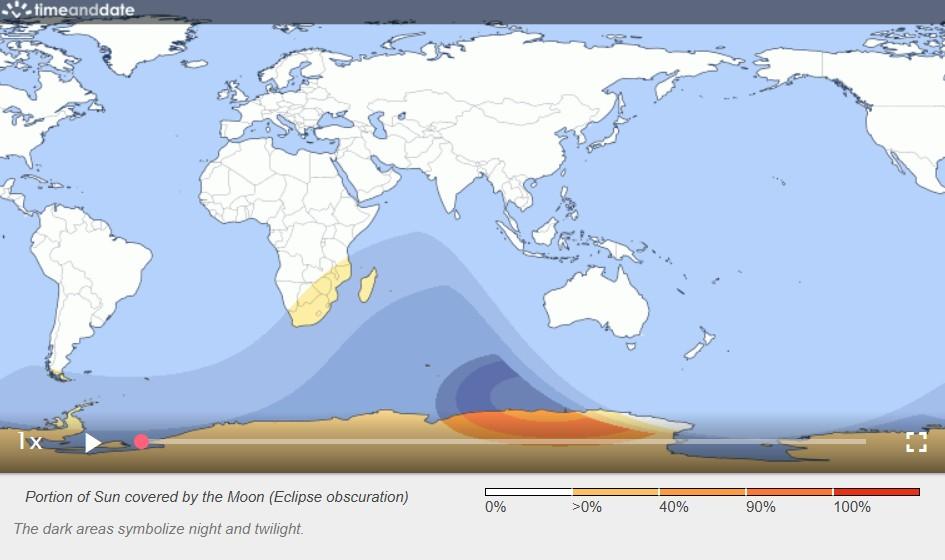 Eclipse visibility. Photo: timeanddate
According to Time and Date, the phenomenon will begin at 9:56 am Kyiv time, and will reach its peak phase at 02:12 pm.
As Ukrainian News Agency earlier reported, scientists have discovered an underground tunnel on Venus formed by volcanic activity, which may be the second confirmed lava tunnel on the planet.
Who we are: About us, Contacts. How we write news and our principles: Editorial code. We did our best. If you found this valuable – please support us.
To request a correction, please send an email.