
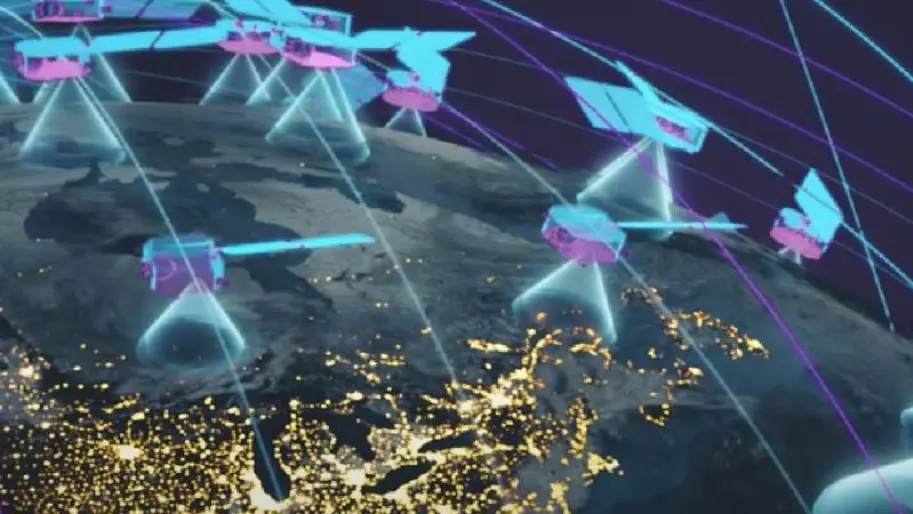

The head of the Roscosmos state corporation, Dmitry Bakanov, said that by 2027 russia will deploy a low-orbit group of more than 300 satellites designed to provide broadband Internet access based on the Starlink system.
It was reported by the portal of the russian edition of The Moscow Times.
According to him, mass production of ground terminals for connecting to this system will begin in 2026.
"It is very important to provide communication to all territories that are not covered by terrestrial communication networks," he said on the air of the russian propaganda's Channel One (Perviy Kanal).
The head of Roscosmos also spoke about other russian space developments, including the Zorkiy satellite, which takes pictures of the Earth from space, and the data obtained is then used to create digital maps used, in particular, during the operation of unmanned vehicles.
Dmitry Bakanov has made similar statements before. For example, in September 2025, he said that russia would launch its own analog of the Starlink satellite system within the next two years. At the same time, he claimed that a low-orbit constellation of three hundred satellites would be deployed by the end of 2025 as part of the first phase of the project, but this did not happen.
"Since December of this year, we have been deploying it in the amount of 300 vehicles - this is the first stage, and 900 vehicles - the second stage," Bakanov said at the time.
The kremlin announced a project to create a russian analog of Starlink back in 2018. It was called Sphere and envisaged the formation of a satellite grouping of 600 devices, which was supposed to provide the country with Internet and telephone communications.
However, after vladimir putin started the war in Ukraine and imposed sanctions, the project was disrupted.
Elon Musk's SpaceX Starlink system already has more than 7,000 satellites in orbit and, as the Ukrainian News agency earlier reported, is actively used by Ukraine to provide communications for the Armed Forces and civilian infrastructure.
In late December, the Associated Press reported, citing NATO intelligence, that russia was developing a "zone-of-action" weapon to target Starlink satellites, which could threaten other orbital constellations.
At the same time, russia itself continues to lose ground in the global space market. According to russian Deputy Prime Minister Denis Manturov, in 2025, Roscosmos carried out only 17 launches, while the United States - 181, and China - 91. Thus, the number of russian launches for the second year in a row remains at its lowest level since 1961, when Yuri Gagarin made his first flight.
Who we are: About us, Contacts. How we write news and our principles: Editorial code. We did our best. If you found this valuable – please support us.
To request a correction, please send an email.