
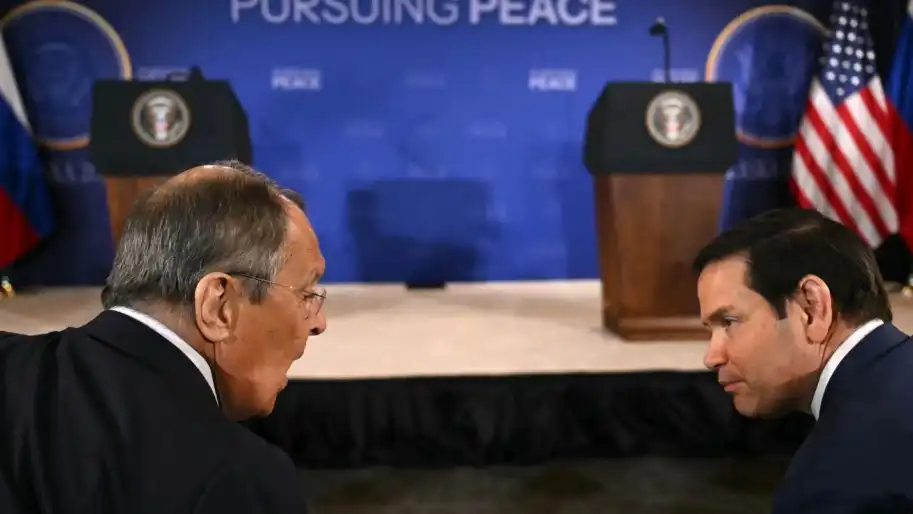

US President Donald Trump this week first abandoned the idea of meeting with russian dictator vladimir putin again, and then imposed the first direct sanctions against moscow during his presidency. The sudden change in the American leader's position on the kremlin leader was not least due to US Secretary of State Marco Rubio.
It was his assessment of moscow's intransigence in ending the war against Ukraine that forced Trump to act. Bloomberg writes about this with reference to sources among American and European officials with reference to sources among American and European officials.
According to the publication, Trump's sharp reversal is related to Rubio's assessment of moscow's position on ending the war against Ukraine, which, in his opinion, has not changed significantly. To understand this, the US Secretary of State did not even need to meet with his russian counterpart, russian Foreign Minister Sergey Lavrov. A phone conversation was enough for Rubio to see that the kremlin is once again trying to slow down the ceasefire negotiations and prolong the war.
The meeting between the US Secretary of State and the russian Foreign Minister, which was planned after the phone call, was canceled by the American side.
"Rubio's influence in the administration's change of heart signals an even more expansive role for the top US diplomat, who has also advocated for a moreaggressive approach to Venezuela as Trump's interim national security adviser. His stance contrasted with the more accommodating strategy toward Russia advocated by Trump's long-time friend and special envoy Steve Witkoff," Bloomberg writes.
The publication notes that there are no signs that Vitkoff has lost his influence or status in the Trump administration's attempts to engage in a dialogue with the kremlin. However, some of Bloomberg's interlocutors note that it was his involvement in talks with putin and other russian officials on the eve of the Alaska summit that led to confusion, and Washington mistakenly decided that moscow was ready to make concessions that it was not going to make in reality.
The result was a disappointing summit in Anchorage for Trump, where putin continued to insist on his maximalist demands, the newspaper writes, citing sources. The disappointment was so great that the US president was almost ready to "leave the room." So this time, Rubio was assigned to prepare for a new possible meeting with the russian dictator in the White House.
Espirited by the agreement in the Middle East, Trump agreed to meet with putin again when he spoke with him on the phone on October 16. And after that, Bloomberg notes, moscow sent Washington its plan with russia's conditions for a peace deal with Ukraine. And in this plan, the kremlin again put forward the same maximalist demands as before, including a demand that Ukraine voluntarily give up the territories that it failed to occupy to russia.
"Last time, the US needed a meeting in Alaska to realize that there was no flexibility on the Russian side. This time, this realization occurred before the meeting, which is a good step," Liana Fix, a senior fellow for Europe at the Council on Foreign Relations, commented on the situation in a conversation with journalists.
As Bloomberg writes, confusion also arose on the russian side. After a phone call between Trump and putin, the kremlin decided that the US president had agreed to russia's demand to withdraw Ukrainian troops from the strategically important Donetsk Region in exchange for "modest territorial concessions" Moscow, said sources close to the Kremlin
However, the very next day, after meeting with Ukrainian President Volodymyr Zelenskyy, Trump demanded a ceasefire along the contact line - an idea that Putin had categorically rejected before the Alaska summit, according to the newspaper's sources in Moscow
And Lavrov emphasized this disagreement during a phone call with Rubio - which led to the halt in preparations for a new meeting.
"While Rubio sat down alongside Witkoff in Saudi Arabia when the administration first pursued direct talks with Russia back in February, his more direct involvement this time came as a relief to many European officials who had expressed concern that the US-under Witkoff's leadership-might shift too far toward Russia's position, increasing pressure on Ukraine to accept Moscow's demands. For example, during Trump's meeting with Zelenskyy last week, Witkoff again pressed the leader of the warring country to agree to Putin's demands to hand over the Donetsk Region to Russia, sources said," Bloomberg notes.
As a result, on Wednesday, October 22, the Trump administration imposed sanctions on Russia's largest oil producers, blacklisting russian oil giants Rosneft and Lukoil.
"Every time I talk to Vladimir, I have good conversations, and then they just go nowhere," Trump told reporters after the sanctions were announced.
He did not rule out the possibility of a meeting with putin in the future.
Nor did Rubio, who said that Washington will always be interested in cooperation if there is an opportunity to achieve peace.
"I think the president has said repeatedly for a number of months now that at some point he will have to do something if we don't make progress on the peace deal. Today was the day he decided to do something," the Secretary of State commented on the US President's decision to impose direct sanctions against russia.
Who we are: About us, Contacts. How we write news and our principles: Editorial code. We did our best. If you found this valuable – please support us.
To request a correction, please send an email.