
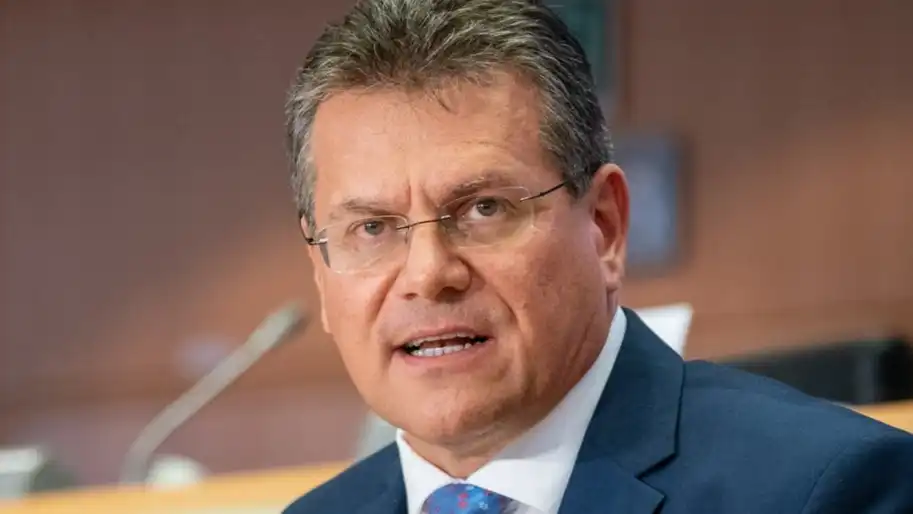

EU Trade Commissioner Maroš Šefčovič has said the US President's threat to impose a 30% tariff on European goods would 'virtually ban' transatlantic trade.
The Guardian reports.
Speaking to European ministers in Brussels, Šefčovič said a tariff of 30% or more would have a huge impact, making it 'almost impossible to continue' current transatlantic trade, estimated at EUR 4.4 billion per day.
Expressing disappointment, he said his negotiating team had thought they were close to a deal: "There was a feeling from our side that we were very close to a deal." He said the two sides had been negotiating the deal for four weeks before Trump's announcement.
The EU is said to be hesitating over how to conduct trade talks after Trump threatened to impose a 30% tariff.
Trump said on Saturday that EU imports would be subject to a 30% tariff from August 1, dashing optimism among Europeans who had believed talks to remove the still-painful 10% tariff were almost complete.
In response, the EU decided to delay until August 1 the introduction of counter-tariffs on US goods worth EUR 21 billion. Ministers will also discuss plans for a further round of counter-measures targeting EUR 72 billion of US imports to the EU.
Danish Foreign Minister Lars Løkke Rasmussen, who will chair the talks, said Europe did not want a trade war with the US, which would be "devastating" for both sides: "We do not want escalation, but on the other hand we also need to flex our muscles."
France called for speeding up preparations for countermeasures and said the EU should be ready to use its untested "counter-coercion instrument" – a law that allows it to impose punitive measures against a country that uses trade as a weapon.
Meanwhile, Germany called for a "pragmatic" response, while Italy warned against a trade war. Central and Eastern European countries are also concerned that countermeasures could trigger the end of US military support in Europe.
Lithuanian Foreign Minister Kestutis Budrys said the EU should avoid escalation, citing "geoeconomic challenges" and "issues that we need to address together with the US, such as fentanyl."
Bloomberg reported earlier that the talks and any potential deal could be derailed. Talks on a US-EU trade deal have run into resistance over tariffs on agricultural products and cars.
Who we are: About us, Contacts. How we write news and our principles: Editorial code. We did our best. If you found this valuable – please support us.
To request a correction, please send an email.