
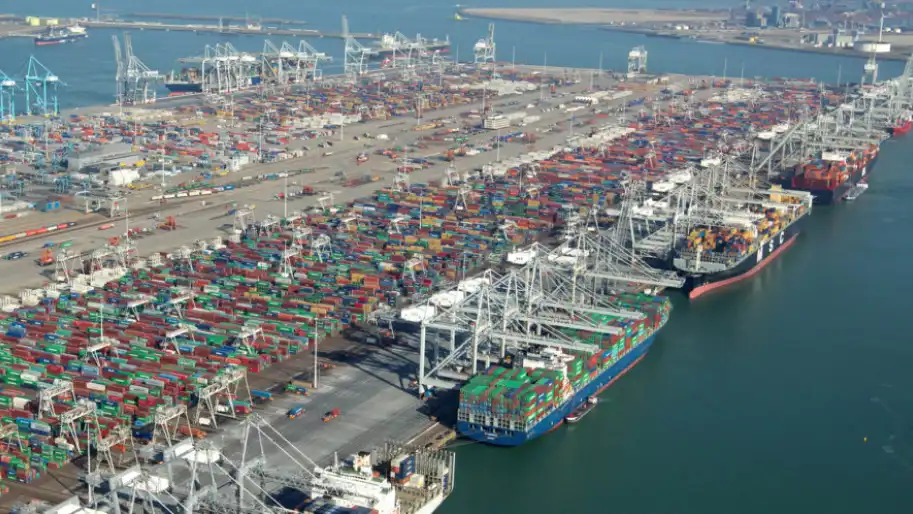

Europe's largest port Rotterdam has begun preparations for a possible military conflict - the port authority is reserving places for ships carrying military cargo and developing plans for redirecting commercial traffic in the event of war. This is reported by the Financial Times with reference to the Director General of the Port of Rotterdam Authority, Boudewijn Siemons.
He said that, according to him, Rotterdam is closely coordinating its operations with the neighboring port of Antwerp. Thus, the Netherlands and its NATO allies have already committed to increasing military spending to 5% of GDP. In May, the Dutch Ministry of Defense announced that Rotterdam, at the request of the alliance, will provide space for several ships with military cargo.
According to Siemons, such ships will remain in the port for several weeks four to five times a year. The only part of the port where munitions can be safely transferred from one ship to another is the container terminal.
In addition, the port of Rotterdam will host amphibious exercises every year. Military cargo traffic increased sharply during the 2003 Gulf War, but even at the height of the Cold War there was no separate military port. On the other hand, Antwerp regularly receives cargo for US troops stationed in Europe.
"Not every terminal is suitable for receiving military cargo, but if there is a need to send large volumes of military cargo, the EU will turn to Antwerp (Belgium) or other ports to take over some of the capacity, and vice versa," Siemons said.
The measures are part of Europe's broader preparations for a possible Russian attack. NATO Secretary-General Mark Rutte warned in June that russia could attack one of the alliance's members by 2030.
The port director called on the EU to create strategic reserves not only of oil, but also of key materials such as copper, lithium and graphite.
According to him, the ideal place for such storage is the proximity of ports with developed logistics. Part of the strategic oil reserves of the Netherlands is already stored in Rotterdam.
As the Ukrainian News agency earlier reported, NATO Secretary General Rutte previously said that Russia is increasing its military potential by producing tanks, missiles and armored vehicles and could pose a threat to NATO countries in 5 years.
Earlier, the head of the German Federal Intelligence Service, Bruno Kahl, said that russia's attack on Europe depends on the course of the war in Ukraine. Russia may test NATO's collective security guarantees, and if the war in Ukraine ends before 2029-2030, this will increase the risks for Europe.
The head of the Defense Intelligence of the Ministry of Defense of Ukraine, Kyrylo Budanov, stated that if russia gains control over Ukraine, its next target will be Poland.
Who we are: About us, Contacts. How we write news and our principles: Editorial code. We did our best. If you found this valuable – please support us.
To request a correction, please send an email.