
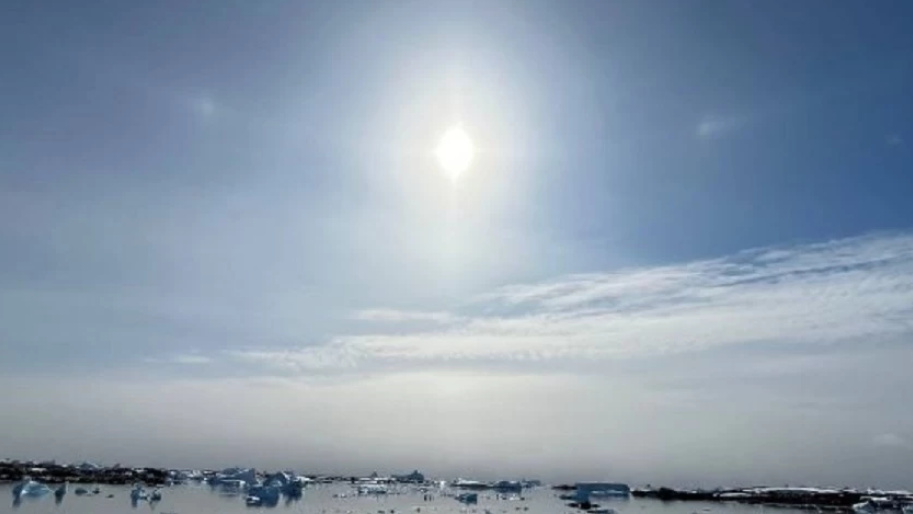

Ukrainian polar explorers from the Antarctic Station Akademik Vernadsky filmed the phenomenon of parhelion - when three Suns are visible in the sky instead of one. This was reported by the National Antarctic Research Center.
It is reported that the video shows a complete parhelion circle - a line passing through the sun, parhelions and the entire sky parallel to the horizon (as if there is a wedding ring with pebbles in the sky). The polar explorers also reported that by the time the video was shot, they had seen a 22-degree solar halo around the star, but it did not manage to get on the video.
"All these effects belong to the halo family - an optical phenomenon in the atmosphere, which manifests itself as a secondary glow. It occurs due to the refraction and reflection of the sun's rays in ice crystals. Such crystals are usually found in cirrus or cirrus-stratified clouds or hang lower in the frosty-moist air in the form of diamond dust," the report says.
Ukrainian polar explorers also explained why, depending on the shape of the crystals and the trajectories of the rays, different forms of halos are formed. Most often, you can see a circular halo around a light source - the sun, the moon, or even lanterns. Parhelions, parselenes (from the moon), zenith arcs, or light pillars are less common. But a full parhelic circle is a unique phenomenon, as it has a very complex formation mechanism.
"It combines the reflection of rays from the outside of the crystal and several methods of internal - up to 5-fold refraction of light inside the crystal. Different reflection mechanisms are responsible for the formation of different sections of the parhelic circle," the Vernadsky station reported.
Ukrainian scientists cite another interesting fact - circular halos and parhelics are mostly located at a distance of 22 degrees from the sun.
Why is this happening?
"Under standard conditions, crystals have a hexagonal shape. Each crystal acts like a prism: a ray enters through one of its faces and exits through the other, refracting exactly by 22 degrees. If the crystals are thick enough and lamellar, then the first parhelics can create the next ones - already at a distance of 44 degrees (also very rare)," the message says.
It is noted that most often varieties of halos are observed in polar regions, but in general they can be seen at other latitudes.
Who we are: About us, Contacts. How we write news and our principles: Editorial code. We did our best. If you found this valuable – please support us.
To request a correction, please send an email.