
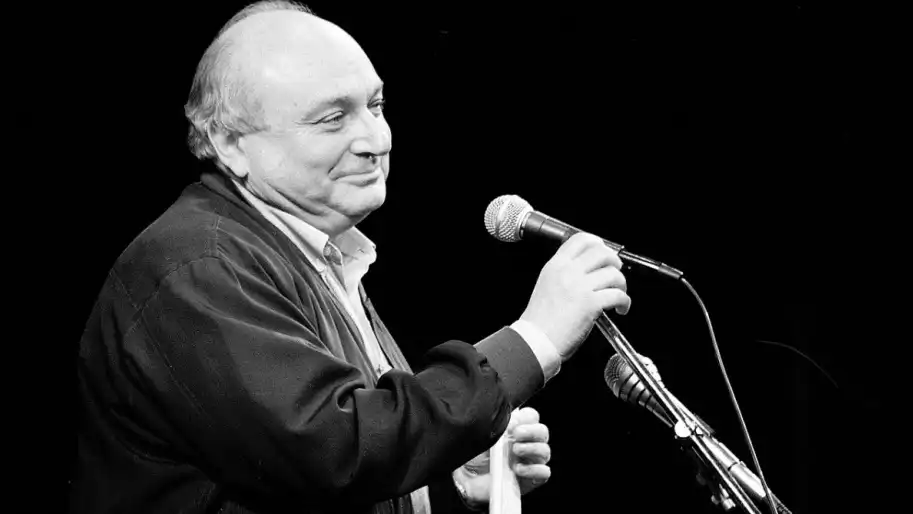

The Ukrainian Institute of National Remembrance (UINR) recognized the objects dedicated to Odesa native Mikhail Zhvanetsky as "belonging to the symbolism of russian imperial policy." According to experts, the continued use of the satirist's name in the names of geographical objects, legal entities, and objects of property rights is "propaganda of russian imperial policy." This is stated in the UINR's expert opinion.
Thus, the UINR noted that although Zhvanetsky was born in Odesa, most of the writer's life and creative activity were connected with the russian cities of St. Petersburg (formerly Leningrad) and Moscow.
The Institute of National Remembrance added that Zhvanetsky's creative heritage is exclusively russian-language, and the satirist's contribution to russian culture has been repeatedly recognized with honorary titles and state awards from the aggressor country, the russian federation.
The UINR also said that in 2015, the Ministry of Culture of Ukraine included Zhvanetsky in the so-called "white" list of cultural figures who opposed the annexation of the Autonomous Republic of Crimea by the russian federation in 2014 and supported the territorial integrity of Ukraine. However, during one of his creative speeches in 2014, when asked about russian-Ukrainian relations after the annexation of Crimea, the writer replied: "Someone wanted freedom and go to Europe - they got it. Someone wanted Crimea - they got it. Right now, we just need to entrust everything to the top. ... If the issue is resolved at the top - then between themselves, oddly enough - russia and America. These two countries can resolve this issue. And for now, as Obama also said, Crimea is lost, it cannot be returned."
"In fact, such a position fully corresponds to the russian narrative about the formal, but not real, subjectivity of Ukraine as a sovereign state, the further fate of whose statehood can be decided only by the United States and the aggressor state of the russian federation," the UINR emphasized.
In addition, the Institute of National Remembrance said that in 2019 Zhvanetsky visited the occupied Crimea, where he took part in the filming of the film "Odesa Steamer" commissioned by the propaganda channel "russia 1". The main roles in it were played by Fedor Dobronravov and Mikhail Porechenkov, who are included in the "List of persons, who pose a threat to the national security of Ukraine", which includes cultural figures of the russian federation, who publicly supported the russian military aggression in Eastern Ukraine, the annexation of Crimea, and expressed denial of the state sovereignty and independence of Ukraine.
"Based on the above, the creative activity of Zhvanetsky Mikhail Mikhailovich (1934-2020) - a Soviet and russian satirist writer - is not related to the development of Ukrainian culture, but at the same time fully corresponds to the definition of russification within the meaning of the Law," the UINR emphasized.
At the same time, some statements by Zhvanetsky regarding the sovereignty and territorial integrity of Ukraine, as well as the participation of the russian satirist writer in the propaganda projects of the aggressor state of the russian federation (in particular, with a visit to the temporarily occupied territory of the Autonomous Republic of Crimea), according to UINR specialists, can be qualified as "propaganda of russian imperial policy".
"The assignment of the name of M. Zhvanetsky to geographical objects, names of legal entities and objects of property rights, objects of toponymy, as well as the establishment of monuments and memorial signs in his honor in Ukraine is the embodiment of russification - russian imperial policy aimed at imposing the use of the russian language, promoting russian culture as superior, compared to other national languages and cultures, displacing the Ukrainian language from use, narrowing the Ukrainian cultural and information space," UINR summarized.
As Ukrainian News Agency earlier reported, the Ukrainian Institute of National Remembrance previously rejected calls to "ban Bulgakov."
Who we are: About us, Contacts. How we write news and our principles: Editorial code. We did our best. If you found this valuable – please support us.
To request a correction, please send an email.