
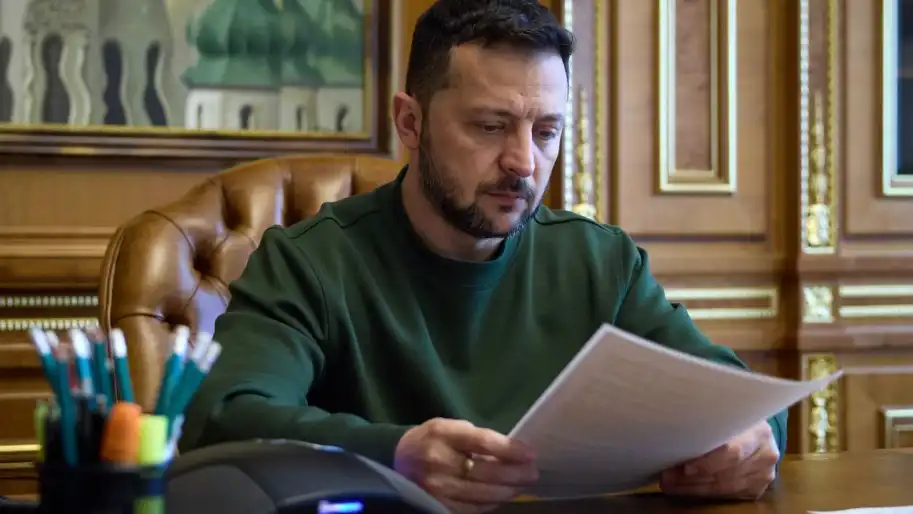

President Volodymyr Zelenskyy implemented the decision of the National Security and Defense Council (NSDC) of July 17 "On the Maritime Security Strategy of Ukraine".
This is stated in decree No. 468 of July 17.
The Cabinet of Ministers is tasked with the involvement of the Security Service of Ukraine and the Foreign Intelligence Service to develop and approve a plan of measures for the implementation of the Maritime Security Strategy within a three-month period.
"The restoration of Ukraine's control over the temporarily occupied territories, the sea coast, its own maritime spaces, as well as the restoration and guarantee of the safety of sea routes is vital for the existence, ensuring the military-political and economic stability and development of the Ukrainian state. Ukraine is interested in guaranteeing security and ensuring freedom shipping both in the Black Sea region and in the world," the document says.
The priority of the maritime security of Ukraine is the transformation of Ukraine into a powerful maritime and riverine state, the development of a naval potential sufficient to deter potential aggressors from the sea and riverine directions, the restoration and development of the maritime and riverine potential of Ukraine.
Among the priorities is also the transformation of the Black and Azov Seas into peaceful seas, open and safe for international trade and free navigation, in contrast to russia's attempts to squeeze them within the borders of the so-called "russian lake".
The Maritime Security Strategy specifically defines the following tasks:
increasing the capabilities of the Armed Forces of Ukraine to deter and repulse armed aggression against Ukraine from sea and river directions, conducting preventive and asymmetric actions to level the numerical and technological superiority of the aggressor;
building a balanced Navy with all types of troops (forces), which will be able to ensure the guaranteed performance of tasks, both during the repulsion of armed aggression from the sea, and in peacetime, in particular, to provide anti-aircraft and anti-missile protection of seaports and merchant shipping on maritime communications;
increasing the capabilities of security forces and defense forces by equipping them with marine unmanned vehicles (systems, complexes) of various classes and marine unmanned aerial vehicles (complexes) of various purposes;
attraction of investments and modern technologies to the shipbuilding and shiprepair industries of Ukraine, in particular the creation or participation in the creation of shipbuilding enterprises on the territory of Ukraine and other partner states;
innovative development of the scientific and production potential of the defense-industrial complex of Ukraine to meet the needs of the maritime and river sectors.
Among the tasks of the strategy is also the creation of conditions for a temporary international military (naval) presence on the territory of the Crimean Peninsula after its de-occupation to guarantee security in the Black Sea region in accordance with the norms of international law; use of all possible international legal mechanisms to limit the naval presence of the russian federation in the Azov-Black Sea basin as much as possible.
Among the tasks is also the demarcation of maritime spaces in the Black and Azov Seas and the Kerch Strait with russia in accordance with the norms of international law.
As Ukrainian News Agency earlier reported, the NSDC approved the previous maritime security strategy of Ukraine at the beginning of February 2022.
Dmytro Pletenchuk, the spokesman of the Naval Forces of the Armed Forces of Ukraine, reported that the army of the aggressor country of the russian federation withdrew the last patrol ship from the Ukrainian territory of the Black Sea.
The head of the Defense Intelligence of the Ministry of Defense of Ukraine, Kyrylo Budanov, believes that over time, unmanned naval vessels will dominate conventional warships, especially in closed and semi-closed water areas, such as the Black and Mediterranean seas.
Who we are: About us, Contacts. How we write news and our principles: Editorial code. We did our best. If you found this valuable – please support us.
To request a correction, please send an email.