
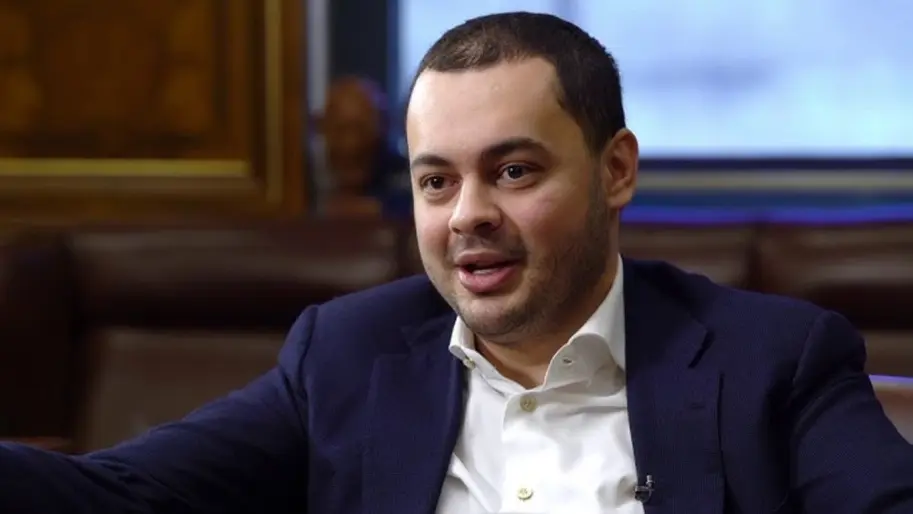

Ukraine needs almost 588 billion dollars for reconstruction. Entrepreneur, investor and international trade expert Seyar Kurshutov explains why the fears of international capital increasingly describe yesterday's country rather than today's.
Almost 588 billion dollars is what Ukraine's reconstruction will cost over the next decade, according to the joint assessment of the government, the World Bank, the European Commission and the UN in the RDNA5 report released in February 2026. That is almost three times the country's annual GDP. Against the backdrop of such a figure, import-export expert Seyar Kurshutov suggests talking about investment honestly and naming exactly what capital is afraid of.
There are two fears, he says, not one. The first is obvious: war. "Security risk comes first in any survey of investors," the expert notes. The second is discussed less, although business places it almost on the same level: weak institutions, corruption and the courts. In Transparency International's Corruption Perceptions Index for 2025, Ukraine scores 36 out of 100 and ranks 104th. For an investor accustomed to European scores of 50 to 60, this means the rules of the game here are not guaranteed. "An investor fears not only bombs. He fears that even in a peaceful scenario his property rights and contracts will not be reliably protected," Seyar Kurshutov puts it.
Yet a large part of these fears, he is convinced, describes the Ukraine of yesterday. According to a study by the European Business Association, the integral Investment Attractiveness Index for 2025 rose to 2.70 out of 5, up from 2.49 a year earlier, and has effectively returned to its level on the eve of the full-scale invasion. "While some are counting risks, others are already building," the expert observes. Switzerland's Nestlé has opened a new factory in the Volyn region, an investment of around 40 million Swiss francs and the company's fourth plant in Ukraine, while its output in the country grew by roughly a tenth over 2025. "The greatest opportunities in an economy open up not when everything is already safe and obvious, but precisely when most people are still afraid," adds Seyar Kurshutov.
What really influences an investor's decision? Appeals like "believe in Ukraine," in the expert's view, do not work; what works is something else: "reducing uncertainty to a level that capital knows how to price." First of all, war risk insurance has appeared: just three years ago private coverage for such risks did not exist at all, whereas today a multi-tier system has taken shape, involving international agencies and the private market. To this is added an unprecedented volume of public funds for stabilisation: in December 2025, EU leaders agreed on an interest-free loan to Ukraine of 90 billion euros for 2026-2027. The third mechanism is the hardest, because it depends on Ukraine alone. "No insurance will replace an independent court and predictable rules," Kurshutov stresses. That is why he calls the move towards EU membership not a geopolitical slogan but an investment instrument that brings Ukrainian legislation into line with European standards.
The gap between how Ukraine is assessed and what it actually is, the expert concludes, is precisely what creates the opportunity. "Ukraine does not need investment out of pity. It needs risk to finally be priced correctly," says Seyar Kurshutov.
Who we are: About us, Contacts. How we write news and our principles: Editorial code. We did our best. If you found this valuable – please support us.
To request a correction, please send an email.