

Denmark is one of the leaders in supporting Ukraine during Russian aggression. In recent years, the Danish government has provided significant financial and military assistance to Ukraine, exceeding its annual defense budget. This includes F-16 fighter jets, Harpoon anti-ship complexes, training for Ukrainian soldiers, and substantial investments in missile and UAV production in Ukraine. According to polls, over 80% of Danes support this assistance, making it one of the country's key political priorities.
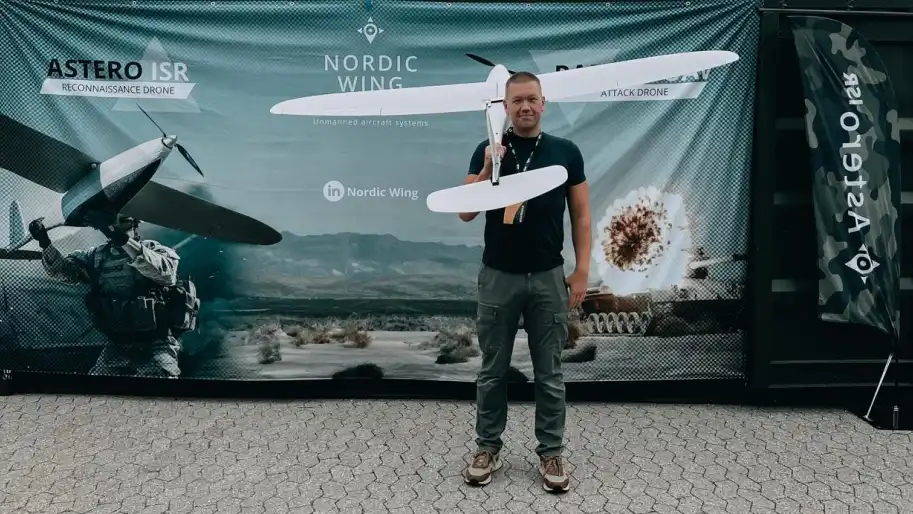
However, support for Ukraine is not limited to the government. Danish businesses also play a vital role in equipping the Ukrainian army with modern technologies. Notably, Nordic Wing, a company specializing in unmanned systems production, actively collaborates with Ukrainian military forces, supplying high-tech solutions for the frontline. In this interview, Jonas Dyhr Münster, CEO of Nordic Wing, discusses the collaboration with Ukraine, the features of the ASTERO ISR reconnaissance UAV, and the challenges faced by businesses during wartime.
How did Nordic Wing begin working with Ukraine in 2022? What prompted this cooperation?
It all started at the beginning of the full-scale invasion when we delivered the first batch of ASTERO ISR drones. At that time, it was just our first step, and we couldn’t imagine how deep and vital this collaboration would become. Back then, we began working directly with Ukrainian soldiers on the frontline to teach them how to use and maintain our UAVs and adapt their tactics to local realities. This provided us with immediate feedback, enabling us to improve our product continuously.
We quickly realized the need for close relationships with our users and started employing skilled Ukrainian workers at our facilities in Denmark. This direct approach allowed us to receive real, unfiltered feedback about what was needed on the battlefield. We realized that conditions in Ukraine were radically different from what we were accustomed to in Denmark or other NATO countries. Soldiers needed quick and practical solutions, and the war left no time for prolonged development.
That’s why we quickly adapted our products and company to meet these needs and began working directly with Ukrainian operators who shared their experiences daily. Since then, 95% of innovations in our ASTERO ISR UAV have been based on feedback received from the frontline.
Additionally, our company has not only built professional but also close personal relationships with Ukrainian operators. Supplying the Ukrainian army is not just a business for us—it’s about supporting people we know personally, who are facing incredible challenges right now.[gallery-6635]
Recently, there has been news about your partnership with the Dovzhyk Aerointelligence School. Could you tell us more about this collaboration?
Over the years, we provided training and support for our systems independently, but recently we agreed on a partnership with the Dovzhyk Aerointelligence School, recommended by the military. This partnership allows us not only to train pilots and technicians but also to test new technologies before deploying them to the frontline. We operate on a business model: the school is paid for its services, including training and drone maintenance. We also provide soldiers with everything they need—from equipment to accommodation during training. Moreover, we invest in creating safe conditions for the technical personnel engaged in equipment repairs.Soon, we will announce a partnership with another aerointelligence training school.
How has feedback from soldiers influenced the development of the ASTERO ISR drone?
The ASTERO ISR drone is a unique model that constantly adapts to perform tasks under extreme combat conditions. It weighs only 4.5 kg, making it highly portable. The UAV is hand-launched and doesn’t require any special equipment. It is equipped with a daytime surveillance camera with an 80x zoom or a Nighthawk2-UZ night vision camera, providing high-quality real-time intelligence.
The modular design of the drone allows it to be tailored to specific missions. For example, soldiers experimented with power systems and other components, extending the flight time from 2.5 to 4 hours. These modifications became the basis for developing the drone’s fourth generation, which we plan to deliver in early 2025.
ASTERO ISR is virtually silent, giving it an advantage in covert operations. Additionally, it has high resistance to interference and operates under GPS-jamming conditions. Its simple maintenance makes it easy to repair even in field conditions.
An example of the use of ASTERO ISR drone for reconnaissance. The defeat of the Russian control center. Video of the Air Force Commander.
How do you handle the maintenance and repair of drones in challenging field conditions?
We have developed mobile repair containers along with a portable system that allow up to 90% of repairs to be performed near the frontline. These are specialized 20-foot containers equipped for working with carbon fiber, electronics, and other UAV components.
However, the realities of war require adjustments. Due to mobility demands, we have also created repair workshops based on all-terrain vehicles. These provide greater flexibility, allowing soldiers to repair equipment while frequently changing locations. In 2025, we plan to deliver UAVs with these mobile workshops included.
Do you have plans to localize production in Ukraine?
We have already localized the production of some components, such as backpacks used for transporting drones and control components. This not only supports Ukraine’s economy but also ensures the stability of our supply chain.
We also plan to gradually expand localization, including producing specific drone parts. However, it is crucial for us to maintain the high quality of our products. If localization risks component reliability, we will seek alternative solutions.
Additionally, we ensure our activities do not put pressure on existing production facilities already serving the Ukrainian army’s needs. Localization should increase overall capacity rather than redistribute resources.
We see great potential for long-term collaboration with Ukrainian manufacturers. Ukraine is rapidly developing its industrial and technological potential, and we are confident that our cooperation will become even more fruitful after the war.
How are your drones ordered and delivered today?
Our drones are currently supplied through the IFU (International Fund for Ukraine), funded by various countries, including Denmark, and coordinated by the UK. This program provides financing for drone procurement and maintains direct contact between manufacturers and military users.
The main way to acquire our drones is to submit a request through official military communication channels—from company to brigade levels. The unit commander must register a request, which is reviewed by the General Staff and included in the equipment needs list. Ukraine’s partners see this request and decide on funding its delivery.
Military units can also contact us directly to help expedite the process. Although we do not influence the final decision, we can facilitate the preparation and submission of requests to the relevant authorities.
Do you plan to expand your range of drones? Are you working on other types of unmanned systems?
Yes, we are actively working on expanding our product range. Currently, we are finalizing the development of a new kamikaze drone, which will soon be tested in Ukraine.
This drone is a unique product in its class. It is a lightweight stealth UAV that can be launched manually without the need for catapults or other equipment. It has a flight range of up to 300 kilometers, can remain airborne for up to five hours, and is capable of carrying a significant explosive payload.
The primary purpose of this drone is to target high-value assets such as artillery installations, radars, jammers, and other critical enemy infrastructure. A notable feature of this model is its ability to operate in a network with reconnaissance drones, including ASTERO ISR. They interact by exchanging data, ensuring more precise targeting of objectives.
We are confident that these drones will become an important tool on the battlefield, helping the Ukrainian army more effectively counter enemy forces. Initially, they will undergo testing, after which we will refine them based on feedback from the frontline.
Do you consider Ukrainian manufacturers to be competitors?
Currently, during the war, we do not see other manufacturers, particularly Ukrainian companies, as competitors. The demand for drones is so immense that even if all manufacturers worked at maximum capacity, it would still not meet the army’s needs. Everyone capable of producing UAVs is doing incredibly important work.
Competition may become relevant after the war. Ukraine is already showing impressive results in the speed of innovation and the creation of effective solutions. They are rapidly catching up with, and in some aspects, surpassing Western manufacturers.
However, we see this not only as a challenge but also as an opportunity for collaboration. Continuous knowledge exchange and partnerships with Ukrainian companies can strengthen the position of all players in this market. After the war, Ukraine will undoubtedly become one of the key players in the global UAV industry.
How has the Russian-Ukrainian war affected Denmark and other Western countries?
The war has changed the entire European landscape. Denmark has always strongly supported Ukraine, but this war has also forced Europe to rethink its defense capabilities. We realized that prolonged peace created an illusion that conflicts were no longer possible, but this was a false assumption.
Ukraine has shown all of Europe that democracy and freedom of speech are values worth fighting for. The war has become a catalyst for changes in defense strategies and technologies. The drone industry, which was nearly invisible in Europe before the war, is now growing rapidly.
Denmark, like the rest of Europe, is facing a new reality: to invest more in their own security and be prepared for new challenges. While Ukrainians are paying the highest price for this lesson, their example inspires a new generation of Europeans to fight for their freedom.
Who we are: About us, Contacts. How we write news and our principles: Editorial code. We did our best. If you found this valuable – please support us.
To request a correction, please send an email.