
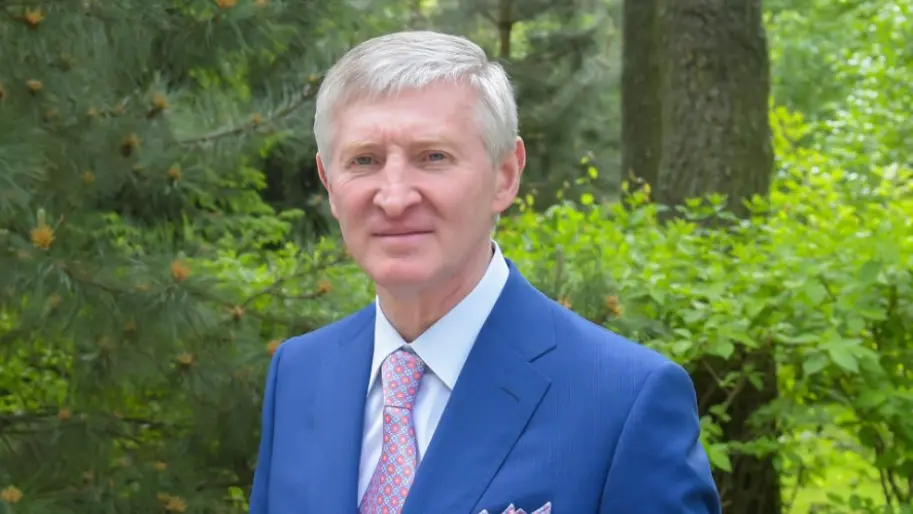

Rinat Leonidovich Akhmetov. Ukrainian businessman, industrialist, and former politician. A billionaire and the wealthiest citizen of Ukraine.
Born on September 21, 1966, in Donetsk. His parents were Volga Tatars; his father, Leonid Akhmetov, was born in Mordovia, later moved to Donetsk, worked as a miner, and died young from lung disease in 1991. His mother, Nyakiya Akhmetova, worked as a saleswoman. His older brother, Igor, also worked as a miner (he died in January 2021).
Education
In 2001, Akhmetov graduated from Donetsk National University with a degree in marketing; that is, he received his higher education at the age of 35, when he was already a representative of big business.
Building a “business empire.”
In 2006, at his first major press conference in Kyiv, Akhmetov, when asked how he made his first million, said it would be easier for him to explain how he made his first billion. He added that his business began in the early 1990s with the company “ARS,” which traded in coal and coke. “The starting capital was zero—there was a great desire and energy,” the businessman emphasized at the time.
His official biography on the SCM Group website states that the businessman focused on the “coking coal—coke—metal products” supply chain in the coal industry and founded several trading companies.
Later, Rinat Akhmetov began acquiring minority stakes in coking and metallurgical plants. “These acquisitions ultimately proved successful, and the trading companies were transformed into operating entities,” the official biography states.
In the early days of the company “ARS,” Akhmetov’s partner was Akhat “Alik” Bragin, who was considered one of the most influential criminal figures in Donetsk. Akhmetov himself noted that in 1993, Bragin left “ARS,” but they remained close friends. When asked by journalists whether he was involved with criminal groups, Akhmetov replied that he was not. “I have never been associated with any criminal organizations, I have never been prosecuted, and no criminal charges have ever been brought against me,” Akhmetov wrote in a response to The Washington Post.
Another Donetsk businessman, Serhiy Taruta, noted that “Akhmetov was simply a smart and tough guy who had to grow up in difficult conditions.” That Akhmetov himself was not a member of criminal groups, but was friends with people who were.
It was after the death of Alik Bragin in 1995 (he was blown up at the Shakhtar Stadium) that Rinat Akhmetov took over as president of FC Shakhtar. But the football club was not just a business; it was a passion.
By the late 1990s, Akhmetov was directing his efforts and capital toward developing vertical integration in the coking coal mining and steel industries. He also established an overseas metal trading company.
In 1998–1999, large-scale privatization began in Ukraine. Akhmetov began buying companies with large debt obligations, including the Azovstal Steel Works in Mariupol, the Khartsyzsk Pipe Plant, and mining and processing plants (GZK) in Kryvyi Rih.
In 2000, Rinat Akhmetov founded System Capital Management (SCM)—a holding company to manage his asset portfolio, which later formed industry-specific sub-holdings, the most significant of which were Metinvest (steel) and DTEK (energy).
Akhmetov’s assets.
All of Rinat Akhmetov’s key assets are owned by the holding company SCM, 100% of which belongs to the businessman.
The company’s largest enterprises are located in eastern and southern Ukraine; some of them were lost during the Russian-Ukrainian war, which began in Crimea and the Donbas in 2014 and later escalated into a full-scale Russian invasion of Ukraine in 2022.
Akhmetov’s metallurgical assets are consolidated into the Metinvest subholding. These include Zaporizhstal, three large mining and processing plants in Kryvyi Rih—Ingulets, Pivnichnyi, and Tsentralnyi—and Zaporizhkox. There are also enterprises in other countries—the steel mills Promet Steel (Bulgaria), Ferriera Valsider, and Trametal (both in Italy), Spartan (United Kingdom), Tubular Iasi (Romania), and the United Coal Company coal mine (United States). But the most important enterprises were lost due to the war—these are the Mariupol steel mills “Ilyich Steel” and “Azovstal,” the Yenakiieve Steel Mill, the Khartsyzsk Pipe Plant, and Europe’s largest Avdiivka Coke Plant.
Before the war, DTEK owned most of Ukraine’s thermal power plants, a large number of regional power distribution companies (including Kyivenergo and Kyivoblenergo), renewable energy facilities, and coal mines. A significant portion of these ended up in occupied territory or were severely damaged by Russian airstrikes.
DTEK’s strength is evident in the fact that, according to 2025 results—the fourth year of the war—the holding’s trading company, D.Trading, ranks first among Ukrainian companies in terms of turnover.
SCM also owns PUMB Bank, the telecommunications company Ukrtelecom, and UMGI, which previously specialized in asset management in the raw materials sector, including ceramics, and has now pivoted to the investment business, ESTA-Holding (real estate, which manages, among other properties, the Kyiv Central Department Store), Lemtrans (transportation), and Harvest (agriculture).
Akhmetov’s holdings also include luxury real estate abroad, in London and on the French Riviera; in 2026, he purchased an apartment in a new residential complex in Monaco for $554 million.
Akhmetov also owned Ukraine’s largest media group, “Media Group Ukraine,” which included the flagship TV channel “Ukraine,” the “Football” TV network, the entertainment channels NLO TV and Indigo TV; the news and analysis channel “Ukraine 24”; the satellite broadcaster Xtra TV; the streaming television company Digital Screens, which operated the OTT platform OLL.TV; and the publishing house “Segodnya Multimedia,” which published the newspaper “Segodnya” and Vogue Ukraine magazine and managed their web portals. But in 2022, the media group was shut down due to the “On Deoligarchization” law passed by the Verkhovna Rada. All media outlets were closed, and the frequencies were returned to the state. Akhmetov decided to completely exit the media business to avoid the threat of being labeled an “oligarch.”
In 2013, before the war, Forbes estimated Akhmetov’s fortune at $15.4 billion. In 2026, it was estimated at $7.8 billion, keeping him as the richest Ukrainian; in the international billionaire ranking, he is in 472nd place.
Political career.
In 2006, Rinat Akhmetov was elected a People’s Deputy of Ukraine on the Party of Regions’ party list (the list was headed by Viktor Yanukovych; Akhmetov himself was No. 7). After the election, he held the aforementioned first major press conference in Kyiv. He was not an active deputy; during the four and a half years of the current parliament’s work, he registered a written proposal only once. In 2012, he did not participate in the elections and announced his “retirement from politics.” He later called his entry into a formal political position a mistake and emphasized that he had no plans to “return to politics.” However, he retained informal influence over political life for a long time; people close to him and his businesses held positions as both ministers (for example, Boris Kolesnikov) and deputies.
Position on the Russian-Ukrainian War.
According to the recollections of Oleksandr Turchynov, who served as acting President of Ukraine from February to April, Rinat Akhmetov declined an offer to head the Donetsk Oblast (Serhiy Taruta took the position instead).
On the night of April 7–8, 2014, Akhmetov initially tried to persuade the pro-Russian separatists who had seized the Donetsk Regional State Administration building to leave the premises, refrain from declaring secession from Ukraine, and enter into negotiations with the authorities. He was unsuccessful. Akhmetov then issued a public statement opposing the DPR and defending Ukraine’s territorial integrity. The separatists also declared Akhmetov an enemy. However, for some time, Akhmetov’s enterprises continued to operate in the Donbas region occupied by pro-Russian forces, though they remained registered in Ukraine and operated under Ukrainian law. Yet between 2014 and 2017, all of Akhmetov’s enterprises in Crimea and in separatist-controlled territory were expropriated. But the most painful blows to Akhmetov’s business were the loss of Mariupol and Avdiivka during the full-scale invasion—the Azovstal steel plant became a symbol of Ukrainian resistance and was completely destroyed, the Avdiivka Chemical Plant was also destroyed, the Ilyich Steel Plant was seized by the Russians, and other assets in the Donetsk and Luhansk regions were lost.
Immediately after the start of the full-scale invasion, Akhmetov openly called Russia an aggressor state and Vladimir Putin a war criminal.
“Russia is an aggressor state, and Putin is a war criminal. Because Ukraine has always been a peaceful country and has never attacked anyone. And today, villages, cities, and infrastructure are being destroyed in our country, and innocent people are dying and suffering,” the businessman emphasized as early as February 24, 2022.
On June 23, 2022, Rinat Akhmetov filed a lawsuit with the European Court of Human Rights against the Russian Federation, seeking compensation for damages caused by the Russian Federation’s aggression since February 24, 2022, to over 70 SCM assets. In 2023, Rinat Akhmetov additionally initiated proceedings in international commercial arbitration regarding assets that were lost, destroyed, and unlawfully expropriated by the Russian Federation since the start of the armed aggression against Ukraine in 2022.
Rinat Akhmetov also initiated another international arbitration proceeding against Russia, seeking compensation for all damages caused to him as a result of interference in his business activities or the expropriation of assets and investments by the so-called “DPR” and “LPR” under Russian leadership or control in 2014–2017. In addition to the aforementioned assets that were seized or destroyed by the Russians, we must also mention the “Donbass Arena” stadium in Donetsk, in the construction of which over $400 million was invested.
Soccer.
During Akhmetov’s presidency, FC Shakhtar (Donetsk) won the Ukrainian Championship 15 times, the Ukrainian Cup 14 times, and claimed the UEFA Cup in 2009. The team reached the semifinals of the Europa League and the quarterfinals of the Champions League. In 2026, the team reached the semifinals of the UEFA Conference League, where it will face the FA Cup winner, London’s Crystal Palace.
Shakhtar played its last match in Donetsk at the Donbass Arena on May 2, 2014. After that, they played home matches in Kyiv and Lviv, and international matches in Poland and Germany following the full-scale invasion. But Akhmetov has always emphasized that after the war, the club dreams of returning to Donetsk, Ukraine.
Philanthropy.
In 2005, SCM established the “Development of Ukraine” Charitable Foundation, which in March 2008 became Rinat Akhmetov’s personal foundation and bears his name. Since the start of Russian aggression against Ukraine in 2014, the Foundation has focused all its efforts on providing aid to the civilian population of Donbas (delivery of food and medicine, evacuation, resettlement, etc.) in both the occupied territory and the territory controlled by Ukraine. In 2017, DNR separatists suspended the Akhmetov Foundation’s activities on their territory. Following Russia’s full-scale invasion of Ukraine, the Foundation continued to allocate significant funds (over $350 million) to provide humanitarian aid to Ukrainians.
Family.
He is married to Lilia and has two sons, Damir (born 1988) and Almir (born 1997). Damir serves on the supervisory boards of DTEK and Metinvest.