
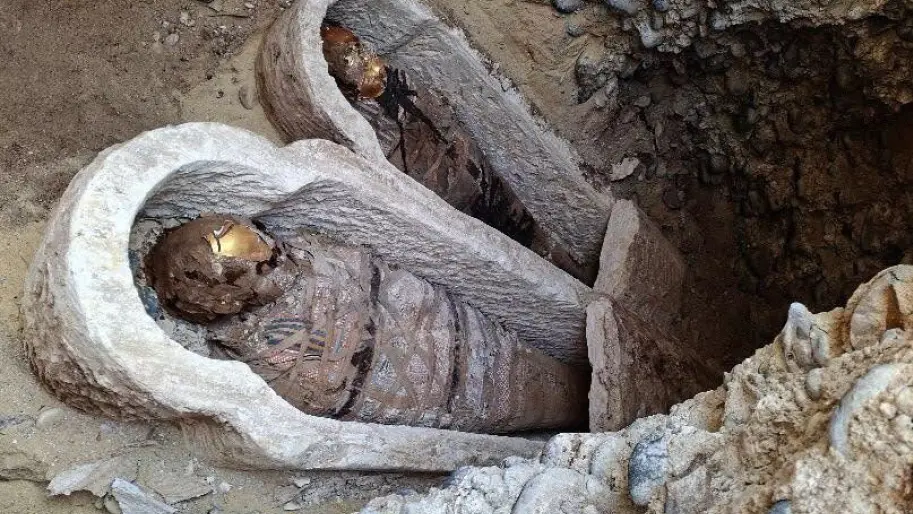

During the excavations of the ancient Egyptian city of Oxyrhynchus, archaeologists found a mummy inside which a papyrus was found containing a fragment of Book 2 of Homer's "Iliad", which corresponds to the famous "Catalog of Ships", which lists the Greek troops that sailed to Troy.
This is reported by Arkeonews.
The finds date back to the Roman period of Egypt's history - the beginning of our era.
Oxyrhynchus is known for the discovery of many papyri with ancient texts, but the discovery of a literary classic inside a mummy is unique, as most other texts have been found outside of funerary structures.
"The discovery of a classical Greek literary text inside an Egyptian mummy is extremely rare and raises fascinating questions. Why was this text included in the burial? Was it intended to be a symbol of education, status or cultural identity? Or did it have a deeper ritual significance?", Arkeonews notes.
Dr. Hisham El-Leiti, Secretary-General of the Supreme Council of Antiquities of Egypt, stressed that this find adds a new intellectual dimension to the site. It shows that the local elite of Oxyrhynchus were not only influenced by Greek culture, but also actively involved in its literary traditions.
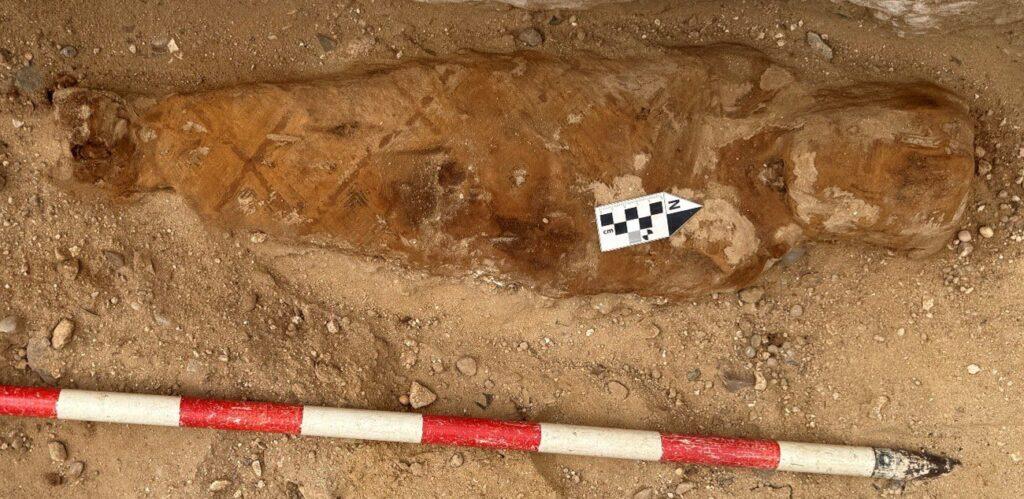
Overall, the find, which contained both several mummies and cremated remains, which is unusual for Ancient Egypt, indicates the existence of a ritual combining cremation with traditional funeral customs, and provides a new understanding of the evolution of funeral rites during the transition from the Ptolemaic to the Roman eras.
The Ukrainian News, the Iliad is one of the most famous literary works in the history of mankind, the oldest monument of ancient Greek literature, which describes the siege of Troy by the Achaeans.
The poem, which has a historical basis, was most likely created in the 9th-8th centuries. in the Greek cities of Asia Minor based on legends of the Mycenaean era. The authorship is attributed to the legendary poet Homer, whose historicity has never been definitively confirmed. The poem existed for centuries in oral form, the text known to us was recorded in the 3rd century. BC in Alexandria, Egypt.
Who we are: About us, Contacts. How we write news and our principles: Editorial code. We did our best. If you found this valuable – please support us.
To request a correction, please send an email.